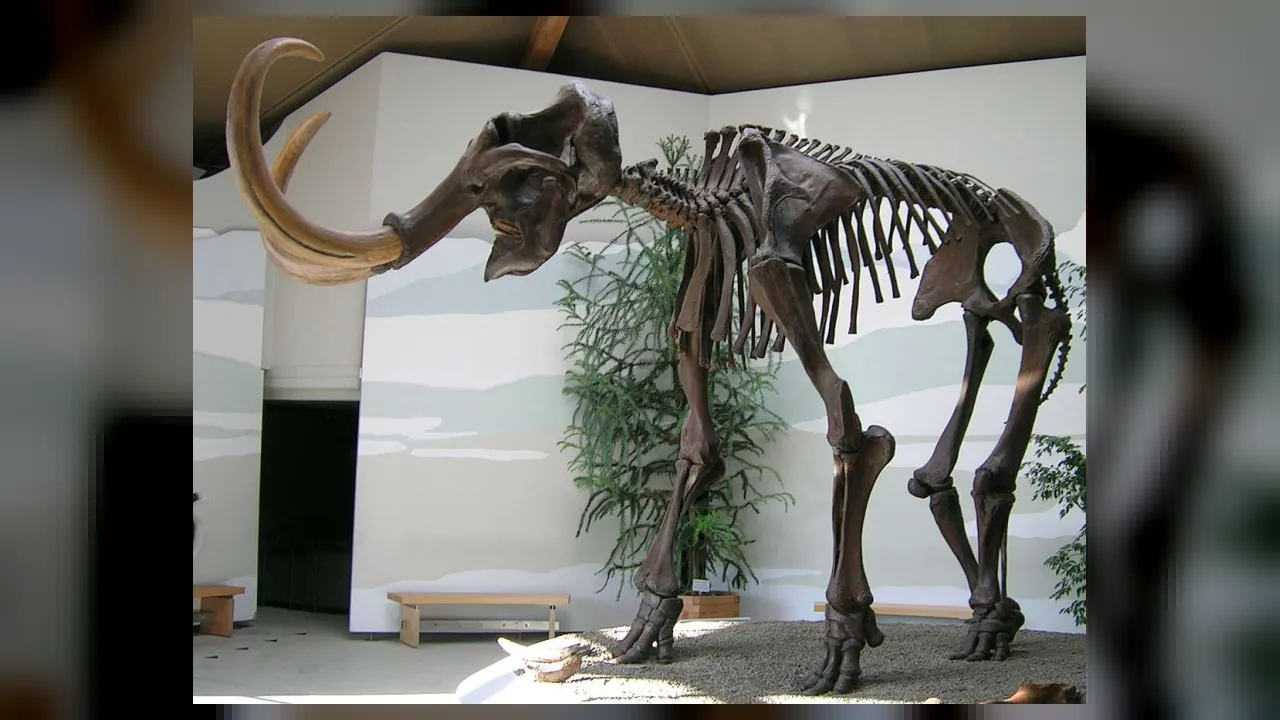
The last Woolly Mammoths lived on a lonely Arctic island so recently that ancient Egyptians had already built the Great Pyramids!
✨ Word Sparks (Grade 1 Glossary)
Tap 🔊 to hear
Steppe
Wide, treeless grassy plain in cold lands
Fleece
Soft thick undercoat of warm wool
Ivory
Hard creamy-white material forming long tusks
🪝
How did an elephant cousin stay cozy in icy winter blizzards?
1
Bundled Up in Shaggy Fur
Whoosh! Cold winter wind blows across snowy grass plains. Out marches a shaggy Woolly Mammoth! Long outer hairs hung down like a warm winter skirt. Soft thick wool underneath trapped cozy heat.
2
Tiny Ears, Giant Tusks
Modern elephants have huge flapping ears to cool off. This snowy cousin had tiny ears so they would not freeze! Long curved tusks swept snow off tasty grass.
3
Not Bigger Than Elephants!
Surprise! Despite its big fluffy coat, it stood about as tall as today's African elephant!
1. Why did the Woolly Mammoth have much smaller ears than modern African elephants?
2. How tall was an adult Woolly Mammoth compared to a modern African bush elephant?
🤯 Mind-Blowing Fact • Grade 2
Flat spots worn onto the undersides of fossilized mammoth tusks prove they scraped icy snow off grass thousands of times every winter!
✨ Word Sparks (Grade 2 Glossary)
Tap 🔊 to hear
Permafrost
Soil that stays frozen solid for thousands of years
Grazer
Animal that feeds mainly on low grasses
Blubber
Thick layer of fat that holds in warmth
🪝
How did frozen Arctic ground preserve whole baby mammoths with eyelashes and breakfast still inside?
1
Snowplows With Trunks
Step onto the crisp, sunny Mammoth Steppe 30,000 years ago, stretching from Spain across Siberia and over the Bering Land Bridge into Alaska! Herds of shaggy swing thirteen-foot curved tusks side to side like snowplows, uncovering sweet winter grasses and wildflowers.
2
Built for Minus-Forty Cold
Beneath three-foot guard hairs and dense underwool lay four inches of insulating fat, plus a camel-like fat hump behind the domed head for lean winters. Two finger-like tips at the end of the trunk plucked tiny grass blades neatly!
3
Frozen Time Capsules
Unlike dinosaur bones turned to rock, some mammoths fell into icy Siberian mud that froze solid as —preserving real skin, reddish-brown wool, and stomach meals for 40,000 years!
1. What clue on fossilized Woolly Mammoth tusks shows they were used like snow shovels?
2. How did Woolly Mammoths walk from Asia into North America during the Ice Age?
🤯 Mind-Blowing Fact • Grade 3
Lyuba, a one-month-old baby Woolly Mammoth found frozen in Siberia in 2007, was preserved so perfectly that scientists could still examine milk from her mother inside her tummy!
✨ Word Sparks (Grade 3 Glossary)
Tap 🔊 to hear
Hemoglobin
Protein in red blood cells that carries oxygen
Molar
Wide back tooth used for grinding plants
Holocene
Warm modern geologic epoch after the Ice Age
🪝
How did ancient DNA from Siberian permafrost reveal 'anti-freeze' blood inside Woolly Mammoths?
1
Closer to Asian Elephants
Picture herds of Mammuthus primigenius trekking across dry, sunlit Ice Age grasslands alongside woolly rhinos, steppe bison, and wild horses. Genetic studies show Woolly Mammoths are actually closer cousins to living Asian elephants than either one is to African elephants!
2
Conveyor-Belt Grazing Teeth
Gritty steppe grass mixed with windblown dust wears down teeth fast. Inside a mammoth's jaws sat just four giant, shoebox-sized at a time—each topped with flat washboard-like enamel ridges. As front molars wore smooth, new larger sets pushed forward from behind like a conveyor belt, up to six sets in a sixty-year lifetime!
3
Anti-Freeze Hemoglobin
Scientists sequenced ancient DNA from 43,000-year-old Siberian mammoth bones and recreated their blood's oxygen-carrying protein, , in lab bacteria. Special genetic tweaks allowed mammoth blood to release oxygen into icy feet and trunks even at near-freezing temperatures!
4
Last Holdouts on Wrangel Island
Warming climates turned dry grasslands into mossy bogs around 10,000 years ago, shrinking mainland herds. Yet an isolated population survived on Russia's Wrangel Island until just 4,000 years ago!
1. Which living animal is the closest genetic relative of the Woolly Mammoth?
2. What happened when a sixty-year-old Woolly Mammoth finally wore down its sixth and final set of flat molars?
🤯 Mind-Blowing Fact • Grade 4
Chemical GPS maps locked inside the 1.7-meter tusk of an Alaskan Woolly Mammoth named Kik proved he walked roughly 45,000 miles across Alaska during his 28-year life—almost twice around the Earth!
✨ Word Sparks (Grade 4 Glossary)
Tap 🔊 to hear
Paleogenomics
Studying complete ancient DNA genomes from fossils
Beringia
Ice Age landmass linking Siberia with Alaska
Isotope
Chemical atom variant recording diet and travel clues
🪝
How did millions of six-ton Woolly Mammoths engineer and maintain the largest biome on Ice Age Earth?
1
Architects of the Mammoth Steppe
Look out across the Pleistocene 'Mammoth Steppe' 25,000 years ago—a continuous, dry, cold grassland spanning from western Europe across into Canada's Yukon. Contrary to old cartoons of mammoths trudging endlessly through lifeless glaciers, Mammuthus primigenius avoided ice sheets! Instead, these six-ton ecosystem engineers maintained lush herbaceous prairies: trampling tree saplings, knocking down shrubs, churning soil nutrients with manure, and clearing winter snow so sunlight warmed grass roots early each spring.
2
Thermal Engineering from Hair to DNA
Evolving in northeastern Siberia roughly 400,000 to 700,000 years ago from Mammuthus trogontherii, the Woolly Mammoth accumulated dozens of cold-adaptive mutations revealed by . Sebaceous glands greased ninety-centimeter guard hairs over dense underwool; ear pinnae shrank to thirty centimeters (one-fifth an African elephant's ear length); tail vertebrae shortened from over thirty to twenty-one; a pre-anal skin flap shielded tissue; and mutated TRPV3 temperature-sensing channels plus cold-active hemoglobin kept extremities functioning without frostbite.
3
Isotope Diaries in Four-Meter Tusks
Strontium and oxygen micro-sampled along split tusks—such as an Alaskan bull named Kik studied in 2021—show adult males walked enough kilometers over twenty-eight years to circle Earth nearly twice!
4
Climate Shift, Human Arrival, and Island Refugia
Rapid end-Pleistocene warming (~14,000–10,000 YA) drenched dry steppes into boggy birch tundra low in grazing nutrients, fragmenting herds exposed to Paleolithic hunters—leaving final holdouts on St. Paul Island (~5,600 YA) and Wrangel Island (~4,000 YA).
1. Why wasn't the Mammoth Steppe covered in deep glaciers where Woolly Mammoths actually fed?
2. How did scientists reconstruct the lifetime migration route of the Alaskan mammoth named Kik?
🤯 Mind-Blowing Fact • Grade 5
In 2024, researchers recovered intact three-dimensional chromosome structures—called 'paleo-chromosomes'—preserved like freeze-dried glass inside the skin of a 52,000-year-old Siberian Woolly Mammoth!
✨ Word Sparks (Grade 5 Glossary)
Tap 🔊 to hear
Hypsodont
High-crowned teeth built to handle gritty grazing wear
Lamellae
Flat parallel enamel plates on mammoth grinding molars
Refugium
Isolated safe pocket where a species survives longer
🪝
What do complete ancient genomes, permafrost mummies, and tusk strontium transects reveal about the rise and final Holocene extinction of Mammuthus primigenius?
1
Evolutionary Origins in Pleistocene Siberia
Recognized scientifically by Johann Friedrich Blumenbach in 1799—establishing extinction as a biological reality alongside Cuvier's comparative anatomy—Mammuthus primigenius descended in northeastern Siberia from the steppe mammoth (Mammuthus trogontherii) between 700,000 and 400,000 years ago. Standing 2.7 to 3.4 meters at the shoulder and massing roughly 5.5 to 6 metric tons, it diverged from the Asian elephant lineage (Elephas maximus) approximately six million years ago, remaining sister to Elephas rather than Loxodonta.
2
Paleogenomic Architecture of Cold Adaptation
High-coverage nuclear genomes sequenced from permafrost hair shafts and petrous bones (Lynch et al., 2015; Díez-del-Molino et al., 2023) cataloged fixed mutations underpinning extreme cryophilic physiology: altered circadian-clock genes suited to Arctic polar day/night cycles, modified brown-adipose and subcutaneous lipid pathways forming a 10-centimeter blubber layer and cervical fat reservoir, desensitized TRPV3 thermal receptors, truncated 30-centimeter pinnae and 21-vertebra tails minimizing radiative heat loss, and three amino-acid substitutions in beta/delta-globin chains lowering the enthalpy of hemoglobin oxygenation so chilled extremities received steady oxygen without overheating the core.
3
Hypsodont Lamellar Dentition and Steppe Engineering
Consuming 150 to 200 kilograms of abrasive C3 graminoids and protein-rich Artemisia/forbs daily required extreme dental wear resistance. Horizontal molar progression cycled six sequential sets of high-crowned () teeth; final M3 molars packed up to 26 tightly compressed enamel acting as self-sharpening files. Spiral premaxillary tusks reaching 4.2 meters cleared wind-packed snow crusts while herd disturbance suppressed mosses and sustained dry, nutrient-cycling steppe soils.
4
Sclerochronology of Matriarchal Herds and Roving Bulls
High-resolution laser-ablation strontium (87Sr/86Sr) and ancient-DNA sexing of Siberian and Alaskan specimens (Wooller et al., 2021) confirm modern elephant-like sociality: multi-generational matriarchal herds paired with adolescent bull dispersal and seasonal migrations spanning tens of thousands of kilometers.
5
Synergistic Extinction and Holocene Island Relicts
Bølling-Allerød and early Holocene warming transformed dry forb-steppes into waterlogged peatlands and boreal forests, interacting with Upper Paleolithic human hunting to collapse continental populations by ~10,000 YA. Relict island populations persisted on Alaska's St. Paul Island until ~5,600 YA (succumbing to shrinking freshwater lakes) and on Arctic Wrangel Island until ~4,000 YA.