2. Which amendment added women's voting rights to the U.S. Constitution in 1920?
🤯 Mind-Blowing Fact • Grade 2
Wyoming let women vote way back in 1869—fifty-one years before the 19th Amendment—earning its state nickname, 'The Equality State'!
✨ Word Sparks (Grade 2 Glossary)
Tap 🔊 to hear
suffragist
Person working peacefully to win voting rights
convention
Big meeting where people share common goals
ratify
Officially approve a law or constitutional change
🪝
How did a letter from a mother change one lawmaker's mind at the very last minute?
1
A Bold Promise at Seneca Falls
Picture three hundred people packing a small chapel in Seneca Falls, New York, in 1848. Leaders Elizabeth Cady Stanton and Lucretia Mott declared that women deserved equal rights, including the right to vote.
2
Parades, Speeches, and Courage
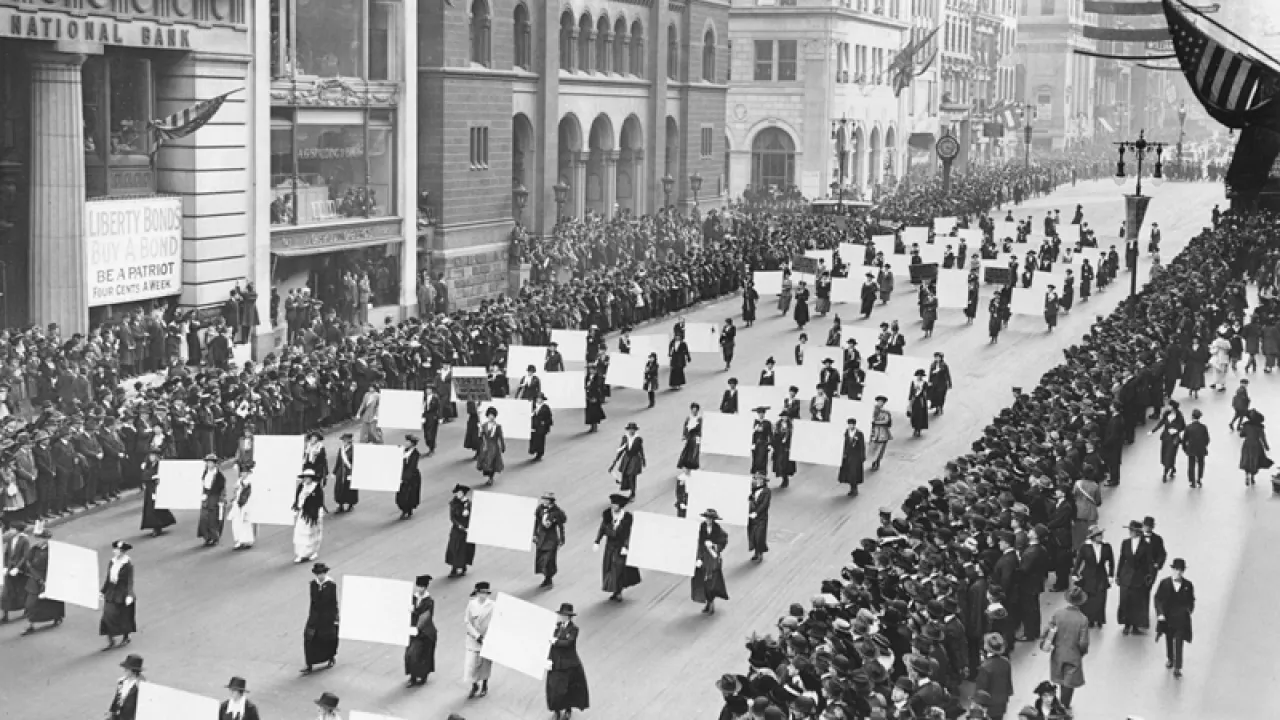
For over seventy years, like Susan B. Anthony, Sojourner Truth, and Ida B. Wells traveled from town to town. They organized peaceful parades, gathered millions of signatures, and convinced western states like Wyoming to let women vote first.
3
One Deciding Vote
In August 1920, thirty-five states had approved the Nineteenth Amendment, and just one more was needed! Young Tennessee lawmaker Harry Burn read a note from his mother saying to be a good boy and help suffrage win, so he cast the winning vote.
1. Where did Elizabeth Cady Stanton and Lucretia Mott hold the famous 1848 women's rights meeting?
2. Who wrote the letter that convinced Tennessee lawmaker Harry Burn to vote yes?
🤯 Mind-Blowing Fact • Grade 3
The actual Nineteenth Amendment was originally written in 1878 and introduced in every single session of Congress for forty-one years before finally passing!
✨ Word Sparks (Grade 3 Glossary)
Tap 🔊 to hear
electorate
All citizens legally allowed to cast votes
petition
Written request signed by many supportive citizens
declaration
Strong public statement of beliefs and goals
🪝
Why did generations of American women spend seventy-two years campaigning for a single sentence in the Constitution?
1
Seeds of Change in 1848
Hear the tap of a gavel inside Wesleyan Chapel in Seneca Falls, New York, in July 1848! There, Elizabeth Cady Stanton read the of Sentiments, modeled on the Declaration of Independence, declaring that all men and women are created equal.
2
Trailblazers Across the Nation
Throughout the late 1800s, tireless organizers such as Susan B. Anthony, Sojourner Truth, Lucy Stone, and Mary Church Terrell spoke before crowds and Congress. Western territories like Wyoming, Utah, Colorado, and Idaho led the way by granting women full voting rights first.
3
Parades on Pennsylvania Avenue
By the 1910s, Carrie Chapman Catt and Alice Paul energized a new generation. Thousands marched peacefully down Pennsylvania Avenue in Washington, D.C., while Virginia suffragists like Adele Clark organized local leagues and voter education drives.
4
Victory in August 1920
Congress passed the Nineteenth Amendment in 1919, sending it to the states for ratification. When Tennessee became the thirty-sixth state to ratify on August 18, 1920, twenty-six million American women gained constitutional protection at the ballot box.
1. Which historic document inspired the 1848 Declaration of Sentiments?
2. How many states were needed to ratify the Nineteenth Amendment in 1920?
🤯 Mind-Blowing Fact • Grade 4
In November 1920, Richmond trailblazer Maggie L. Walker helped register thousands of African American women in Virginia so they could cast ballots in their very first presidential election!
✨ Word Sparks (Grade 4 Glossary)
Tap 🔊 to hear
sentinel
Person standing watch to guard a cause
representative
Government where citizens elect leaders to decide
ratification
Formal vote making a proposed law official
🪝
How did state-by-state organizing and peaceful civic action amend the U.S. Constitution in 1920?
1
From Seneca Falls to a National Movement
Imagine standing outside the White House in 1917 as silent hold purple, white, and gold banners in freezing rain! Their peaceful vigil built upon decades of civic effort begun at the 1848 Seneca Falls Convention, where Elizabeth Cady Stanton and Frederick Douglass argued passionately that democracy required women's voices at the ballot box.
2
Two Complementary Strategies
Suffrage leaders pursued two paths simultaneously. Carrie Chapman Catt's National American Woman Suffrage Association worked methodically state by state while lobbying Congress, pointing to women's vital contributions on farms, in factories, and as nurses during World War I. Meanwhile, Alice Paul's National Woman's Party staged dramatic parades and White House pickets to keep national attention focused on a constitutional amendment.
3
Virginia Voices and Diverse Reformers
Across the nation, Black suffragists such as Ida B. Wells, Mary Church Terrell, and Richmond banker Maggie L. Walker championed voting rights alongside educational and civic equality. In Virginia, Lila Meade Valentine and Adele Clark founded the Equal Suffrage League of Virginia in 1909, transforming public awareness across the Commonwealth.
4
Ratification and Ongoing Civic Progress
After Tennessee clinched the thirty-sixth state on August 18, 1920, the Nineteenth Amendment took effect on August 26—celebrated today as Women's Equality Day. Although poll taxes and literacy rules still blocked many minority women until the Voting Rights Act of 1965, the Nineteenth Amendment permanently barred voting discrimination based on sex.
1. Which famous abolitionist stood up at the 1848 Seneca Falls Convention to support Elizabeth Cady Stanton's call for women's voting rights?
2. How did Maggie L. Walker and Lila Meade Valentine advance civic life in Virginia?
🤯 Mind-Blowing Fact • Grade 5
Charlotte Woodward Pierce, a nineteen-year-old glove maker who signed the Declaration of Sentiments at Seneca Falls in 1848, was the sole original signer who lived long enough to see the 19th Amendment ratified in 1920 at age ninety-one!
✨ Word Sparks (Grade 5 Glossary)
Tap 🔊 to hear
abridge
Cut short or reduce a legal right
munitions
Supplies and equipment made for military defense
jurisdiction
Official authority to make laws and decisions
🪝
Why did achieving the 19th Amendment require three-quarters of a century, two generations of leaders, and Article V of the Constitution?
1
Constitutional Foundations of the Suffrage Debate
When the Framers drafted the U.S. Constitution in 1787, they left voting qualifications largely to individual states, nearly all of which restricted ballots to male citizens. At the 1848 Seneca Falls Convention, Elizabeth Cady Stanton and Lucretia Mott challenged that exclusion with the Declaration of Sentiments, igniting a seventy-two-year nonviolent campaign grounded in the First Amendment rights of speech, assembly, and petition.
2
Laboratories of Democracy in the West
Because amending the Constitution under Article V requires a two-thirds vote in both houses of Congress plus ratification by three-fourths of the states, suffragists first proved their case locally. Beginning with Wyoming Territory in 1869 and Utah in 1870, fifteen mostly western states granted women full suffrage before 1920, electing Jeannette Rankin of Montana as the first woman in Congress in 1916.
3
Wartime Service and Turning the Tide
During World War I, millions of American women operated plants, railroads, farms, and Red Cross hospitals while suffragists pressed President Woodrow Wilson to match democratic ideals abroad with voting equality at home. Combining Carrie Chapman Catt's 'Winning Plan' with Alice Paul's public demonstrations, advocates persuaded Congress to pass the Susan B. Anthony Amendment in June 1919.
4
The Dramatic Showdown in Nashville
By August 1920, thirty-five of the required thirty-six states had ratified, leaving everything hinging on a tied Tennessee House of Representatives in Nashville. Wearing a red anti-suffrage rose on his lapel, twenty-four-year-old Representative Harry T. Burn heeded a heartfelt letter from his mother, switched his vote to 'Aye,' and secured constitutional ratification on August 18, 1920.
5
Completing the Promise of the Ballot
Certified on August 26, 1920, the Nineteenth Amendment states that the right of citizens to vote shall not be denied or abridged on account of sex. While Native American women gained citizenship in 1924, Asian American immigrants in 1952, and Southern Black women full ballot protection through the Voting Rights Act of 1965, the Nineteenth Amendment remains a cornerstone of American constitutional democracy.