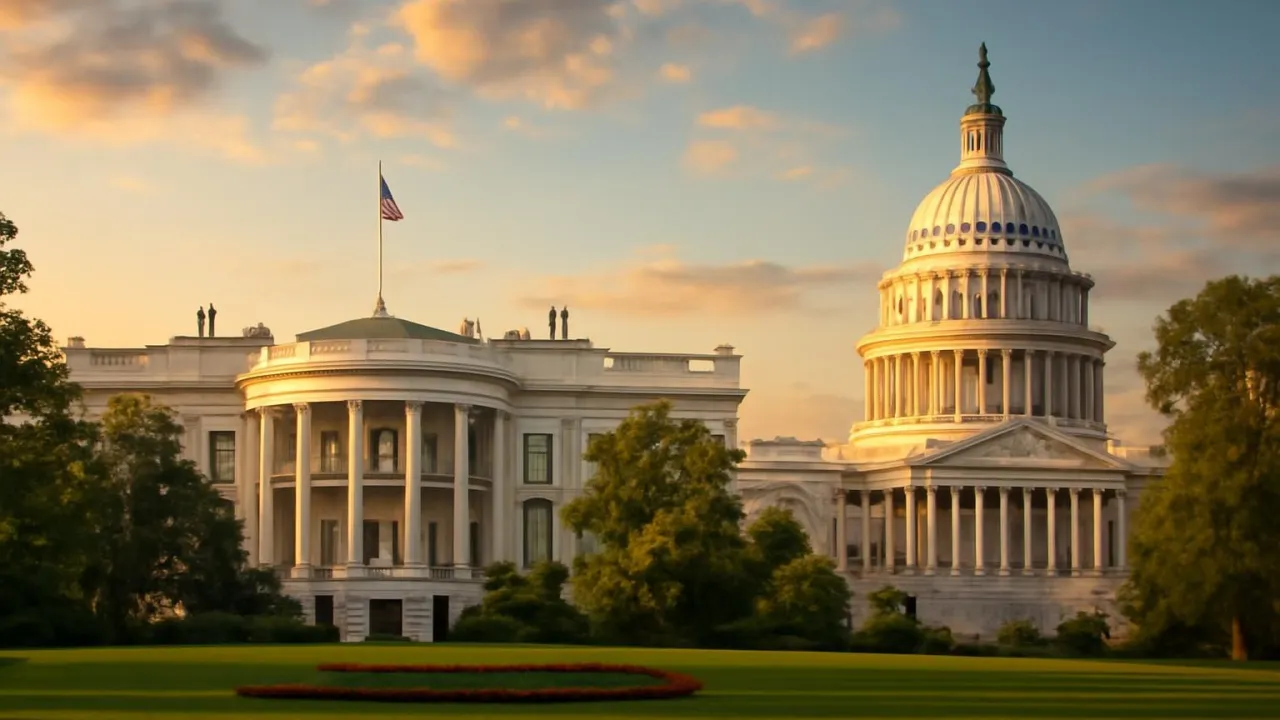
The White House has 132 rooms and 35 bathrooms inside!
✨ Word Sparks (Grade 2 Glossary)
Tap 🔊 to hear
columns
Tall posts that hold up buildings
Congress
A group that makes U.S. laws
democracy
People help choose their leaders
🪝
Have you ever wondered where leaders make big choices for the country?
1
The White House: Home of the President
The White House is where the president lives and works each day. Its white walls and tall make it easy to spot. People from all over visit to see its famous rooms. Sometimes, the president greets visitors outside.
2
The U.S. Capitol: Where Laws Are Made
The U.S. Capitol has a huge dome that shines bright in the sun. Inside, leaders called meet to talk and vote on new laws. The building is filled with long halls and special meeting rooms. It is a symbol of American .
3
Two Historic Buildings in One City
Both landmarks stand in Washington, D.C., the nation’s capital city. Many people tour these sites and take pictures each year. The buildings are part of important American stories. They help teach us about our country’s government.
1. Who meets inside the U.S. Capitol to make laws?
2. What color are the walls of the White House?
🤯 Mind-Blowing Fact • Grade 3
The U.S. Capitol’s dome weighs nearly 9 million pounds!
✨ Word Sparks (Grade 3 Glossary)
Tap 🔊 to hear
rotunda
A large round room under a dome
neoclassical
A style with columns and Greek shapes
cast-iron
Strong metal used for building domes
🪝
Can you imagine standing under a giant dome where history is made every day?
1
The White House: A Presidential Home
The White House is the official home and workplace of the U.S. president. Its design features tall columns and a grand entrance. Visitors can tour some rooms, like the famous Blue Room and the East Room. The White House is a symbol of leadership and national pride.
2
Inside the U.S. Capitol’s Dome
The U.S. Capitol is famous for its massive, dome. The dome’s shape creates a sense of openness and lets sound vibrate throughout the . Congress meets here to debate and vote on laws that affect the country. The Capitol’s halls are decorated with statues and paintings of important Americans.
3
How Were These Landmarks Built?
Both buildings were built in the late 1700s and early 1800s using stone, brick, and iron. Workers used scaffolding, pulleys, and careful planning to lift heavy materials high into the air. The Capitol’s dome was added later, using a special technique for strength and beauty. These buildings have survived wars, fires, and many changes over time.
4
Why Are They Important Today?
The White House and U.S. Capitol are important monuments of American democracy. People visit them to learn about government and history. They are sites for celebrations, speeches, and national events. Their architecture and stories inspire visitors from all over the world.
1. What special room is found under the Capitol’s dome?
2. What does the White House symbolize for Americans?
🤯 Mind-Blowing Fact • Grade 4
The Capitol’s dome was built during the Civil War, showing hope for the future.
✨ Word Sparks (Grade 4 Glossary)
Tap 🔊 to hear
symmetrical
The same on both sides
ventilation
System that moves fresh air inside
inauguration
A ceremony for a new president
🪝
What would it feel like to walk through the halls where presidents and lawmakers shape the nation’s future?
1
Designs of Power: White House and Capitol
The White House and U.S. Capitol were both designed in the neoclassical style, inspired by ancient Greek and Roman architecture. The White House’s tall columns and shape reflect strength and order, while the Capitol’s grand dome rises above Washington, D.C., as a symbol of unity. Both buildings use marble, sandstone, and cast-iron to create impressive facades. Their architectural details were meant to show the world America’s ideals of democracy and justice.
2
Engineering Marvels of the Nation’s Capital
Building these landmarks required creative engineering and teamwork. The Capitol’s cast-iron dome was assembled piece by piece, using cranes and scaffolding to lift sections into place. The White House has stood through fires and renovations, with skilled workers restoring its walls and columns. Both structures have hidden passages, secret rooms, and intricate systems. Their construction set new standards for American building techniques in the 1800s.
3
History Written in Stone and Iron
The White House and U.S. Capitol have witnessed many turning points in American history. Presidents have made important decisions in the Oval Office, while Congress has debated laws that shape the nation. These buildings have survived wars, protests, and even a burning during the War of 1812. Their walls are filled with stories of triumph, challenge, and change.
4
Symbols for the World
Millions of people visit these landmarks each year, exploring their museums, galleries, and gardens. The White House hosts world leaders, while the Capitol is the stage for presidential and national celebrations. Both buildings appear on coins, stamps, and in art, reminding everyone of America’s commitment to democracy. Their presence continues to inspire people across the globe.
1. Why did builders use cast-iron for the Capitol’s dome?
2. What do the White House and Capitol symbolize for visitors?
🤯 Mind-Blowing Fact • Grade 5
The Statue of Freedom atop the Capitol dome stands 19.5 feet tall and weighs 15,000 pounds!
✨ Word Sparks (Grade 5 Glossary)
Tap 🔊 to hear
portico
A covered entrance with columns
self-supporting dome
A dome held up by its own shape
diplomacy
Working with other countries for peace
🪝
Imagine hearing echoes of history as you climb the steps of America’s most powerful buildings—what secrets would their walls reveal?
1
Architectural Grandeur: Neoclassical Visions in Stone and Iron
The White House and U.S. Capitol are masterpieces of neoclassical architecture, designed to reflect the ideals of ancient democracies. James Hoban designed the White House with a balanced, symmetrical façade, featuring Ionic columns and a stately , while William Thornton’s original Capitol design was later expanded by Benjamin Latrobe and Thomas U. Walter, who engineered the iconic dome. The Capitol’s cast-iron dome, completed during the Civil War, stands 288 feet tall and weighs nearly 9 million pounds, making it one of the world’s largest . Both buildings use marble, sandstone, and iron to achieve their monumental appearance, blending beauty with structural strength.
2
Engineering Feats and Hidden Innovations
The construction of these landmarks required advanced engineering for their era, including the use of wooden scaffolding, block-and-tackle hoists, and intricate ventilation systems. The Capitol’s dome was built in two shells—a structural inner dome and an ornate outer shell—using over 8,900,000 pounds of cast iron, assembled section by section with steam-powered cranes. The White House has undergone multiple renovations, including the addition of steel girders and reinforced concrete to strengthen its foundation after fires and structural concerns. Both buildings contain secret passages, hidden rooms, and innovative heating and cooling systems that were cutting-edge for their time.
3
Historical Evolution and Enduring Significance
Since their completion in the early 1800s, the White House and U.S. Capitol have been at the heart of American government and history. The White House has housed every president except George Washington, serving as the executive’s home and a stage for historic decisions, treaties, and global . The Capitol has witnessed the passage of landmark legislation, presidential inaugurations, and pivotal debates that shaped the nation. Both buildings survived the British burning during the War of 1812 and have been restored and expanded to meet the needs of a growing democracy.
4
Cultural and Global Impact
These landmarks are not only symbols of American democracy but also serve as global icons of freedom and governance. The White House hosts state dinners and welcomes foreign leaders, while the Capitol is the site of major national ceremonies, including the annual State of the Union address and presidential inaugurations. Their images appear on currency, stamps, and in countless works of art, representing the ideals of liberty, justice, and unity to people around the world. Both buildings are protected as National Historic Landmarks and are visited by millions each year.
5
Legacy in Architecture and Civic Life
The White House and U.S. Capitol continue to influence civic architecture worldwide, inspiring the design of government buildings in many countries. Their blend of beauty, functionality, and symbolism demonstrates the power of architecture to shape national identity and public life. Guided tours, educational exhibits, and public events allow citizens and visitors to experience history firsthand, fostering a deeper understanding of the nation’s past and its democratic principles. As enduring monuments, they remind future generations of the ongoing work of democracy.