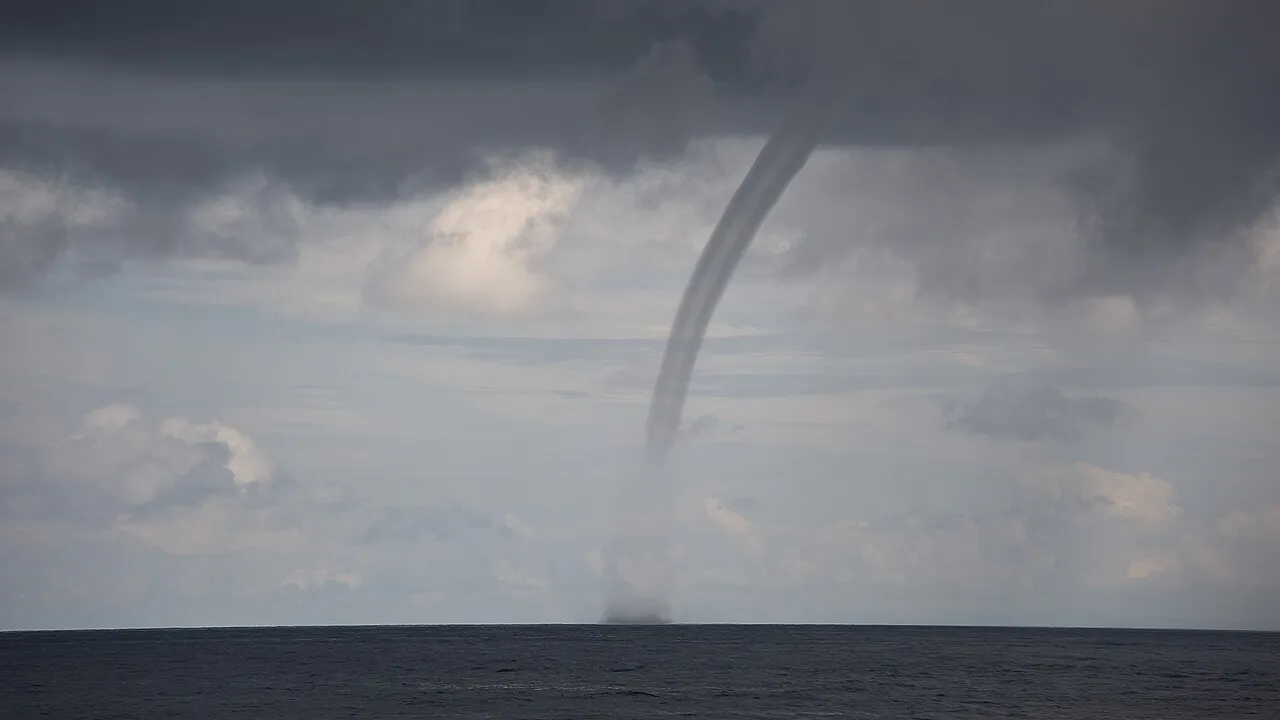
1. What makes up most of the visible tube in a waterspout?
2. What usually happens when a gentle waterspout moves onto dry land?
🤯 Mind-Blowing Fact • Grade 2
Sometimes two or three fair-weather waterspouts spin side by side beneath the exact same cloud line!
✨ Word Sparks (Grade 2 Glossary)
Tap 🔊 to hear
funnel
A cone shape wide on top, narrow below
fair-weather
Calm, mild skies without severe thunderstorms
whirling
Spinning around quickly in tight circles
🪝
How can a spinning funnel grow over calm, sunny ocean water?
1
A Twister on the Water
Picture a warm summer morning beside a sparkling bay. Suddenly, a dark ring forms on the water, and a pale stretches toward a puffy cloud. You are watching a waterspout spin across the waves!
2
Two Kinds of Spouts
Weather scientists study two main types of waterspouts. spouts grow upward from warm water under gentle clouds and move slowly. Tornadic spouts drop down from fierce thunderstorms and bring much stronger winds.
3
Mist, Not Solid Ocean
A waterspout looks like a giant straw drinking the sea, yet the holds tiny condensed water droplets. winds whip up a ring of foamy sea spray right at the surface before the spout fades.
1. Which type of waterspout forms under fierce thunderstorms and carries stronger winds?
2. Where do fair-weather waterspouts start building their spinning motion?
🤯 Mind-Blowing Fact • Grade 3
In 2020, weather observers along the Great Lakes counted record outbreaks of over sixty waterspouts in a single autumn week!
✨ Word Sparks (Grade 3 Glossary)
Tap 🔊 to hear
vortex
A whirling mass of air or liquid
condense
Change from invisible gas into liquid drops
cumulus
Puffy white clouds with flat bottoms
🪝
Why does a dark circle appear on the ocean before you can even see the funnel cloud?
1
Clues on the Water Surface
Before a fair-weather waterspout becomes a tall white column, the ocean gives away a secret clue. Sailors first spot a flat, dark patch on the waves where invisible winds begin rotating. Soon a spiral pattern of light and dark rings swirls across the water.
2
Building the Visible Funnel
Warm water heats the moist air resting just above the sea. As that warm air rises into cooler air aloft, low pressure inside the spinning makes invisible water vapor into cloud droplets. Meanwhile, forty-mile-per-hour gusts kick up a collar of salty spray.
3
Fair-Weather vs. Tornadic
Meteorologists separate waterspouts into two distinct groups. Fair-weather waterspouts develop beneath growing clouds with little lightning and rarely last more than twenty minutes. Tornadic waterspouts descend from rotating supercell thunderstorms and pack dangerous, boat-flipping winds.
4
Coastal Safety Rules
Even a weak waterspout can knock over sailboats or toss loose gear across a deck. Coast Guard advisories warn captains to steer at a ninety-degree angle away from a spout's path until the funnel decays.
1. What is the very first visual stage of a developing fair-weather waterspout?
2. How should a boat captain steer to move safely away from an approaching waterspout?
🤯 Mind-Blowing Fact • Grade 4
Tiny frogs or minnows swept from shallow ponds by strong waterspouts have occasionally fallen onto nearby towns during rainstorms!
✨ Word Sparks (Grade 4 Glossary)
Tap 🔊 to hear
updraft
A rising current of warm, moist air
cascade
Swirling ring of sea spray around base
downdraft
Sinking current of cool air in clouds
🪝
What five stages transform warm ocean air into a towering marine vortex?
1
When Warm Seas Meet Cool Air
Stand on a pier along the Chesapeake Bay or the Florida Keys after a late-summer cold snap, and the ingredients for a waterspout may align right before your eyes. Sun-warmed water evaporates abundant moisture into the lowest layer of air while cooler air drifts overhead. Because warm, humid air is less dense than cool air, buoyant surge skyward and stretch gentle horizontal breezes into a tight vertical spin.
2
Five Stages of a Life Cycle
Dr. Joseph Golden mapped five classic stages in the life of a fair-weather waterspout. Stage one reveals a dark spot on the water, followed in stage two by a spiral pattern of ripples. Stage three whips up a swirling spray ring called a . During stage four, the mature funnel becomes fully visible from cloud base to sea surface. Finally, stage five arrives when cool wrap around the column and make the rope-like funnel collapse.
3
Tornadic Threats at the Coast
Not every waterspout is gentle. Tornadic waterspouts form inside severe mesocyclones—rotating thunderstorm —or occur when land tornadoes cross rivers, bays, or coastlines. If a tornadic waterspout moves ashore, the National Weather Service immediately switches a Special Marine Warning to a Tornado Warning because winds exceeding one hundred miles per hour can damage docks and homes.
4
Tracking Marine Vortices
Virginia and coastal weather offices use Doppler radar, buoys, and pilot reports to spot conditions favorable for waterspouts. Understanding temperature differences between water and air helps forecasters protect fishermen, cargo ships, and beachgoers alike.
1. Which weather setup best fuels the updrafts needed for fair-weather waterspouts?
2. What triggers the fifth and final decay stage of a fair-weather waterspout?
🤯 Mind-Blowing Fact • Grade 5
The tallest waterspout ever measured towered 1,528 meters high off Eden, New South Wales, Australia, on May 16, 1898—nearly four times the height of the Empire State Building!
✨ Word Sparks (Grade 5 Glossary)
Tap 🔊 to hear
vorticity
Spinning motion within a moving fluid
hectopascal
Metric unit used to measure air pressure
nomogram
Chart comparing measurements to predict weather events
🪝
How did flying research planes near spinning ocean funnels unlock the physics of fair-weather waterspouts?
1
A Laboratory Over Shallow Seas
During the late 1960s, meteorologist Joseph Golden flew small aircraft around dozens of spinning columns off Key West, Florida, dropping smoke flares onto the ocean surface to trace invisible airflow. Until those daring flights, many observers assumed all waterspouts descended top-down like classic Great Plains supercell tornadoes. Golden's observations proved that non-tornadic, or fair-weather, waterspouts actually organize from the water surface upward along converging sea-breeze boundaries beneath developing cumulus congestus clouds.
2
Thermodynamics and Vortex Stretching
Waterspout genesis depends on steep lapse rates in the marine boundary layer—specifically when water temperatures exceed 26 degrees Celsius or when crisp autumn air masses sweep across relatively mild lakes such as Lake Erie and Lake Ontario. High latent heat and moisture flux destabilize the lowest few hundred meters of the atmosphere. Where opposing breezes converge, small pockets of vertical become stretched upward by buoyant updrafts, conserving angular momentum the way a figure skater spins faster by pulling in outstretched arms.
3
Condensation vs. Sea Spray
Inside the tightened core, barometric pressure plunges by 10 to 30 . That rapid pressure drop cools moist air to its dew point, forming a hollow-looking condensation funnel composed of freshwater cloud droplets rather than pumped seawater. Only the lowest few meters—the turbulent spray vortex or cascade—consist of saltwater droplets sheared off wave crests when tangential winds exceed roughly 65 kilometers per hour.
4
Comparing Fujita and Marine Scales
Most fair-weather waterspouts correspond to EF0 intensity on the Enhanced Fujita Scale, generating winds between 65 and 110 kilometers per hour and drifting slowly at 5 to 25 kilometers per hour for ten to twenty minutes. By contrast, tornadic waterspouts spawned by rotating supercells carry deep radar signatures, frequent cloud-to-water lightning, and destructive winds capable of exceeding 180 kilometers per hour.
5
Forecasting With Nomograms
Modern marine forecasters apply the Szilagyi Waterspout Index, a specialized comparing cloud-top heights against the temperature difference between the water surface and the 850- pressure level. When convective depth aligns with light wind shear, meteorologists issue timely marine alerts that keep shipping lanes and coastal communities safe.