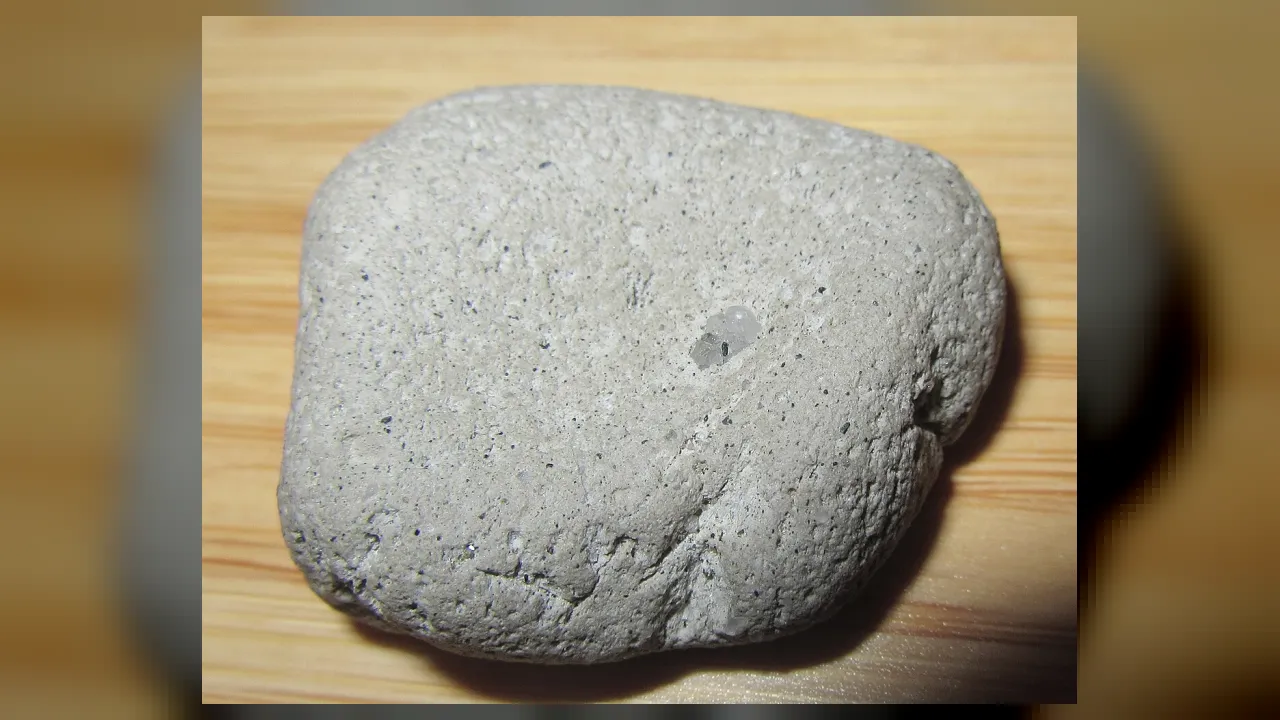
Tiny crabs, barnacles, and corals hitchhike across entire oceans by riding on floating pumice rafts!
✨ Word Sparks (Grade 2 Glossary)
Tap 🔊 to hear
froth
A thick mass of tiny bubbles in liquid
pumice raft
A huge floating blanket of pumice on ocean water
magma
Hot melted rock still beneath Earth's surface
🪝
How can an underwater volcano cover the ocean with a giant floating island of rock?
1
Frozen Volcanic Froth
Imagine shaking a warm bottle of root beer and popping off the cap! Thick, gas-filled blasts out of a volcano the very same way. Before the gas bubbles can pop, chilly air freezes the foam into pale, rough pumice.
2
Giant Ocean Pumice Rafts
When an underwater volcano erupts, billions of floating pumice stones bob up to the surface together. Sailors have spotted floating wider than big cities drifting across the Pacific Ocean for months!
3
Helpful Scrubbing Stone
Even though pumice feels feather-light, its thin bubble walls are made of hard volcanic glass. People use pumice stones to scrub rough skin, clean grills, and mix lightweight concrete.
1. What are the thin walls around pumice bubbles made of?
2. How do sea creatures use floating pumice rafts?
🤯 Mind-Blowing Fact • Grade 3
Rome's massive Pantheon concrete dome has stood unreinforced for nearly 1,900 years thanks to lightweight volcanic pumice mixed into its upper rings!
✨ Word Sparks (Grade 3 Glossary)
Tap 🔊 to hear
vesicle
A small bubble cavity preserved inside volcanic rock
density
How much mass is packed into a space
dissolved gas
Gas mixed invisibly inside liquid under high pressure
🪝
How can pumice and obsidian be made of the exact same volcanic glass when one sinks and one floats?
1
Pressure Drop Inside the Vent
Deep beneath a volcano, sticky silica-rich magma holds dissolved water vapor and carbon dioxide under tremendous pressure. When an eruption blows the top off the vent, pressure drops in an instant. expand violently, whipping the molten rock into a roaring froth.
2
Ninety Percent Empty Space
Hurled high into cold sky, the frothy shreds chill so rapidly that crystals cannot grow. Instead, volcanic glass hardens around millions of tiny sealed pockets called . Up to ninety percent of a pumice stone's volume is actually trapped gas!
3
Why Density Makes It Float
Solid obsidian glass is denser than water, so it sinks right away. Because pumice locks air inside closed glass walls, its overall drops below that of water. Only after months or years of water slowly seeping into broken pores does pumice finally sink.
4
Ancient Roman Builders
Two thousand years ago, Roman engineers mixed crushed pumice into concrete to build the famous Pantheon dome in Rome, keeping the giant roof strong yet remarkably lightweight.
1. Roughly how much of a typical piece of pumice can be empty bubble space?
2. Why did ancient Roman engineers add pumice to the top of the Pantheon dome?
🤯 Mind-Blowing Fact • Grade 4
After Indonesia's Krakatoa volcano erupted in 1883, thick rafts of pumice floated across the Indian Ocean for years and washed ashore in Africa 3,500 miles away!
✨ Word Sparks (Grade 4 Glossary)
Tap 🔊 to hear
porosity
Percentage of open pore space inside a rock
permeability
How easily water flows between connected rock pores
abrasive
A gritty material used for scrubbing or polishing
🪝
What turns a quiet magma chamber into a supersonic fountain of floating glass stone?
1
Explosive Felsic Magma Chemistry
Pick up a pale piece of pumice and look closely with a hand lens: you are holding frozen volcanic violence. Pumice forms primarily from felsic or intermediate magmas, such as rhyolite and dacite, which are rich in silica and thick as cold taffy. Because gas bubbles cannot escape easily through sticky magma, pressure builds until the volcano erupts explosively in towering ash-and-pumice columns.
2
Porosity, Permeability, and Buoyancy
How can a rock with glass walls—whose solid mineraloid density is around 2.3 grams per cubic centimeter—bob on water whose density is 1.0 gram per cubic centimeter? The secret is high paired with low . Pumice is riddled with microscopic vesicles separated by unbroken glass partitions. Water cannot rush into sealed inner chambers, keeping the stone's bulk density around 0.25 to 0.9 grams per cubic centimeter.
3
Submarine Eruptions and Ecological Bridges
In 2012, the deep-sea Havre volcano near New Zealand erupted nearly a mile underwater, blanketing 150 square miles of ocean with a dazzling white pumice raft. Marine biologists watched barnacles, bryozoans, worms, and coral larvae colonize those floating stones, proving pumice helps replenish distant island ecosystems.
4
Everyday Abrasive Power
Measuring around 5.5 on the Mohs hardness scale, finely ground pumice acts as a gentle in pencil erasers, polishing compounds, stone-washed denim, and horticultural soil mixes that aerate plant roots.
1. Why doesn't water immediately fill up a floating piece of pumice and sink it?
2. Which type of magma usually produces light-colored, frothy pumice?
🤯 Mind-Blowing Fact • Grade 5
A single cubic inch of frothy pumice contains so many microscopic bubble walls that its total internal surface area could cover a dining table!
✨ Word Sparks (Grade 5 Glossary)
Tap 🔊 to hear
pyroclastic
Made of rock fragments blasted from explosive volcanoes
specific gravity
Ratio comparing a material's density to pure water
pozzolan
Volcanic ash or pumice strengthening durable cement mixes
🪝
How does rapid decompression transform dissolved volcanic steam into a rock that is nine-tenths sky?
1
Volatile Exsolution and Magma Fragmentation
Hold a pale specimen of pumice up to the light and examine its silky, stretched glass fibers. Before eruption, rhyolitic or dacitic melt sits miles beneath a caldera at temperatures near 850 degrees Celsius, holding up to six percent dissolved volatiles—mostly superheated steam and carbon dioxide—confined by immense lithostatic pressure. Once a conduit fractures to the surface, rapid decompression triggers runaway bubble nucleation. Expanding gas stretches the viscous silicate melt until thin bubble walls rupture or freeze mid-expansion inside a Plinian eruption column.
2
Pyroclastic Fall Deposits and Ignimbrites
Prevailing stratospheric winds sort airborne pumice clasts—called lapilli when 2 to 64 millimeters wide—across hundreds of miles, creating distinctive marker beds that volcanologists use to date ancient landscapes. When an overloaded eruption column collapses downward, incandescent clouds of pumice and ash race across valleys at over 100 miles per hour as density currents, depositing thick sheets of tuff.
3
Specific Gravity Physics and Eventual Waterlogging
Although solid rhyolitic glass has a of roughly 2.35, pumice exhibits vesicularity between 64 and 90 percent, lowering bulk specific gravity to as little as 0.25. Over months at sea, capillary action and vapor condensation gradually replace trapped air inside interconnected micro-tubes until bulk density exceeds 1.025 grams per cubic centimeter—the density of seawater—sending the stone drifting to the abyssal seafloor.
4
Pozzolanic Chemistry in Durable Engineering
Beyond lowering structural weight, finely pulverized pumice behaves as a natural . Its amorphous silica reacts chemically with calcium hydroxide in wet lime or Portland cement to grow interlocking calcium-silicate-hydrate crystals that resist seawater corrosion.
5
Planetary Clues and Origin-of-Life Hypotheses
Astrobiologists even study ancient pumice rafts as natural chemical reactors: with vast internal surface area, trace catalytic metals, and exposure to ocean waves and solar radiation, floating pumice pores may have concentrated organic molecules on early Earth.