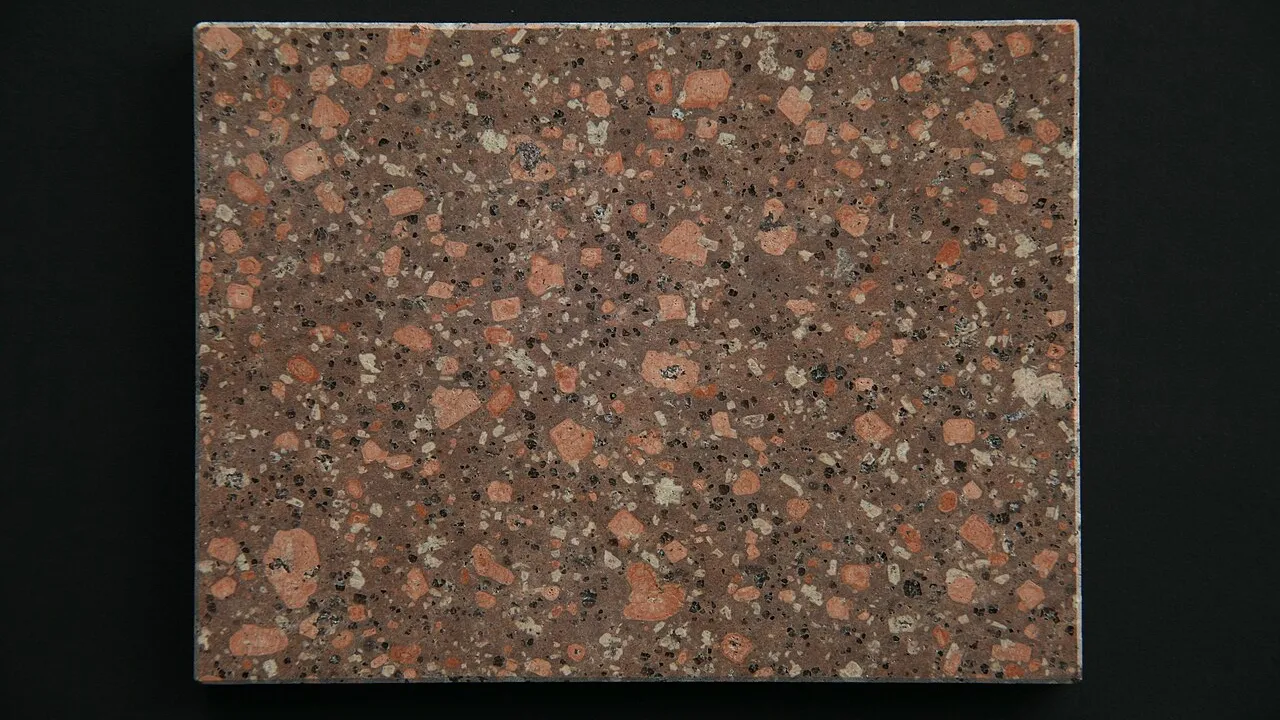
1. Why are most of the crystals in rhyolite too small to see with just your eyes?
2. What colors do you often see in rhyolite?
🤯 Mind-Blowing Fact • Grade 2
The name rhyolite comes from a Greek word meaning 'streaming rock' because of its swirling lava stripes!
✨ Word Sparks (Grade 2 Glossary)
Tap 🔊 to hear
lava dome
A steep mound formed by thick, slow lava
microscopic
So tiny you need a microscope to see
erupt
To burst or pour out from a volcano
🪝
How can bumpy kitchen-counter granite have a twin brother that erupted out of a volcano?
1
Granite's Surface Twin
Picture two batches of the exact same cookie dough. Bake one slowly and one super fast, and they look different! Granite cools slowly deep underground with big crystals, while its twin, rhyolite, from volcanoes and cools fast with grains.
2
Swirling Lava Ribbons
Rhyolite lava is so thick and pasty that it piles up into steep domes instead of racing downhill. As the stiff lava creeps forward, layers fold over each other and freeze into pretty, wavy stripes.
3
Virginia's Tallest Peak
Hikers climbing Mount Rogers in southwestern Virginia walk across dark purple rhyolite that erupted from ancient volcanoes hundreds of millions of years ago!
1. Which underground rock has the exact same recipe of minerals as volcanic rhyolite?
2. What creates the wavy stripes often seen in rhyolite?
🤯 Mind-Blowing Fact • Grade 3
Oregon's official state rock, the 'thunderegg,' is a round, crystal-filled treasure ball that grew inside ancient rhyolite volcanic layers!
✨ Word Sparks (Grade 3 Glossary)
Tap 🔊 to hear
aphanitic
Igneous rock texture with crystals too tiny to see
phenocryst
A noticeably larger crystal set in fine-grained rock
geode
A hollow rock lined inside with sparkling crystals
🪝
Why does a rock packed with sparkling quartz and feldspar look dull and smooth until you zoom in?
1
High-Silica Felsic Recipe
Examine a hand sample of pale pink or buff rhyolite, and its surface looks smooth and matte, almost like unglazed pottery. Yet inside, it holds the same light-colored felsic minerals as granite: abundant quartz, potassium feldspar, and sodium plagioclase, with more than 69 percent silica.
2
Fine-Grained Groundmass and Phenocrysts
When rhyolitic magma erupts onto continental crust, heat escapes rapidly into the atmosphere. Millions of microscopic crystals nucleate at once, forming a fine-grained texture geologists call . Sometimes a few larger crystals—called —had already started growing underground before the eruption, sparkling like tiny windowpanes inside the smooth stone.
3
Lava Domes and Yellowstone's Canyons
Because high-silica lava resists flowing, gas pressure often shatters it into ash or squeezes out steep lava domes. In Yellowstone National Park, hydrothermal hot springs altered pale rhyolite lava flows bright golden-yellow, inspiring the park's name!
4
Hidden Geode Treasures
Gas cavities trapped inside cooling rhyolite flows sometimes fill later with silica-rich groundwater, growing banded agate and sparkling quartz known as thundereggs.
1. How did Yellowstone National Park get its famous yellow canyon walls?
2. What do geologists call the occasional larger crystals scattered inside fine-grained rhyolite?
🤯 Mind-Blowing Fact • Grade 4
A single thick rhyolite lava dome can wear three disguises at once—frothy pumice on top, shiny obsidian on the rim, and striped rhyolite in the middle!
✨ Word Sparks (Grade 4 Glossary)
Tap 🔊 to hear
extrusive
Igneous rock cooled from lava at Earth's surface
porphyritic
Rock texture mixing large crystals inside fine grains
rifting
Splitting and pulling apart of Earth's continental crust
🪝
How did ancient rhyolite volcanoes build Virginia's highest summit 750 million years ago?
1
Continental Crust Melting and Extrusive Texture
Stand atop 5,729-foot Mount Rogers in Virginia's Blue Ridge province, and the rugged purple outcrops beneath your boots tell a dramatic story. About 750 million years ago, as an ancient supercontinent began apart, rising heat melted thick continental crust into silica-rich magma. Where that magma cooled miles underground, it formed coarse granite; where it breached the surface in violent calderas and viscous lava domes, it chilled rapidly into fine-grained, rhyolite.
2
Two-Stage Cooling and Flow Banding
Many Mount Rogers rhyolites display a texture: glossy quartz beads and pink feldspar phenocrysts sit embedded in an aphanitic purple-gray matrix. That texture proves two-stage cooling—slow crystal growth deep inside a magma chamber followed by sudden surface quenching. Elsewhere on a single rhyolite dome, chilling speed shifts dramatically: a frothy pumice shell on top, glassy black obsidian along chilled edges, and banded crystalline rhyolite in the insulated core!
3
Tough Resistance to Weathering
Because quartz and alkali feldspar score 6 to 7 on the Mohs hardness scale and resist chemical breakdown by slightly acidic rainwater, thick rhyolite formations outlast softer neighboring rocks. That durability explains why Mount Rogers and nearby Whitetop Mountain still tower above surrounding valleys after hundreds of millions of years of erosion.
4
Human Uses Through History
In areas lacking flint or obsidian, Indigenous peoples across eastern North America quarried fine-grained Blue Ridge and Piedmont metarhyolite to knap durable spear points, while modern quarries crush tough rhyolite for highway aggregate.
1. What does a porphyritic texture in Virginia's Mount Rogers rhyolite reveal to geologists?
2. Why does Mount Rogers still stand as Virginia's tallest peak after hundreds of millions of years?
🤯 Mind-Blowing Fact • Grade 5
Yellowstone's massive caldera rests atop solidified rhyolite ash sheets and lava flows more than a thousand feet thick!
✨ Word Sparks (Grade 5 Glossary)
Tap 🔊 to hear
ignimbrite
Rock formed from superheated volcanic ash-flow deposits
sanidine
High-temperature potassium feldspar mineral common in rhyolite
fractional crystallization
Process where early crystals settle, changing remaining magma
🪝
Why are rhyolite eruptions rare on ocean islands yet capable of reshaping entire continents?
1
Crustal Partial Melting and Magmatic Differentiation
Pick up a slab of banded rhyolite and trace its delicate pale pink and smoky gray laminae: you are holding the most chemically evolved volcanic lava on Earth. Defined on the total-alkali-silica diagram as an extrusive rock exceeding 69 weight percent silicon dioxide with high sodium and potassium oxides, rhyolite rarely forms over thin oceanic plates. Instead, it arises where hot mantle plumes or subduction zones partially melt thick, silica-rich continental crust, or where strips iron, magnesium, and calcium from deeper magma reservoirs.
2
Eruption Styles: Welded Ignimbrites Versus Effusive Domes
Erupting at relatively cool magmatic temperatures of 700 to 850 degrees Celsius, polymerized rhyolite melt exhibits extraordinary viscosity. When charged with dissolved steam, it unleashes caldera-forming super-eruptions—such as Yellowstone's Lava Creek Tuff 631,000 years ago—blanketing landscapes in incandescent ash-flow sheets that weld under their own heat into dense rhyolitic . Only after volatiles degas does degassed melt ooze quietly from vents to build steep, flow-banded coulees and domes.
3
Mineralogy Under the Petrographic Microscope
Under polarized microscope light, crystalline rhyolite reveals microcrystalline quartz, (a high-temperature potassium feldspar), and sodic plagioclase, accented by minor biotite or hornblende. Laminar shear during viscous extrusion stretches gas vesicles and devitrified glass lenses into millimeter-scale flow banding.
4
Hydrothermal Ore Systems and Epithermal Veins
Cooling rhyolitic calderas drive vigorous hydrothermal circulation cells that leach trace metals and redeposit gold, silver, lithium, and topaz crystals within fractured volcanic vents across Nevada, Utah, and the Andes.
5
Neoproterozoic Witness in the Appalachians
Along the Appalachian Blue Ridge—from Pennsylvania's South Mountain to Virginia's Mount Rogers Formation—750-million-year-old rhyolites preserve fiery evidence of the breakup of the supercontinent Rodinia long before the Atlantic Ocean existed.