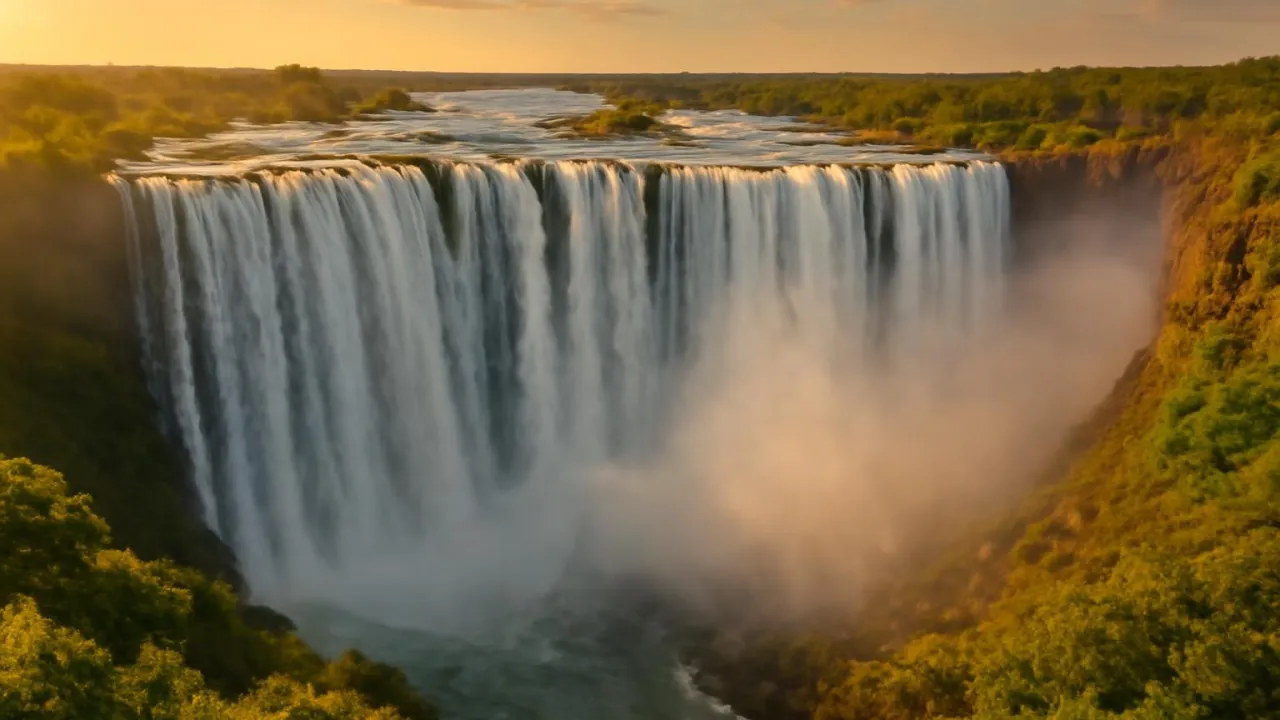
Victoria Falls is over a mile wide—wider than 17 football fields!
✨ Word Sparks (Grade 2 Glossary)
Tap 🔊 to hear
cliff
A steep, high rock wall
trail
A path for walking or hiking
guide
A person who shows the way
🪝
What if you stood near a waterfall so big the ground rumbled?
1
The Thundering Falls
Victoria Falls makes a huge roaring sound, shaking the earth below. Water tumbles down tall , making a misty cloud. People call it 'The Smoke That Thunders' because of its noise.
2
A Rainbow Show
When sunlight shines through the mist, rainbows appear in the sky. Visitors love watching the colors dance above the water. The falls are a favorite place for photos and fun.
3
Exploring the Falls
People walk on safe to see the falls up close. Boats float on the Zambezi River, giving riders a wild view. help everyone explore and stay safe.
Victoria Falls sends up so much mist, it can look like smoke from 30 miles away!
✨ Word Sparks (Grade 3 Glossary)
Tap 🔊 to hear
erosion
Wearing away of rock by water
basalt
Hard, dark volcanic rock
vibration
A shaking or trembling movement
🪝
Imagine feeling the ground tremble as water crashes down with a wild roar—what could it be?
1
A Mighty Curtain of Water
Victoria Falls stretches across the Zambezi River, forming the world’s widest sheet of falling water. The waterfall’s powerful can be felt from far away, shaking the ground and rattling your feet. Its local name, 'Mosi-oa-Tunya,' means 'The Smoke That Thunders.' The roaring sound is made by tons of water plunging over the cliff every second.
2
Mist, Rainbows, and Rain Forests
As water crashes down, it creates a thick mist that rises high into the air. Sunlight shining through this mist forms brilliant rainbows and keeps nearby plants wet all year. The constant spray helps a special rain forest grow right beside the falls. This jungle is home to many unique plants and animals.
3
How the Falls Were Formed
Long ago, the Zambezi River cut through layers of rock, creating deep gorges. Over thousands of years, water carved the wide gap we see today. The falls are still changing as water keeps wearing away the rock. Scientists study the erosion and to learn how the land is shaped.
4
Visiting Victoria Falls
Visitors can walk along safe paths and stand on viewing platforms close to the spray. Some take boat rides or even swim in a pool near the edge, called Devil’s Pool. Local guides share stories about the falls’ history and wildlife. People from all over the world come to see this natural wonder.
1. What helps the rain forest grow near Victoria Falls?
2. What does 'Mosi-oa-Tunya' mean?
🤯 Mind-Blowing Fact • Grade 4
During flood season, over 500 million liters of water plunge over Victoria Falls every minute!
✨ Word Sparks (Grade 4 Glossary)
Tap 🔊 to hear
gorge
A deep, narrow valley with steep sides
ecosystem
A community of living things and their environment
plateau
A large flat area of high land
🪝
What if you stood so close to a waterfall, your voice vanished beneath its thunder?
1
The Thunderous Wonder of Africa
Victoria Falls is one of the most powerful waterfalls on Earth, stretching across the Zambezi River between Zambia and Zimbabwe. Its massive curtain of water plunges over a basalt cliff, creating a thunderous roar that can be heard from over 25 miles away. The falls’ local name, 'Mosi-oa-Tunya,' means 'The Smoke That Thunders,' describing the misty cloud that rises high above the . This mist is so thick, it creates a constant drizzle and even rainbows that arch across the sky.
2
Geology and Erosion at Work
The falls formed over thousands of years as the Zambezi River eroded cracks in the ancient basalt . The river’s powerful flow carved deep , which continue to shift as water wears away the rock through erosion. Scientists study the vibration and movement of the rock to understand how the waterfall is slowly changing shape. Each year, the falls move just a little farther upstream, showing how powerful water can shape the land.
3
A Unique Rain Forest Ecosystem
The thick mist from Victoria Falls supports a rare rain forest right beside the river, even though the surrounding area is much drier. This is filled with lush ferns, palms, and colorful flowers that thrive in the constant spray. Many unique animals, like vervet monkeys and tiny frogs, depend on this wet environment to survive. The falls’ mist is so strong, it can even create small rain showers in the forest below.
4
Visiting and Protecting the Falls
Millions of tourists visit Victoria Falls every year, walking along safe trails and viewing platforms for unforgettable sights. Local guides share stories about the falls’ history, wildlife, and cultural importance to nearby communities. The falls are protected as a UNESCO World Heritage Site, helping to preserve their beauty and the surrounding habitats. People work together to keep the area clean and safe for future generations.
1. Why do scientists study the vibration and erosion at Victoria Falls?
2. What makes the rain forest near the falls unique?
🤯 Mind-Blowing Fact • Grade 5
Victoria Falls’ spray is so powerful, it creates its own rain forest and weather system nearby!
✨ Word Sparks (Grade 5 Glossary)
Tap 🔊 to hear
seismic
Related to vibrations or shaking in the ground
microclimate
A small area with its own special weather
conservation
Protecting nature and its living things
🪝
What if you could measure the force of a waterfall so mighty, its spray created its own weather?
1
A Natural Wonder of Immense Power
Victoria Falls, straddling the border between Zambia and Zimbabwe, is renowned for being the world’s largest sheet of falling water. The falls are approximately 355 feet (108 meters) high and stretch over 5,600 feet (1,700 meters) wide, making them both taller and wider than Niagara Falls. During the peak flood season, more than 500 million liters of water crash over the edge every minute, producing a thunderous roar that can be heard up to 25 miles (40 kilometers) away. The indigenous Lozi name, 'Mosi-oa-Tunya,' perfectly captures this phenomenon, meaning 'The Smoke That Thunders.' The immense volume and velocity of water create vibrations so strong, they can be felt in the ground by visitors standing nearby.
2
Geological Forces and Evolving Landscapes
The formation of Victoria Falls began approximately 150,000 years ago, as the Zambezi River gradually eroded cracks in the region’s hard basalt plateau. Over millennia, the relentless force of water exploited these weaknesses, carving out a series of zigzagging gorges downstream from the main falls. The process of erosion continues today, with the waterfall slowly retreating upstream as water and sediment wear away the rock face. Geologists use sensors to study the vibration and structural changes, tracking how the landscape is shaped by both natural forces and seasonal flooding.
3
Mist, Microclimates, and Unique Ecosystems
The colossal spray generated by Victoria Falls rises over 1,300 feet (400 meters) into the air, creating a persistent mist visible from more than 30 miles (48 kilometers) away. This mist forms its own , producing frequent rain showers and supporting a rare rain forest ecosystem on the riverbanks. The forest is home to diverse plant species, such as wild date palms and ebony trees, as well as animals like baboons, bushbucks, and rare birds. Scientists study the interaction between the falls’ mist, local weather patterns, and the specialized plants and animals that have adapted to this unique environment.
4
Cultural Significance and Global Recognition
Victoria Falls has held cultural importance for local communities for centuries, serving as a sacred site and a source of legends. European explorer David Livingstone brought the falls to international attention in 1855, naming them in honor of Queen Victoria. Today, the falls are protected as a UNESCO World Heritage Site, recognized for both their natural beauty and their role in supporting local economies through tourism. efforts focus on balancing visitor access with the need to protect fragile habitats and respect indigenous traditions.
5
Experiencing and Preserving the Falls
Millions of people from around the world visit Victoria Falls each year, exploring safe walkways, viewing platforms, and boat tours along the Zambezi River. Adventurous visitors can swim at the edge in Devil’s Pool during the dry season or take guided hikes into the gorges below. Environmental scientists and local organizations work together to monitor water quality, manage erosion, and educate visitors about the falls’ ecological and cultural value. By combining scientific research, community engagement, and sustainable tourism, Victoria Falls continues to inspire awe while being preserved for future generations.