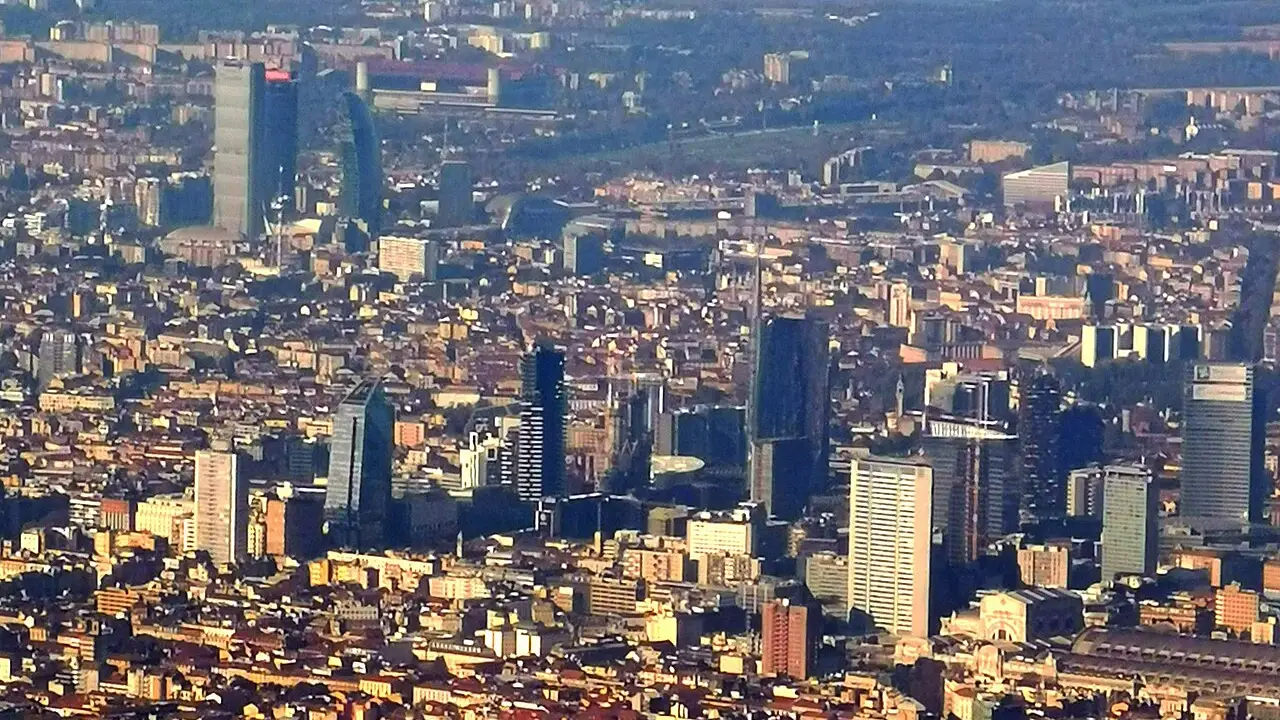
🌋 Where It FormsUrban Canopy & Boundary Layer Over Cities and Paved Suburbs
💎 Key PropertiesDaytime 1–7 °F Warmer • Nighttime Up to 5–22 °F Warmer Than Rural Land
⚡ Planet Earth SparkDark roads, brick buildings, and sparse trees trap daytime sunshine and radiate stored heat deep into the night
🤯 Mind-Blowing Fact • Grade 1
On a hot summer evening, a big city downtown can stay ten degrees warmer than farms just outside town!
✨ Word Sparks (Grade 1 Glossary)
Tap 🔊 to hear
urban
Belonging to a town or city
pavement
Hard blacktop or concrete road surface
reflect
Bounce light or heat back away
🪝
Why does black parking-lot pavement feel so much hotter than green park grass?
1
Hot Streets, Cool Parks
Touch a shaded grass lawn, then feel the air above a dark parking lot! Dark streets and tall buildings soak up bright sunshine all day. That makes a busy city an heat island!
2
Warm Even at Night
Country fields cool off fast after the sun goes down. City bricks and roads hold heat and stay warm past bedtime.
3
Planting Cool Shade
Planting leafy street trees and painting roofs bright white bounces sunlight away. Green parks help keep cities cool!
1. Why is a big city often warmer than grassy farmland nearby?
2. What is one great way neighborhoods can cool down an urban heat island?
🤯 Mind-Blowing Fact • Grade 2
Dark black rooftops can heat up fifty degrees hotter in afternoon sunshine than the air right around them!
✨ Word Sparks (Grade 2 Glossary)
Tap 🔊 to hear
rural
Open countryside with farms and woods
rooftop
Outside top surface of a building
cluster
Gather closely together in one group
🪝
Why is it called an 'island' of heat even when there is no ocean water around?
1
An Island on a Weather Map
Look at a summer temperature map of a big city and the towns around it. Warm red colors right over downtown buildings, surrounded by cooler green countryside on all sides—looking just like a warm island in a cool sea!
2
Missing Nature's Sweat
When rain falls on forests and meadows, damp soil and green leaves evaporate water to cool the air, much like sweat cools your skin. In cities, storm drains carry rainwater away fast while dark asphalt and bake in the sun.
3
Extra Heat From Engines
Cars, buses, and air conditioners also puff extra warmth onto busy streets. Adding gardens, white 'cool roofs,' and shady trees helps neighborhoods beat the heat!
1. Why do scientists call a warm city center an 'urban heat island'?
2. How does painting a dark flat roof bright white help a school building in summer?
🤯 Mind-Blowing Fact • Grade 3
Volunteer citizen scientists in Richmond, Virginia, drove temperature sensors through neighborhoods in 2017 and found a sixteen-degree difference between shady tree-lined streets and paved blocks at the exact same hour!
✨ Word Sparks (Grade 3 Glossary)
Tap 🔊 to hear
concrete
Hard gray building material made with cement
canyon
Deep, narrow valley between steep walls
downwind
In the direction the wind blows
🪝
Why is the temperature gap between a city and the countryside often BIGGEST after sunset?
1
Discovered in London Over 200 Years Ago
Back in 1818, British chemist and weather observer Luke Howard—the same scientist who named cumulus and cirrus clouds—compared thermometers inside London with thermometers in rural villages. He discovered London stayed noticeably warmer, especially at night, giving science its very first study of an urban heat island!
2
Concrete Canyons Trap Night Heat
Once the sun sets, open farm fields radiate their heat straight up into the clear night sky and cool off rapidly. Downtown skyscrapers, however, stand close together like narrow stone . and brick walls radiate stored heat right across the street into neighboring buildings, trapping warmth until dawn.
3
Changing Local Summer Weather
Rising plumes of hot city air can even nudge afternoon clouds upward, sometimes triggering heavier summer rainstorms of large cities like Atlanta or Houston!
4
Cool Solutions Across Towns
Cities from Richmond, Virginia, to Los Angeles now plant thousands of street trees, lay lighter-colored pavements, and plant living green roofs to cool hot blocks.
1. When is the temperature difference between an urban heat island and nearby rural land usually largest?
2. What surprising finding did citizen scientists measure across Richmond, Virginia, on a summer afternoon?
🤯 Mind-Blowing Fact • Grade 4
NASA satellites orbiting hundreds of miles in space can spot the warm thermal glow of cities, airports, and shopping-mall parking lots using infrared cameras!
✨ Word Sparks (Grade 4 Glossary)
Tap 🔊 to hear
impervious
Waterproof surface water cannot soak through
anthropogenic
Created or caused by human activity
permeable
Having tiny gaps water drains through
🪝
How do albedo, impermeable pavement, and waste heat combine to warm metropolitan areas?
1
Four Drivers of Urban Warmth
Environmental scientists trace urban heat islands to four connected causes. First is low albedo: dark asphalt roads and tar roofs absorb eighty to ninety-five percent of incoming sunlight instead of reflecting it. Second is high thermal mass: dense stone, steel, and concrete store far more daytime heat than loose soil. Third is surfaces: waterproof streets funnel rainwater into storm sewers, shutting down natural evaporative cooling from soil and plant transpiration. Fourth is waste heat escaping from vehicle engines, factories, and air-conditioning condensers.
2
A Feedback Loop on Power Grids
Hotter city air forces homes, schools, and offices to run air conditioners harder, which burns more electricity AND pumps even more exhaust heat outdoors! Calmer city winds blocked by tall skyscrapers also allow ground-level ozone smog to build on sunny summer afternoons.
3
Mapping Heat From Orbit and Cars
NASA Landsat satellites measure surface temperatures block by block from space, while community teams in Virginia, Maryland, and dozens of states attach fast-response thermistors to cars and bicycles to map exactly which playgrounds and bus stops need shade first.
4
Engineering Cooler Cities
Reflective white or silver 'cool roofs,' pavers that soak up rain, bioswales, and expanding urban tree canopies work together to lower summer street temperatures by five to nine degrees.
1. How do waterproof (impervious) streets and parking lots make cities hotter after a rainstorm?
2. Why do air conditioners create a tricky feedback loop inside a hot city?
🤯 Mind-Blowing Fact • Grade 5
Meteorological studies around St. Louis, Atlanta, and Houston proved that rising urban heat plumes actually boost summer thunderstorm rainfall ten to thirty-five miles downwind of big cities!
✨ Word Sparks (Grade 5 Glossary)
Tap 🔊 to hear
infrared
Invisible heat energy waves radiated outward
sensible
Heat you feel raising air temperature
vegetated
Covered with living green plants and trees
🪝
How do urban street-canyon geometry and sky-view factor trap infrared radiation hours after the sun sets?
1
Surface vs. Canopy-Layer Heat Islands
Urban climatologists led by researchers such as Timothy Oke distinguish between two distinct thermal layers. The Surface Urban Heat Island (SUHI), measured via satellite thermal radiometers like NASA's ECOSTRESS and Landsat TIRS, peaks at midday when low-albedo asphalt (albedo ~0.05–0.12) reaches $50\text{ to }65\,^{\circ}\text{C}$—far hotter than transpiring rural forests. By contrast, the Canopy-Layer Urban Heat Island (CUHI)—the air temperature people actually breathe between ground and roof level—peaks three to five hours after sunset on calm, cloudless nights, frequently remaining $3\text{ to }12\,^{\circ}\text{C}$ ($5\text{ to }22\,^{\circ}\text{F}$) warmer than rural surroundings.
2
Bowen Ratio and Sky-View Factor
Two quantitative ratios govern this nocturnal warmth. First, replacing soil with impervious concrete spikes the Bowen ratio ($B = Q_H / Q_E$, heat flux divided by latent evaporative heat flux) from below 0.5 in forests to above 4.0 downtown. Second, tall buildings along narrow streets shrink the sky-view factor ($\psi_{sky}$): instead of escaping to cold outer space, outgoing longwave photons bounce repeatedly between opposing masonry walls, drastically slowing radiative cooling.
3
Downwind Convection and Precipitation
Field campaigns such as METROMEX (Metropolitan Meteorological Experiment) and NASA satellite studies confirmed that buoyant urban thermal plumes plus rough-skyline wind convergence enhance thunderstorm initiation and increase warm-season rainfall 20 to 60 kilometers downwind of major cities!
4
Public Health and Energy Equity
Elevated nighttime minimum temperatures prevent human bodies and uncooled apartments from recovering during summer heat waves while increasing peak electric cooling demand by two to four percent per degree Celsius of urban warming.
5
Sponge Cities and Super-Cool Materials
Next-generation urban design pairs mature street-tree corridors, green roofs, and permeable 'sponge city' plazas with radiative-cooling roof coatings that reflect over ninety-five percent of sunlight while emitting thermal cleanly through the atmospheric window.