🇺🇸 U.S. HISTORY
🏛️ 18th President of the United States (1869–1877)
VA History & Social Science SOL K.1, 1.2, 2.4, VS.1–VS.10, USI & USII
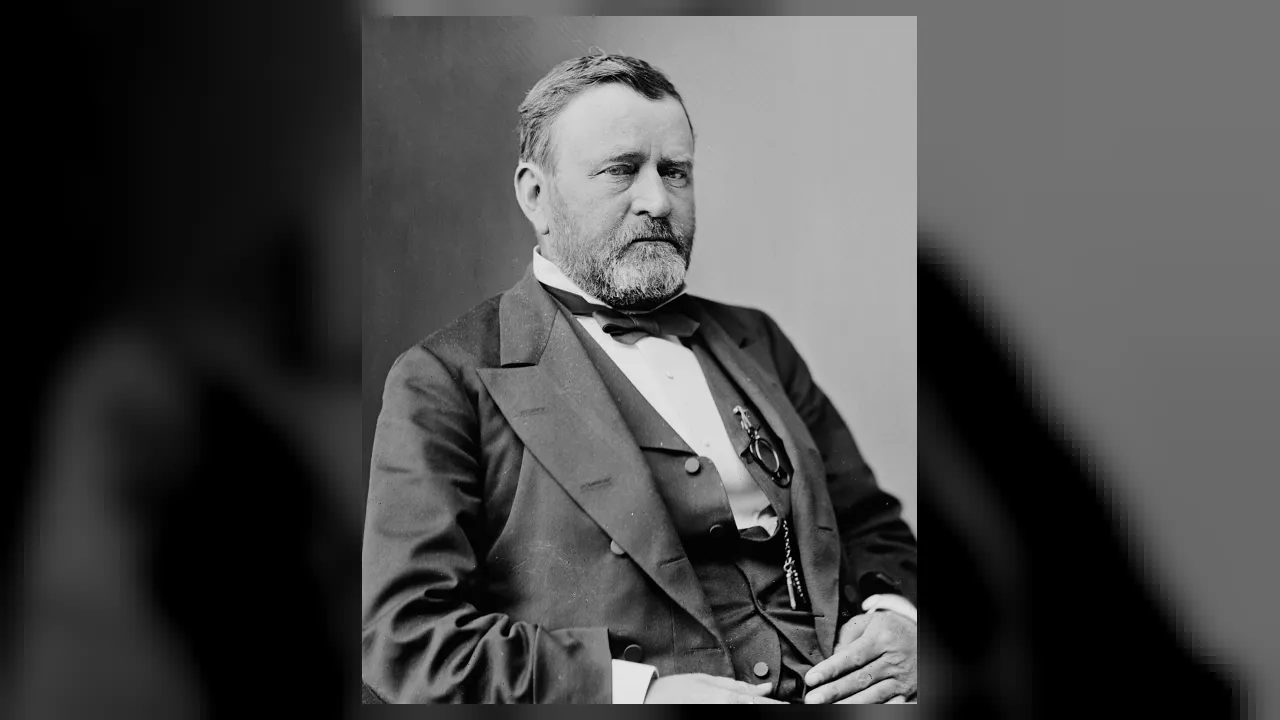
Ulysses S. Grant
Calm General of Appomattox and Civil Rights President
Grade 2 • Developing • 113 words
⏳ Era / StatehoodPresidential Term: 1869–1877 (Appomattox Peace: April 9, 1865)
🗺️ Region / CapitalPoint Pleasant, Ohio; Galena, Illinois & Appomattox, Virginia
📜 Key MilestoneUnion Victory at Appomattox, 15th Amendment & Yellowstone National Park
⚡ Historical SparkAccepted peaceful surrender at Appomattox Court House and created the world's first national park
🤯 Mind-Blowing Fact • Grade 1
Ulysses S. Grant was actually born Hiram Ulysses Grant—a mix-up on his West Point school form accidentally gave him the initials 'U.S.'!
✨ Word Sparks (Grade 1 Glossary)
Tap 🔊 to hear
steady
Calm, firm, and dependable during tough moments
surrender
To stop fighting and agree to peace
geysers
Natural hot springs that shoot steaming water upward
🪝
How can a quiet person who loves horses become a great peacemaker?
1
A Quiet Horse Whisperer
Clip-clop, whoa! Even as a small boy in Ohio, young Ulysses could calm spooky horses gently. He did not boast or shout, yet people trusted his courage.
2
Peace in Virginia
President Lincoln chose him to lead the Union Army in the Civil War. At Appomattox in Virginia, General Grant ended the fighting kindly, letting tired soldiers go home in peace.
3
Fair Votes and First Park
As our eighteenth president, he protected fair voting rights for freed citizens. He also signed a law making Yellowstone the very first national park in the whole world!
1. Where in Virginia did General Grant accept the surrender that ended the main Civil War fighting?
2. Which famous outdoor wonder did President Grant make the world's first national park?
🤯 Mind-Blowing Fact • Grade 2
While serving as president in Washington, D.C., Grant was once stopped by Police Officer William H. West—a Black Civil War veteran—for driving his horse carriage too fast, and Grant politely paid the twenty-dollar ticket and praised the officer!
✨ Word Sparks (Grade 2 Glossary)
Tap 🔊 to hear
determination
Refusing to give up when a job is hard
parlor
A formal sitting room for welcoming guests
Reconstruction
The period of rebuilding and reuniting after 1865
🪝
Why did General Grant feed hungry opposing soldiers instead of celebrating loudly when the Civil War ended?
1
Calm Under Pressure
Thunder boomed across Civil War battlefields, yet General Ulysses S. Grant stayed calm and focused while writing clear orders. Impressed by his at Vicksburg along the Mississippi River, President Abraham Lincoln placed Grant in charge of all Union armies.
2
Kindness at Appomattox Court House
On April 9, 1865, General Robert E. Lee met Grant in the of the McLean House at Appomattox Court House, Virginia. Rather than punishing the defeated troops, Grant fed Lee's hungry army and let soldiers keep their horses for spring planting.
3
Protecting Rights as President
Voters elected Grant our eighteenth president in 1868. During , he championed the Fifteenth Amendment so Black men could not be denied the vote, and in 1872 he preserved Yellowstone as Earth's first national park.
1. Why did General Grant let Confederate soldiers keep their horses at Appomattox?
2. What right did the Fifteenth Amendment, strongly supported by President Grant, protect?
🤯 Mind-Blowing Fact • Grade 3
During his final year of life in 1885, racing against terminal illness so his family wouldn't be left poor, Grant handwrote a two-volume memoir that Mark Twain published to huge acclaim!
✨ Word Sparks (Grade 3 Glossary)
Tap 🔊 to hear
rations
Measured shares of food given to soldiers
memoir
A book of true memories written from experience
magnanimity
Generous kindness shown by a winner toward rivals
🪝
How did a former leather-shop clerk from Illinois lead Union armies to victory and defend civil rights from the White House?
1
From West Point to Galena
Imagine setting a horseback high-jump record at West Point that stood unbroken for twenty-five years! Born Hiram Ulysses Grant in Ohio, he earned the nickname 'Sam' from his accidental West Point initials, 'U.S.' Before the Civil War, he worked quietly in his father's leather store in Galena, Illinois.
2
Turning the Tide of the Civil War
Rejoining the army in 1861, Grant won key western victories at Fort Donelson, Vicksburg, and Chattanooga, securing Union control of the Mississippi River. Promoted by Lincoln to Lieutenant General—a rank previously held in full only by George Washington—Grant coordinated all Union armies.
3
Magnanimity at Appomattox
When General Lee surrendered the Army of Northern Virginia at Appomattox Court House on April 9, 1865, Grant forbade noisy Union cannon salutes, reminding his officers, 'The rebels are our countrymen again.' He sent 25,000 food to Lee's troops.
4
Reconstruction and Yellowstone
Campaigning on the slogan 'Let Us Have Peace,' Grant served two terms as president (1869–1877). He signed the law creating the Department of Justice to protect newly freed African Americans, backed the Fifteenth Amendment, and established Yellowstone National Park in 1872.
1. Why did Grant stop his Union troops from firing loud celebratory cannons at Appomattox?
2. Which famous American author helped publish Grant's bestselling Personal Memoirs in 1885?
🤯 Mind-Blowing Fact • Grade 4
Before Grant signed the 1871 Treaty of Washington settling the 'Alabama Claims' with Great Britain through peaceful arbitration, countries almost always settled major wartime ship disputes by fighting another war!
✨ Word Sparks (Grade 4 Glossary)
Tap 🔊 to hear
composure
Staying calm and self-controlled during stressful events
ratification
Official approval that makes an amendment become law
arbitration
Settling a dispute peacefully through neutral judges
🪝
Why is Ulysses S. Grant remembered both for ending the Civil War in Virginia and for defending constitutional rights during Reconstruction?
1
Unlikely Rise of a Master Strategist
Standing in his family's harness shop in Galena, Illinois, in early 1861, thirty-eight-year-old Ulysses S. Grant seemed an unlikely candidate to save the Union. Yet his West Point mathematics training, photographic memory for terrain maps, and quiet under fire soon set him apart. By capturing Vicksburg on July 4, 1863, Grant split the Confederacy along the Mississippi River and earned Abraham Lincoln's full confidence.
2
Appomattox Court House and National Healing
Promoted to command all Union forces in March 1864, Grant coordinated simultaneous campaigns across Virginia and Georgia. On Palm Sunday, April 9, 1865, at Appomattox Court House in central Virginia, Grant drafted remarkably generous surrender terms for General Robert E. Lee: Confederate soldiers would not be imprisoned for treason, could return home unmolested so long as they obeyed the laws, keep personal horses, and share 25,000 Union rations.
3
Championing the Fifteenth Amendment and Justice
Elected eighteenth president in 1868 on the unifying call 'Let Us Have Peace,' Grant fought to make freedom real during Reconstruction. He celebrated of the Fifteenth Amendment in 1870, declaring it a measure of grander importance than any one act since our nation's founding. Working with Congress, he established the U.S. Department of Justice in 1870 and signed the Enforcement Acts to stop violent intimidation of Black voters.
4
Diplomacy, Conservation, and Final Courage
Though scandals involving dishonest subordinates tarnished parts of his administration, Grant achieved lasting milestones: resolving Civil War maritime disputes peacefully with Great Britain through the 1871 Treaty of Washington—a landmark in international —and signing the Yellowstone National Park Protection Act in 1872. After a two-year world tour, Grant bravely completed his celebrated Personal Memoirs just days before his death in July 1885.
1. Which federal department did President Grant and Congress create in 1870 to enforce civil rights laws during Reconstruction?
2. How did the 1871 Treaty of Washington set an important example for world diplomacy?
🤯 Mind-Blowing Fact • Grade 5
At Ulysses S. Grant's 1885 funeral procession in New York City, two former Union generals (William Tecumseh Sherman and Philip Sheridan) rode side by side with two former Confederate generals (Joseph E. Johnston and Simon Bolivar Buckner) as pallbearers in a powerful symbol of national healing!
✨ Word Sparks (Grade 5 Glossary)
Tap 🔊 to hear
synchronizing
Coordinating several actions to happen at the same time
retribution
Harsh punishment inflicted as payback for a wrong
stewardship
Careful, responsible protection of land or resources
🪝
How did Ulysses S. Grant translate Union battlefield victory at Appomattox into constitutional civil-rights enforcement during Reconstruction?
1
Strategic Vision and Cartographic Clarity
While flashier generals panicked over what an opponent might do next, Ulysses S. Grant possessed what Abraham Lincoln prized most: steady resolve and strategic clarity across an entire continent. Born in Point Pleasant, Ohio, in 1822 and educated at West Point, Grant demonstrated unmatched operational mastery during the 1863 Vicksburg Campaign—crossing the Mississippi south of the fortress, living off the land, and opening the river from Minnesota to the Gulf of Mexico.
2
Grand Strategy and Appomattox Court House
Commissioned Lieutenant General in March 1864, Grant ended piecemeal warfare by five Union armies simultaneously so Confederate forces could no longer shift reinforcements along interior rail lines. After the nine-month Petersburg siege broke Confederate defenses in Virginia, Grant cornered Robert E. Lee's army at Appomattox Court House on April 9, 1865. Seated in Wilmer McLean's parlor, Grant wrote magnanimous parole terms that honored Lincoln's vision of national reconciliation over .
3
Enforcing Constitutional Reconstruction
When resistance threatened emancipated Americans' liberties after Lincoln's death, Grant stood firmly behind Congressional Reconstruction and won the 1868 presidency. Calling ratification of the Fifteenth Amendment (1870) 'a measure of grander importance than any other one act of the kind from the foundation of our free government,' Grant signed the Act creating the Department of Justice (1870) and three Enforcement Acts (1870–1871), empowering federal marshals to dismantle violent terror groups and safeguard the 1872 election.
4
Conservation, Arbitration, and Administrative Trials
Grant's two terms also pioneered environmental and peaceful statecraft. On March 1, 1872, he signed legislation preserving over two million acres around Yellowstone Lake as 'a public park or pleasuring-ground for the benefit and enjoyment of the people'—the world's first national park. Internationally, Secretary of State Hamilton Fish and Grant concluded the 1871 Treaty of Washington, pioneering modern international arbitration, even as economic depression after the Panic of 1873 and misplaced trust in corrupt appointees strained his second term.
5
Literary Triumph and Enduring Unity
Bankrupted by a dishonest Wall Street partner in 1884 while battling throat cancer, Grant embarked on one final campaign at Mount McGregor, New York: writing his 275,000-word Personal Memoirs in clear, understated prose. Published by his friend Mark Twain just after Grant's death in July 1885—where former Union and Confederate generals walked side by side as pallbearers—the volumes earned his family nearly $450,000 and remain a cornerstone of American historical writing.