1. How many Justices serve together on the U.S. Supreme Court today?
2. What friendly custom do all nine Justices share before hearing cases?
🤯 Mind-Blowing Fact • Grade 2
On the top floor of the Supreme Court building sits a gym with a basketball court playfully nicknamed 'the Highest Court in the Land'!
✨ Word Sparks (Grade 2 Glossary)
Tap 🔊 to hear
judicial
Relating to courts, judges, and interpreting laws
nominate
To officially suggest someone for an important job
confirm
To approve an appointment by an official vote
🪝
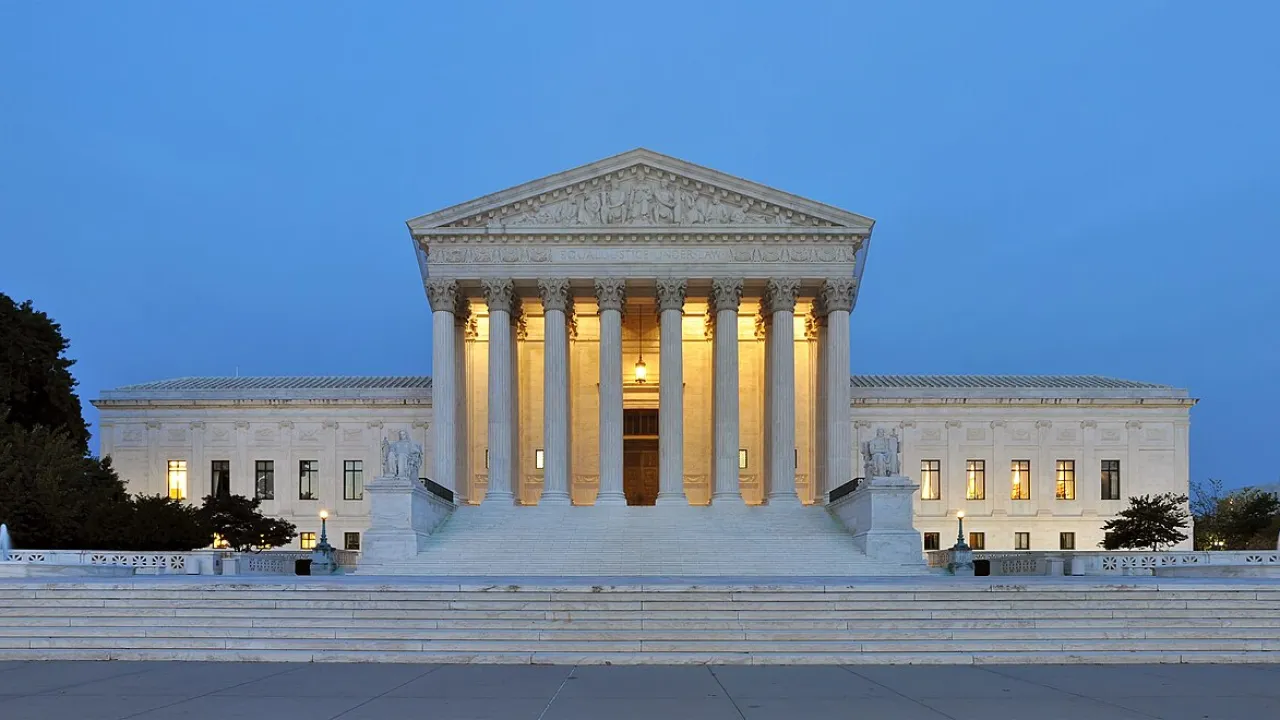
Why are the words 'Equal Justice Under Law' carved in stone above the Supreme Court's front doors?
1
Leading the Judicial Branch
Climb the wide white marble steps across the street from the U.S. Capitol in Washington, D.C.! Inside sits the nation's highest court, leading the branch of government. Its main job is to explain what the U.S. Constitution and federal laws mean.
2
How Justices Are Chosen
Nine Justices—one Chief Justice and eight Associate Justices—serve on the Supreme Court. When there is an opening, the President a candidate, and the U.S. Senate votes to the choice.
3
Listening and Deciding
Lawyers from both sides answer tough questions from the nine Justices. Afterward, the Justices vote and write careful explanations of their decision for the whole nation!
1. Which branch of the U.S. government is led by the Supreme Court?
2. Who nominates a new Supreme Court Justice, and who votes to confirm them?
🤯 Mind-Blowing Fact • Grade 3
Lawyers arguing a case at the Supreme Court still find two handmade white goose-quill pens crossed neatly on their tables each morning as a souvenir!
✨ Word Sparks (Grade 3 Glossary)
Tap 🔊 to hear
opinion
A written explanation of a court's legal ruling
independent
Free from outside pressure when making fair choices
unconstitutional
Going against the rules of the U.S. Constitution
🪝
Why did the Supreme Court not even have its own building for the first 146 years of American history?
1
From Borrowed Rooms to Marble Columns
Imagine the nation's highest judges meeting in a basement room inside the U.S. Capitol! Created by Article III of the Constitution and the Judiciary Act of 1789, the Supreme Court met in New York, Philadelphia, and Capitol chambers before moving into its own marble building in 1935.
2
Virginian John Marshall's Big Moment
Early on, many wondered how much authority the Court truly held. Then Virginian John Marshall—the longest-serving Chief Justice from 1801 to 1835—wrote the 1803 in Marbury v. Madison, confirming judicial review: the power to strike down laws that conflict with the Constitution.
3
Independent for Life
Unlike elected lawmakers, Supreme Court Justices serve during 'good Behaviour,' meaning for life or until they choose to retire. This independence lets them follow the Constitution fairly, even when a decision is unpopular.
4
Trailblazers on the Bench
Over time, landmark appointments broadened the Court, including Thurgood Marshall as the first African American Justice in 1967 and Sandra Day O'Connor as the first woman Justice in 1981.
1. Which Chief Justice from Virginia established judicial review in 1803?
2. Why does the U.S. Constitution allow Supreme Court Justices to serve for life?
🤯 Mind-Blowing Fact • Grade 4
Congress originally set the Supreme Court at six Justices in 1789, and the number changed six times—from five up to ten—before Congress settled on nine Justices in 1869!
✨ Word Sparks (Grade 4 Glossary)
Tap 🔊 to hear
petition
A formal legal request asking a court to review
unanimous
Agreed upon completely by every single voter
dissent
A written disagreement with the majority ruling
🪝
Out of nearly eight thousand appeals sent to Washington each year, how does the Supreme Court choose roughly seventy cases to hear?
1
The Rule of Four
Step behind the red velvet curtains of the Supreme Courtroom on the first Monday in October, when a new annual term begins! Every year, citizens, states, and organizations send between 7,000 and 8,000 asking the Justices to review lower-court rulings. Under an unwritten custom called the 'Rule of Four,' if at least four of the nine Justices agree a case raises an urgent constitutional question, the Court grants a writ of certiorari—Latin for 'to be made more certain.'
2
Oral Arguments and Private Conference
Instead of hearing witnesses or juries like a trial court, the Supreme Court reviews legal briefs and holds timed oral arguments where Justices pepper attorneys with rapid-fire constitutional questions. Later, in a locked oak-paneled room with no clerks present, the nine Justices debate and vote in order of seniority.
3
Virginia's Connection to Landmark Cases
In 1803, Virginia native Chief Justice John Marshall cemented judicial review in Marbury v. Madison. Over 150 years later, brave students at Moton High School in Farmville, Virginia, joined four other communities in the landmark 1954 case Brown v. Board of Education, in which a Supreme Court ruled racial segregation in public schools unconstitutional.
4
Majority and Dissenting Voices
At least five votes form a majority opinion that becomes binding law nationwide, while Justices who disagree may publish a dissenting opinion explaining their constitutional reasoning for future generations.
1. How many of the nine Justices must vote to accept a case under the Court's 'Rule of Four'?
2. How did students in Farmville, Virginia, connect to the landmark 1954 Supreme Court ruling Brown v. Board of Education?
🤯 Mind-Blowing Fact • Grade 5
William Howard Taft is the only person in American history to serve both as President of the United States (1909–1913) and later as Chief Justice of the United States (1921–1930)!
✨ Word Sparks (Grade 5 Glossary)
Tap 🔊 to hear
appellate
Having authority to review decisions from lower courts
precedent
An earlier court ruling guiding future similar cases
jurisdiction
Official legal authority to hear and decide cases
🪝
How did Article III's brief sketch of 'one supreme Court' grow into the guardian of constitutional liberties for more than 330 million Americans?
1
Article III and the Judiciary Act of 1789
Read Article III of the U.S. Constitution and you might be surprised by its brevity: just 375 words vest federal judicial power 'in one supreme Court, and in such inferior Courts as the Congress may from time to time ordain and establish.' Congress filled in the blueprint with the Judiciary Act of 1789, creating lower federal district and circuit courts and seating six initial Justices under Chief Justice John Jay. Congress adjusted the Court's size several times before fixing the bench at one Chief Justice and eight Associate Justices in the Judiciary Act of 1869.
2
John Marshall and Judicial Review
Appointed in 1801, Virginia statesman John Marshall transformed the judiciary during his thirty-four-year tenure. In Marbury v. Madison (1803), Marshall wrote unequivocally that 'it is emphatically the province and duty of the judicial department to say what the law is.' By establishing judicial review over federal statutes—and later state laws in cases like McCulloch v. Maryland—the Court became a co-equal constitutional check alongside Congress and the Presidency.
3
Appellate Jurisdiction and Certiorari
Except for rare original- disputes such as boundary cases between states, the Supreme Court functions almost exclusively as an tribunal. Out of roughly 7,000 to 8,000 petitions for a writ of certiorari filed each term, the Justices select about sixty to eighty cases that resolve conflicting rulings among federal circuit courts or address profound constitutional questions.
4
Deliberation, Precedent, and Dissent
Guided by stare decisis—respect for prior legal —Justices examine written briefs, conduct public oral arguments, and deliberate in strictly confidential conferences where the junior Justice even answers knocks at the door! Majority, concurring, and dissenting opinions are published openly so citizens can evaluate every word of constitutional reasoning.
5
Expanding Equal Justice Under Law
Designed by architect Cass Gilbert and opened in 1935 under former President and Chief Justice William Howard Taft's vision, the Supreme Court Building bears the motto 'Equal Justice Under Law'—a promise continually tested and strengthened across generations.