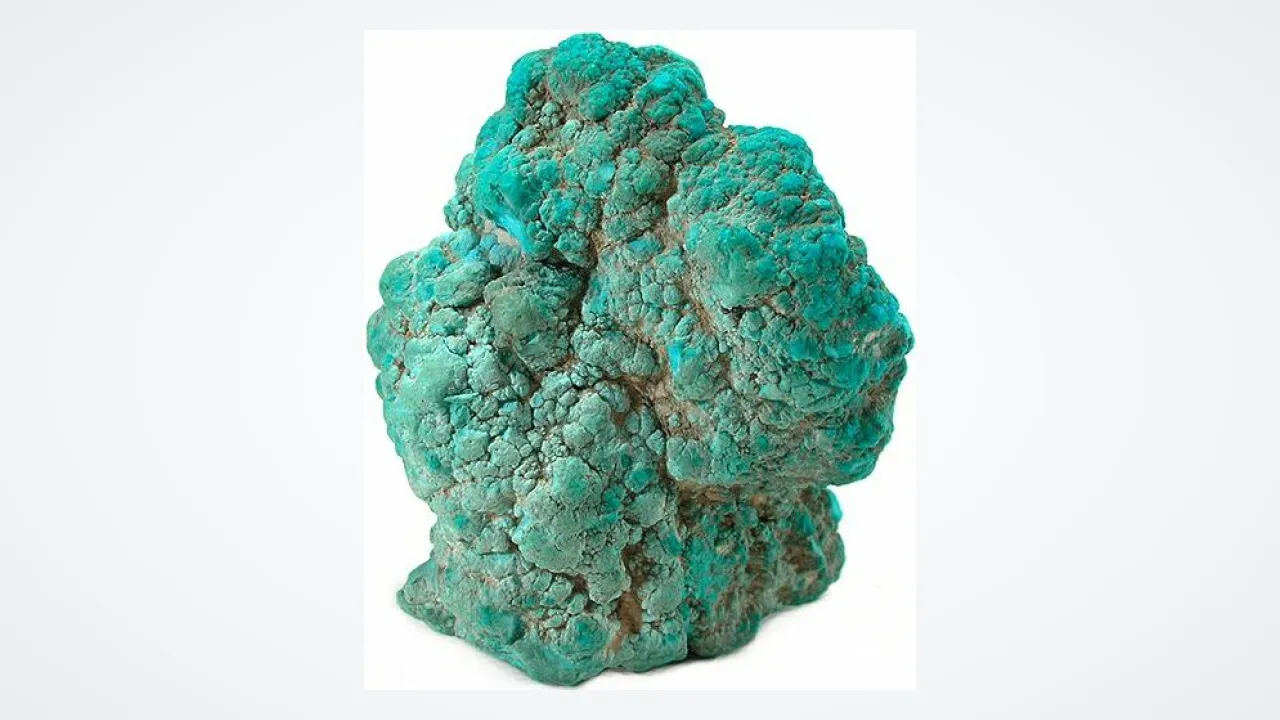
1. What bird's egg matches the famous bright blue color of fine turquoise?
2. Which metal in desert rocks gives turquoise its bright blue color?
🤯 Mind-Blowing Fact • Grade 2
King Tutankhamun's famous golden burial mask in ancient Egypt was inlaid with real desert turquoise more than 3,300 years ago!
✨ Word Sparks (Grade 2 Glossary)
Tap 🔊 to hear
matrix
Host rock web lines running through turquoise
Indigenous
The first native peoples of a land
inlay
Setting fitted stones neatly into metal designs
🪝
Why did French traders name this stone 'Turkish stone' when it didn't even come from Turkey?
1
A Traveling Name
Hundreds of years ago, merchants carried sky-blue gems from ancient mines in Persia (modern-day Iran) through markets in Turkey on their way to Europe. French buyers called the gem 'pierre turquoise,' meaning 'Turkish stone,' and the name stuck!
2
Brewed Near Desert Surfaces
Unlike diamonds that form deep underground, turquoise forms close to the surface in dry deserts. Occasional desert rain trickles down through copper-rich rock, mixing copper, aluminum, and phosphorus in narrow cracks.
3
Southwestern Heritage
Across Arizona, New Mexico, and Nevada, artists of the Diné (Navajo), Zuni, and Pueblo nations have crafted world-famous silver and turquoise jewelry for generations.
1. How did turquoise get its French name meaning 'Turkish stone'?
2. In which U.S. region are famous turquoise mines and Indigenous silver-inlay traditions centered?
🤯 Mind-Blowing Fact • Grade 3
Campbell County, Virginia, is one of the only places on the entire planet where turquoise grew as distinct, sparkly, see-through blue crystals instead of solid nuggets!
✨ Word Sparks (Grade 3 Glossary)
Tap 🔊 to hear
porous
Having tiny microscopic holes that soak liquids
phosphate
A mineral group built with phosphorus and oxygen
spiderweb matrix
Lacy dark host-rock lines framing turquoise patches
🪝
Why are some pieces of turquoise bright sky blue while others are leafy apple green?
1
Copper for Blue, Iron for Green
Compare a tray of turquoise cabochons from Nevada and Arizona and you will spot a whole spectrum from pure sky blue to forest green! Copper atoms create the rich blue color. Whenever iron sneaks in to replace some of the aluminum—or zinc replaces copper—the stone shifts toward teal and apple green.
2
Spiderweb Matrix Patterns
Because turquoise fills narrow fractures inside crumbling host rock, thin dark veins of brown iron oxide or black chert often stay trapped inside. Collectors call a tight lacy pattern of dark lines '.'
3
Rare Crystal Micro-Blades
Almost everywhere on Earth, turquoise forms chalky or waxy solid nuggets made of microscopic grains. Yet at one remarkable spot in Campbell County, Virginia—the Bishop Mine at Lynch Station—turquoise grew as glittering, transparent sky-blue single crystals!
4
Porous Stone Care
Ranking 5 to 6 on the Mohs scale, turquoise has tiny microscopic pores that can absorb skin oils or soap, slowly changing its color unless sealed or kept dry.
1. What causes some natural turquoise stones to look green instead of pure sky blue?
2. What makes the turquoise found at Lynch Station in Campbell County, Virginia, world-famous to mineralogists?
🤯 Mind-Blowing Fact • Grade 4
Over 1,000 years ago, Ancestral Puebloans in New Mexico operated some of North America's largest ancient mines at Cerrillos Hills using handheld stone hammers to harvest turquoise!
✨ Word Sparks (Grade 4 Glossary)
Tap 🔊 to hear
secondary mineral
Mineral formed later by weathering older rocks
cryptocrystalline
Made of crystals too tiny for regular microscopes
arid
Extremely dry with very little yearly rainfall
🪝
How do giant copper mines and dry desert weather team up to brew veins of turquoise near Earth's surface?
1
Supergene Weathering in Arid Climates
Geologists call turquoise a 'secondary supergene mineral'—meaning it forms afterward when rainwater alters older rocks near the surface! In copper districts like Arizona's Sleeping Beauty Mine or Iran's Nishapur hills, acidic rainwater trickles through copper sulfide ores, feldspar-rich volcanic rocks, and apatite phosphate grains. Below the surface but above the water table, the mineral-loaded water evaporates slightly and precipitates hydrated copper aluminum phosphate, CuAl6(PO4)4(OH)8·4H2O, typically less than one hundred feet underground.
2
Cryptocrystalline Structure and Luster
Most turquoise is : millions of microscopic triclinic platelets interlock randomly so light cannot pass straight through, giving polished stones a warm waxy-to-subvitreous luster and opaque sky-blue body color.
3
Archaeological Trade Networks of the Americas
Over a thousand years ago, Ancestral Puebloan miners at Cerrillos Hills in New Mexico used heavy stone mauls and antler picks to quarry tons of turquoise. Chemical fingerprinting shows Cerrillos turquoise traveled thousands of miles along pre-Columbian trade roads from Chaco Canyon all the way to Mesoamerica!
4
Spotting Imitations in Mineral Science
Because high-grade natural turquoise is scarce, sellers sometimes dye white porous minerals like howlite or magnesite bright blue. Gemologists check magnification for dye pooling in cracks and test specific gravity to verify genuine turquoise.
1. Why does turquoise almost always form within about 100 feet of the ground surface in dry climates?
2. Which white mineral is frequently dyed blue to imitate natural spiderweb turquoise?
🤯 Mind-Blowing Fact • Grade 5
In 1911, U.S. Geological Survey mineralogist Waldemar Schaller solved the mystery of turquoise's atomic symmetry for the first time in history by studying tiny sparkling crystals from Campbell County, Virginia!
✨ Word Sparks (Grade 5 Glossary)
Tap 🔊 to hear
triclinic
Crystal system with three unequal tilted axes
solid solution
Minerals trading similar-sized metal ions smoothly
supergene
Mineral enrichment caused by downward-percolating rainwater
🪝
How do archaeologists use lead and copper isotopes inside ancient turquoise beads to map prehistoric highways across North America?
1
Triclinic Solid-Solution Chemistry
Within the turquoise mineral group, pure end-member turquoise—CuAl6(PO4)4(OH)8·4H2O—crystallizes in the lowest-symmetry crystal class, the system. In nature, turquoise forms continuous solid-solution series with two chemical cousins: chalcosiderite, in which ferric iron (Fe3+) substitutes for octahedral Al3+ to shift hues from Persian robin's-egg blue to pistachio green, and faustite, in which divalent zinc (Zn2+) replaces Cu2+ to yield vivid apple-green veins such as those mined in Eureka County, Nevada.
2
Supergene Porphyry Copper Caps
Why are major commercial turquoise deposits tied to arid volcanic belts in Iran, Egypt's Sinai Peninsula, central China, and the Basin and Range province of the American Southwest? Oxidation of disseminated pyrite (FeS2) and chalcopyrite (CuFeS2) inside porphyry copper stocks generates sulfuric acid solutions (pH 2 to 4). Those acidic fluids alter potassium feldspar into kaolinite while liberating aluminum, leach phosphate from accessory apatite, and precipitate turquoise nodules inside shallow oxidized caps.
3
Virginia's Type-Locality Triclinic Crystals
Before 1911, mineralogists debated whether turquoise could ever form visible euhedral crystals. Then Geologist Waldemar Schaller analyzed shimmering sub-millimeter sky-blue blades coating quartz fractures at the Bishop Mine in Lynch Station, Campbell County, Virginia—establishing turquoise's exact crystallography for science!
4
Isotopic Provenance in Archaeology
By measuring trace lead (208Pb/204Pb) and copper (65Cu/63Cu) isotope ratios alongside hydrogen isotopes of structural water, archaeometrists match prehistoric turquoise mosaics from Chaco Canyon and Aztec sites in Mexico directly back to individual mine pits in New Mexico, Arizona, and Nevada.
5
Porosity and Polymer Stabilization
Only the densest 'gem-grade' turquoise reaches Mohs hardness 6 with low porosity; chalkier material is routinely impregnated under vacuum with clear acrylic resins to lock in color and durability without artificial dyes. Gemologists verify untreated natural stones using Fourier-transform infrared spectroscopy, checking that only natural hydroxyl and water vibrations appear without synthetic plastic peaks.