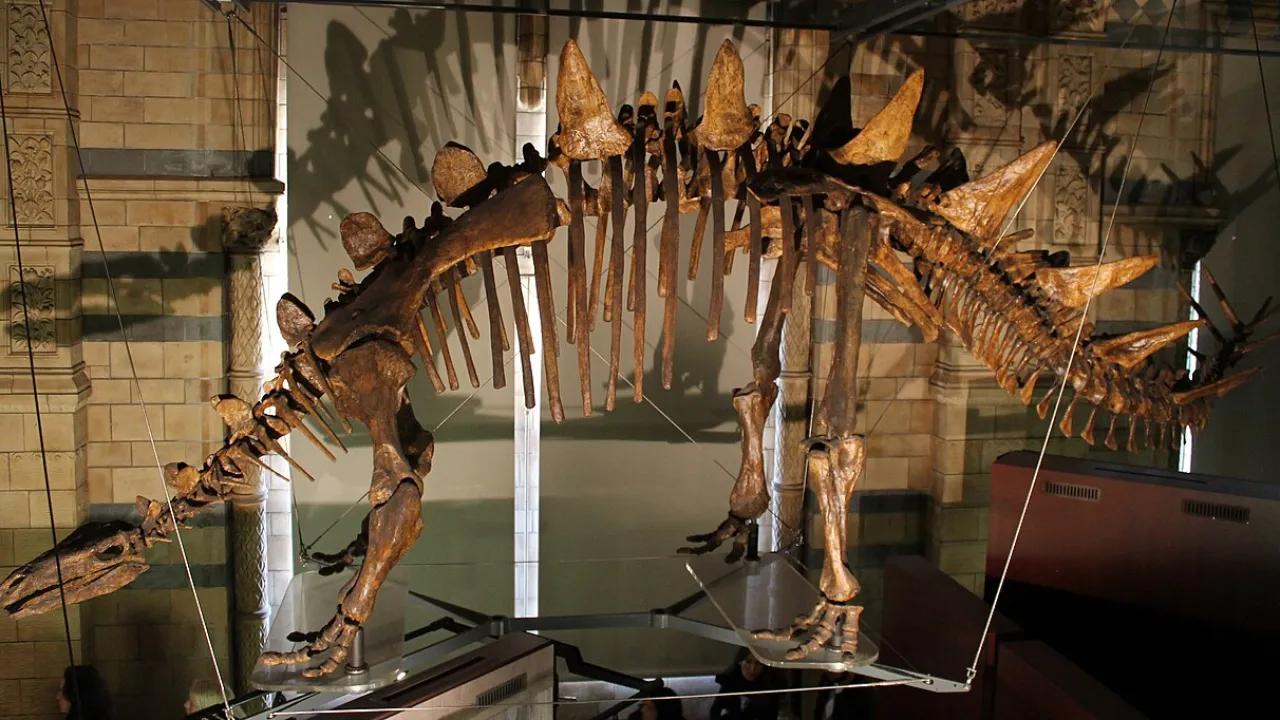
1. What shape were the plates running along the back of Tuojiangosaurus?
2. How many pairs of plates and spikes lined Tuojiangosaurus from neck to tail?
🤯 Mind-Blowing Fact • Grade 2
Tuojiangosaurus was the very first nearly complete stegosaur skeleton ever discovered in all of Asia!
✨ Word Sparks (Grade 2 Glossary)
Tap 🔊 to hear
dam
a strong wall built to hold river water
dagger
a short blade tapering to a sharp point
moss
soft, low green plants carpeting damp ground
🪝
How did workers building a dam by a river in China uncover Asia's most famous stegosaur?
1
Found Beside the Tuo River!
In 1974, workers building a water in Zigong, China, uncovered two amazing armored skeletons in red rock! Scientists named the twenty-three-foot plant-eater Tuojiangosaurus, meaning 'Tuo River lizard.'
2
Pointier Plates Than Stegosaurus
American Stegosaurus had wide, rounded plates, while Chinese Tuojiangosaurus wore thicker, -pointed triangles arranged in two matching rows! Its tallest plates stood high over its hips like twin shark fins.
3
Living With Long-Necked Neighbors
Tuojiangosaurus munched low and ferns beneath giant Mamenchisaurus while swinging its four-spiked tail to guard against fierce predator Yangchuanosaurus along warm Jurassic riverbanks!
2. How did Tuojiangosaurus's back plates look different from American Stegosaurus plates?
🤯 Mind-Blowing Fact • Grade 3
Because one of the two original Tuojiangosaurus skeletons preserved a complete, uncrushed skull, it helped scientists understand how Asian stegosaurs ate and saw their world!
✨ Word Sparks (Grade 3 Glossary)
Tap 🔊 to hear
bonebed
a rock layer packed with many fossil skeletons
multispinus
Latin species name meaning having many spines
beak
toothless front jaw tip for clipping stems
🪝
Why is Zigong, China, famous around the world for armored dinosaurs like Tuojiangosaurus?
1
Star of the Zigong Dinosaur Museum
Step inside China's world-famous Zigong Dinosaur Museum—built directly over a giant Late Jurassic —and you'll meet Tuojiangosaurus ! Described in 1977 by legendary paleontologist Dong Zhiming from Wujiaba Dam fossils, its species name means 'many-spined.'
2
An Intact Stegosaur Skull
Stegosaur skulls are thin and rarely survive fossilization, so finding a complete skull on Tuojiangosaurus was huge news! Low, long, and flat-topped, it held small overlapping triangle teeth behind a horny front .
3
Armor From Neck to Thagomizer
Small rounded plates began right behind its head, growing taller and sharper down the back until dagger-like hip plates towered overhead. At the tail tip, four heavy spikes jutted outward at forty-five-degree angles!
4
Guarding Against Yangchuanosaurus
Sharing lush river plains with thirty-foot predator Yangchuanosaurus meant Tuojiangosaurus needed both broad sideways shoulder spines and rapid tail swings to keep every herd member safe.
1. Why was finding a complete skull on Tuojiangosaurus such a big deal for scientists?
2. At what angle did the four heavy spikes on Tuojiangosaurus's tail tip stick out?
🤯 Mind-Blowing Fact • Grade 4
Casts of Tuojiangosaurus are so prized as ambassadors of Chinese paleontology that London's Natural History Museum displays its dramatic spiky skeleton in a place of honor!
✨ Word Sparks (Grade 4 Glossary)
Tap 🔊 to hear
symmetrical
matching evenly on both left and right sides
diversity
a rich variety of different related species
pelvis
the sturdy hip-bone ring supporting back legs
🪝
Why did Jurassic China burst with more kinds of stegosaurs than any other region on Earth?
1
Cradle of Stegosaur Diversity
Although North America's Stegosaurus gets most movie fame, Late Jurassic China was the true global capital of stegosaur evolution! Around 158 million years ago in Sichuan's lush Shaximiao river basins, Tuojiangosaurus multispinus reigned as the largest and best-understood Asian stegosaur—stretching seven meters (twenty-three feet) long and weighing nearly three metric tons.
2
Anatomy of Seventeen Paired Rows
Whereas Stegosaurus evolved thin, vascularized diamond plates staggered in alternating rows primarily for visual display, Tuojiangosaurus retained robust, thickened triangular osteoderms arranged in seventeen pairs. Thick bases and pointed tips over the made its plates far tougher against downward bites, complemented by broad parascapular shoulder spines and a four-spike tail thagomizer.
3
Selective Ground-Level Nibbler
Short pillar-like forelimbs held its elongated, flat-roofed skull close to the earth. Because Tuojiangosaurus lacked fleshy cheeks as bulky or grinding batteries as advanced as duck-bills, roughly twenty-five small, ridged leaf-shaped teeth on each jaw side snipped tender mosses, horsetails, and low cycad fronds along shady forest streams.
4
Standing Ground Against Apex Theropods
Faced with Yangchuanosaurus—a ten-meter Jurassic hunter armed with serrated teeth—adult Tuojiangosaurus relied on low-slung stability, side-guarding shoulder spikes, and devastating lateral tail lashes that made any careless ambush costly for a hungry carnivore.
1. How did the structure of Tuojiangosaurus's plates suggest a different balance of uses than Stegosaurus's wide, paper-thin plates?
2. Why did Tuojiangosaurus always browse within about three feet of the ground?
🤯 Mind-Blowing Fact • Grade 5
Zigong in Sichuan Province preserved BOTH primitive Middle Jurassic Huayangosaurus (which still had front snout teeth!) and Late Jurassic Tuojiangosaurus (which lost them for a sleeker beak), capturing millions of years of stegosaur evolution in one city!
✨ Word Sparks (Grade 5 Glossary)
Tap 🔊 to hear
Oxfordian
earliest stage of the Late Jurassic Period
acuminate
tapering upward into a slender sharp point
denticulate
lined with tiny bump-like tooth ridges
🪝
How did an Oxfordian dam excavation in Sichuan illuminate East Asia's isolated stegosaur radiation and challenge Western-centric views of dinosaur evolution?
1
Wujiaba Dam Discovery and Holotype Completeness
In 1974, blasts for the Wujiaba irrigation dam beside the Tuo River in Zigong, Sichuan Province, exposed two stegosaurian skeletons within purplish-red mudstones of the Upper Shaximiao Formation ( stage, ~160–157 MYA). Formally described in 1977 by Dong Zhiming, Li Xuanmin, Zhou Shiwu, and Zhang Yihong—just as Chinese vertebrate paleontology rebounded internationally—holotype CV 00205 preserved a nearly complete skull, vertebral column, limb girdles, and dermal armor, establishing Tuojiangosaurus multispinus as Asia's Rosetta Stone for Stegosauria.
2
Cranial Osteology and Basal-to-Derived Mosaic
Unlike the deeper snout of Stegosaurus stenops, the skull of Tuojiangosaurus is low, narrow, and dorsoventrally depressed, retaining small antorbital fenestrae and lacking a prominent premaxillary tooth row—demonstrating a transitional evolutionary mosaic between Middle Jurassic basal stegosaur Huayangosaurus (also from Zigong!) and later Kimmeridgian–Tithonian stegosaurids. Roughly 25 to 27 small, , overlapping teeth lined each maxilla and dentary behind a selective keratinous predentary rhamphotheca.
3
Seventeen Pairs of Conical-Triangular Osteoderms
Measuring ~7 meters long and weighing ~2.8 metric tons, Tuojiangosaurus carried 17 paired rows of dermal osteoderms: small rounded cervical scutes graded smoothly into thickened, laterally compressed, sharply triangular plates peaking in height above the sacro-iliac arcade, terminating in two pairs of robust, 45-degree caudolateral thagomizer spikes plus broad parascapular shoulder spines.
4
Vertical Niche Partitioning in the Shaximiao Biota
With a humerus-to-femur ratio holding its shoulders low (~0.65 meters jaw height), Tuojiangosaurus occupied the lowest herbivorous tier—cropping lycopods, horsetails, and Dicksoniaceae ferns beneath mid-browsing ornithopods and 15-meter-necked mamenchisaurids.
5
Global Phylogenetics of Asian Stegosauria
Cladistic revisions by Susannah Maidment and colleagues underscore how Sichuan's Middle-to-Late Jurassic basins preserved the richest stegosaurian lineage diversity on Earth, proving East Asia served as a powerhouse center of armored dinosaur innovation.