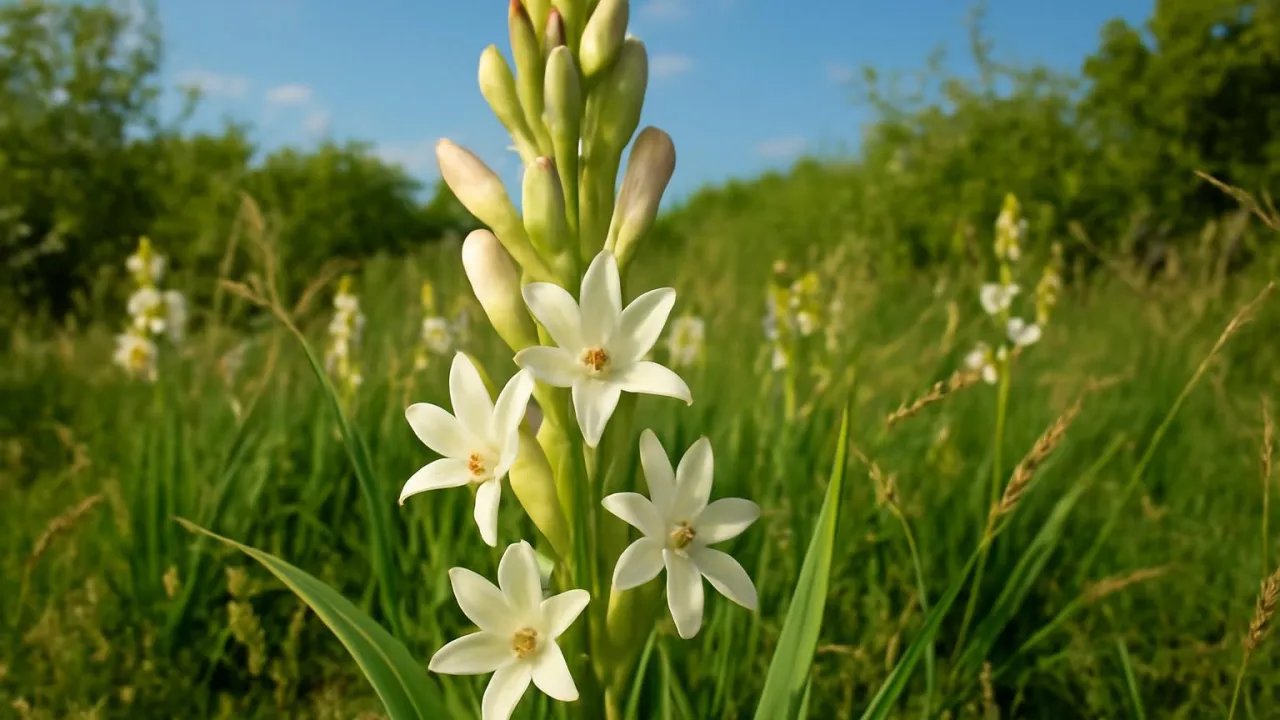
Tuberose flowers bloom only at night to attract moths with their strong scent.
✨ Word Sparks (Grade 2 Glossary)
Tap 🔊 to hear
nectar
Sweet juice flowers make for insects
pollen
Powder flowers use to make seeds
climate
The usual weather in a place
🪝
Have you ever smelled a flower that only blooms at night?
1
Nighttime Sweet Smell
Tuberose flowers bloom at night and give off a very sweet smell. Many insects come to the flower to drink . This helps the flower spread and make seeds.
2
Where It Grows
Tuberose grows best in warm with full sun and moderate water. It is native to Mexico but is grown in many gardens around the world. Gardeners love this flower for its beauty and scent.
3
Flower Shape and Size
The tuberose has long, thin white flowers that grow on tall stems. The flowers look like small stars and can grow up to three feet tall. Bees and moths are attracted to the flower’s sweet scent.
Tuberose’s night scent is a clever adaptation that helps it attract moth pollinators safely.
✨ Word Sparks (Grade 3 Glossary)
Tap 🔊 to hear
pollination
When pollen moves to make seeds
adaptation
A change that helps plants survive
tuber
A thick root that stores food
🪝
How does tuberose’s night scent help it survive in nature?
1
Night Blooming and Pollination
Tuberose flowers open at night to release a strong, sweet scent that attracts moths. This night blooming is an to avoid daytime predators and heat. Moths act as pollinators by carrying pollen from flower to flower. This process helps tuberose reproduce and spread its seeds.
2
Physical Features and Growth
The tuberose plant grows tall stems with clusters of white, star-shaped flowers. Its long petals and bright color help it stand out in the dark. The plant’s tuberous roots store nutrients and water, helping it survive dry periods. These make tuberose strong in warm climates.
3
Habitat and Ecosystem Role
Native to Mexico, tuberose thrives in warm, sunny places with well-drained soil. It plays a role in local ecosystems by providing nectar for night-flying moths. This flower also supports gardeners and farmers who use it for perfumes and decorations. Its scent helps maintain a healthy balance in its environment.
4
Interesting Botanical Facts
Though often called a flower, tuberose is also a botanical fruit because it produces seeds after . Its sweet scent is made from natural oils that humans use in perfumes. The plant’s name comes from its thick, -like roots called tubers. These roots help the plant survive tough conditions.
Tuberose’s night-only blooming is a perfect adaptation to attract moth pollinators and avoid daytime dangers.
✨ Word Sparks (Grade 4 Glossary)
Tap 🔊 to hear
symbiosis
When two living things help each other
nocturnal
Active during the night
pollinator
An animal that moves pollen between flowers
🪝
What causes tuberose to bloom only at night, and why is this important?
1
Night Blooming and Survival
Tuberose flowers bloom exclusively at night as a cause-and-effect adaptation to avoid daytime heat and predators. This night blooming allows the flower to release its strong scent when night-flying moths are active. Because moths are its main , this timing increases the chances of successful pollination and reproduction.
2
Ecosystem Role and Human Uses
In its native habitat of Mexico and warm regions worldwide, tuberose supports local ecosystems by providing nectar to moths. Humans cultivate tuberose for its fragrant flowers used in perfumes and decorations, showing a symbiotic relationship between people and plants. The flower’s scent also influences agricultural practices by attracting beneficial insects.
3
Geographic Distribution and Growth
Tuberose originally grew in Mexico but has spread to tropical and subtropical regions globally due to its popularity. It thrives in well-drained soils with full sun and moderate watering. The plant grows between two and three feet tall, with clusters of white flowers that bloom in late summer or early fall, depending on climate conditions.
4
Physical Adaptations and Botanical Traits
Tuberose’s tuberous roots store water and nutrients, enabling survival during dry spells. Its white, star-shaped flowers have long petals that reflect moonlight, making them visible at night. Botanically, tuberose produces seeds after pollination, classifying it as a flowering plant with fruiting capabilities. These adaptations help tuberose thrive in diverse environments.
Tuberose’s scent molecules can travel several meters, helping it attract moth pollinators from far away.
✨ Word Sparks (Grade 5 Glossary)
Tap 🔊 to hear
circadian rhythms
Natural daily cycles that control living things
volatile organic compounds
Molecules that make strong smells
genetic diversity
Variety of genes in plants or animals
🪝
How does the tuberose’s unique physiology support its survival and human uses worldwide?
1
Taxonomy and Botanical Classification
Tuberose, scientifically known as Polianthes tuberosa, belongs to the Agavaceae family, which includes plants with succulent leaves and tuberous roots. Unlike many flowers, tuberose produces seeds after pollination, classifying it as both an ornamental flower and a fruiting plant. Its botanical classification helps scientists understand its evolutionary adaptations and relationships.
2
Physiological Mechanics of Blooming and Scent
Tuberose’s night blooming is regulated by that control flower opening and scent release. The plant produces that create its intense fragrance, attracting nocturnal moth pollinators. Its white petals reflect moonlight, enhancing visibility in darkness, while tuberous roots store water and nutrients to sustain the plant during dry periods.
3
Conservation and Botanical History
Originally native to Mexico, tuberose has been cultivated worldwide for centuries due to its fragrant flowers and ornamental value. While not currently endangered, habitat loss and climate change could impact wild populations. Conservation efforts focus on preserving and promoting sustainable cultivation practices to maintain its ecological and economic importance.
4
Quantitative Comparisons and Growth Metrics
Tuberose plants typically reach heights of 2 to 3 feet (60 to 90 centimeters) and produce flower spikes with up to 20 individual blossoms. The scent molecules emitted can travel several meters, attracting pollinators from afar. Optimal growth occurs at temperatures between 70 and 85 degrees Fahrenheit (21 to 29 degrees Celsius) with moderate watering schedules.
5
Economic and Cultural Importance
Tuberose is widely used in the perfume industry due to its rich, sweet fragrance, often blended with other floral scents. It also holds cultural significance in ceremonies and decorations in various countries. The flower’s ability to bloom at night and produce a strong scent makes it a valuable plant both ecologically and economically worldwide.