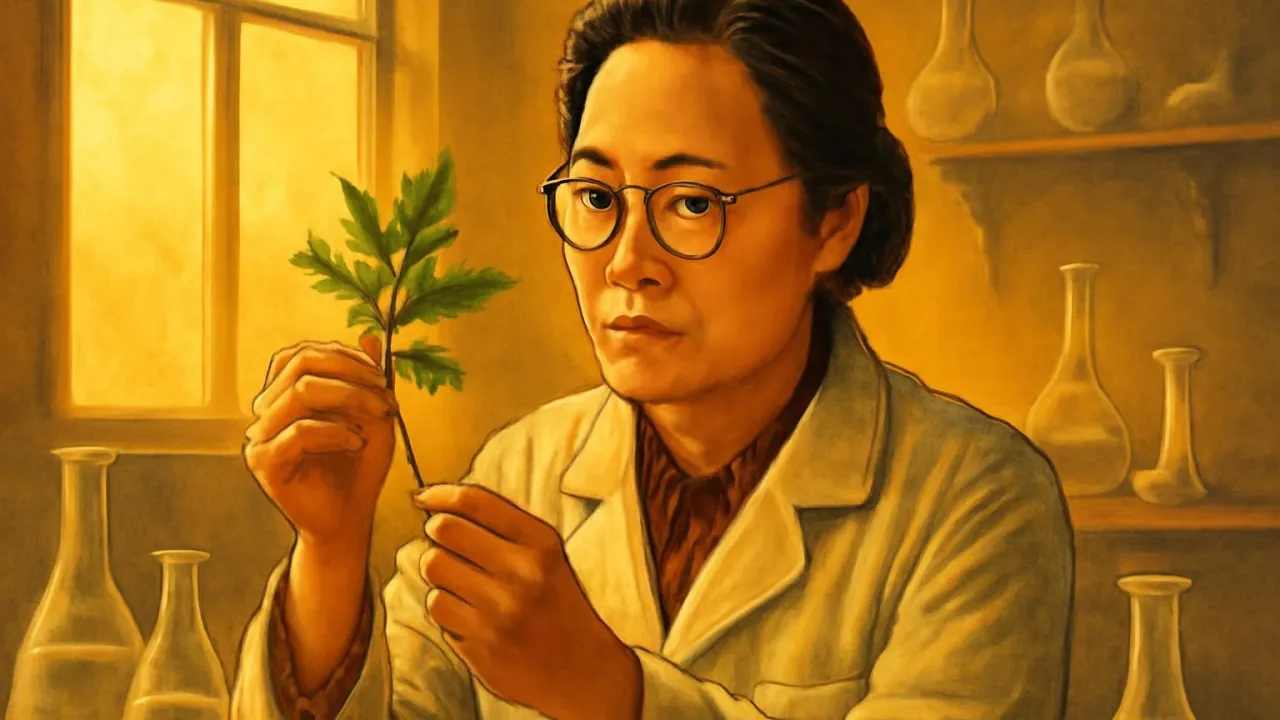
Tu Youyou is the first Chinese woman to win a Nobel Prize in science!
✨ Word Sparks (Grade 2 Glossary)
Tap 🔊 to hear
laboratory
A place where scientists do experiments
cure
Something that makes a sickness go away
discovery
Finding something new and important
🪝
Have you ever wondered if nature hides powerful secrets?
1
Nature’s Helper
Tu Youyou loved exploring gardens and reading plant books. She wondered if plants could help sick people. Her curiosity grew as she learned more in school.
2
Hard Work Pays Off
Tu studied medicine and worked in a . She tested many plants to find a for malaria. She never gave up, even when it was difficult.
3
A Life-Saving Discovery
Tu found that the qinghao plant could help. She made a new medicine called artemisinin. This medicine saved many lives around the world.
Tu tested her medicine on herself before giving it to others!
✨ Word Sparks (Grade 3 Glossary)
Tap 🔊 to hear
perseverance
Never giving up, even when it’s hard
recipe
A set of steps to make something
Nobel Prize
A special award for big discoveries
🪝
Could an old plant recipe change the world?
1
A Young Explorer
As a child, Tu Youyou was fascinated by nature and traditional Chinese medicine. She often read about healing plants and dreamed of helping people. Her curiosity led her to study science at university. She believed that nature held many mysteries.
2
A Dangerous Problem
In China, many people were getting sick from malaria, a disease spread by mosquitoes. Scientists searched for a cure, but nothing worked well. Tu joined a secret team to help solve this problem. She wanted to use her knowledge of plants to help.
3
Testing and Trying
Tu and her team tested hundreds of plant from old books. She showed by working day and night in the laboratory. After many failures, she discovered that the qinghao plant could fight malaria. She carefully made a medicine called artemisinin.
4
Changing the World
Tu’s discovery saved millions of lives and changed how malaria is treated. Her work showed the power of combining ancient wisdom with science. She became the first Chinese woman to win the in science. Tu inspired many future scientists around the world.
Tu Youyou’s discovery helped reduce malaria deaths by more than half worldwide!
✨ Word Sparks (Grade 4 Glossary)
Tap 🔊 to hear
extract
To pull out something important
pharmacology
The science of how medicines work
legacy
What someone leaves behind for others
🪝
How did Tu Youyou’s search through ancient texts lead to a global medical breakthrough?
1
Inspired by Ancient Wisdom
Growing up in China during the 1930s and 1940s, Tu Youyou became fascinated by traditional remedies and the healing power of plants. She studied at university, determined to bridge the gap between ancient knowledge and modern science. When malaria threatened millions, Tu was chosen to join a secret research project called Project 523. Her deep respect for both history and science set her apart from other researchers.
2
A Race Against Malaria
Malaria, a deadly disease carried by mosquitoes, was causing suffering across Asia and Africa. Existing medicines were failing, and scientists were desperate for a new solution. Tu searched through centuries-old Chinese medical texts for clues. She found a recipe using the qinghao plant, which had been used to treat fevers long ago.
3
Turning Plants into Medicine
Tu’s team experimented with hundreds of plant , showing incredible perseverance and creativity. She discovered that extracting qinghao at a low temperature preserved its healing power. After carefully testing her new medicine, artemisinin, Tu bravely volunteered to try it herself before giving it to patients. This bold step proved the medicine’s safety and effectiveness.
4
A Lasting Legacy
Artemisinin became the world’s most effective treatment for malaria, saving millions of lives every year. In 2015, Tu Youyou received the Nobel Prize in Physiology or Medicine, becoming the first Chinese woman to earn this honor. Her work inspired scientists everywhere to explore the wisdom hidden in nature and history. Tu’s story reminds us that curiosity and determination can change the world.
Tu Youyou’s research has saved over 3 million lives and continues to protect millions more each year.
✨ Word Sparks (Grade 5 Glossary)
Tap 🔊 to hear
clinical trial
A test to check if medicine is safe
parasite
A tiny creature that lives off others
innovation
A new idea that changes things
🪝
What happens when a determined scientist turns to ancient wisdom to solve a modern crisis?
1
A Childhood Spark for Science
Long before she became a Nobel laureate, Tu Youyou was a curious child in Ningbo, China, collecting leaves and reading about traditional remedies. Her fascination with the natural world and her persistent questions about how plants could heal people led her to study pharmacology at Beijing Medical College. In the aftermath of war and disease in mid-20th-century China, Tu’s early experiences shaped her resolve to help those suffering from illness. She believed that the answers to modern medical problems could sometimes be found in the wisdom of the past. This belief would guide her most important work.
2
Project 523: The Urgent Search for a Cure
By the late 1960s, malaria was a deadly threat across Asia, Africa, and beyond, killing hundreds of thousands each year. Existing drugs were losing their effectiveness, and scientists worldwide were racing to find a new solution. Tu was selected to join Project 523, a secret Chinese government initiative to discover a new anti-malarial medicine. Drawing on her expertise in both Western science and traditional Chinese medicine, Tu led a team that meticulously reviewed over 2,000 ancient medical texts and tested more than 200 herbal recipes. Her methodical, cross-disciplinary approach set her apart in the scientific community.
3
Discovery and Innovation: Artemisinin’s Journey
After countless failed experiments, Tu found a centuries-old recipe describing how to extract healing compounds from the qinghao plant (Artemisia annua). She realized that using low-temperature extraction preserved the plant’s active ingredient, which could fight malaria in the blood. Tu’s team isolated the compound artemisinin, which proved highly effective in laboratory tests and . Demonstrating extraordinary courage and scientific rigor, Tu volunteered to take the medicine herself before administering it to patients, ensuring its safety for others.
4
Global Impact and Recognition
Artemisinin quickly became the world’s frontline defense against malaria, dramatically reducing death rates in countries across Africa, Asia, and South America. The World Health Organization adopted artemisinin-based therapies as the global standard, and Tu’s discovery is credited with saving millions of lives. In 2015, Tu Youyou was awarded the Nobel Prize in Physiology or Medicine, making history as the first Chinese woman to receive this honor. Her achievement highlighted the value of integrating traditional knowledge with modern science for global health.
5
Legacy: Inspiring Future Generations
Tu Youyou’s story is a testament to perseverance, creativity, and the power of curiosity. Her willingness to bridge ancient and modern knowledge changed the course of medical history and inspired scientists worldwide to look beyond conventional boundaries. Today, Tu continues to advocate for scientific exploration and the careful study of nature’s secrets. Her legacy encourages young learners to ask questions, seek answers in unexpected places, and believe that their discoveries could one day help the world.