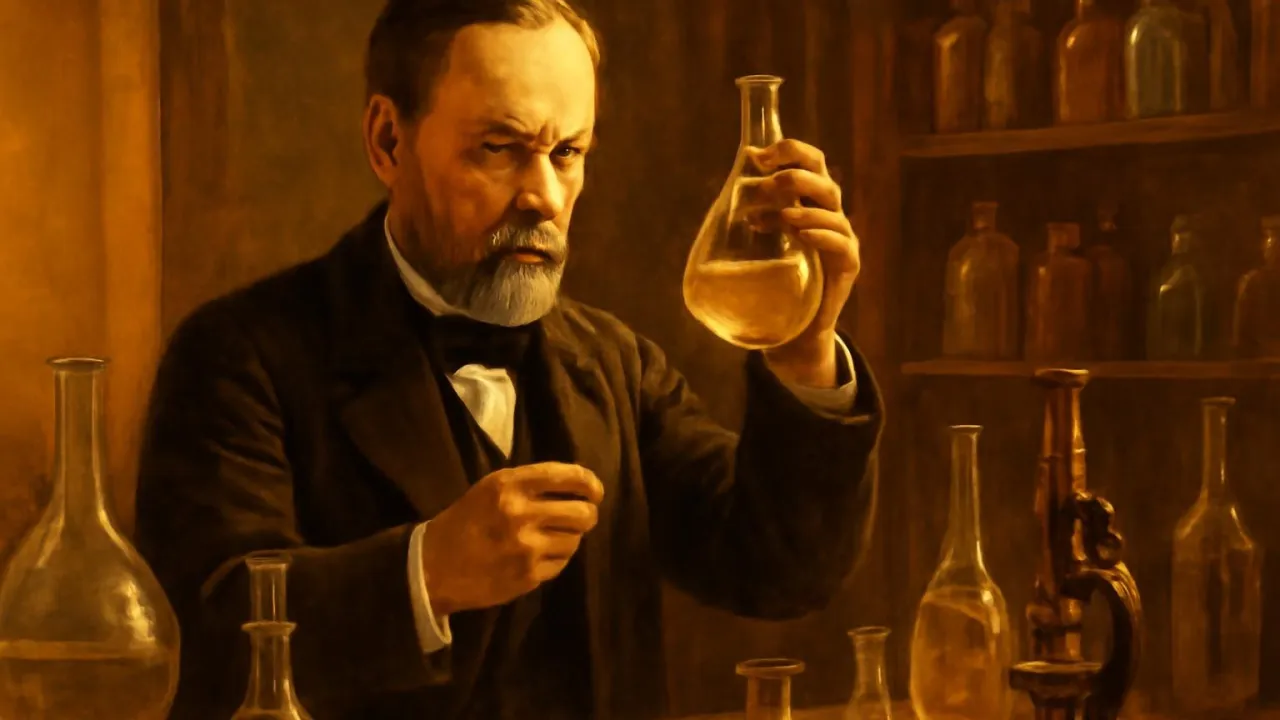
Pasteurization is named after Louis Pasteur because he invented it!
✨ Word Sparks (Grade 2 Glossary)
Tap 🔊 to hear
pasteurization
Heating milk to kill bad germs
microscope
A tool to see tiny things
rabies
A sickness from animal bites
🪝
Have you ever wondered why milk is safe to drink?
1
Louis’s Big Questions
As a young boy, Louis loved science and drawing. He wanted to know why people got sick. He looked at drops of water with a glass tube and saw tiny moving things.
2
Discovering Germs
Louis learned that germs made people and animals sick. He worked hard in his lab to find ways to stop germs. He made milk safe by heating it up, a process called .
3
A Life of Helping
Louis also made a vaccine to stop . Many people and animals were saved by his work. His discoveries changed medicine forever.
Louis Pasteur’s rabies vaccine saved a young boy’s life in 1885!
✨ Word Sparks (Grade 3 Glossary)
Tap 🔊 to hear
experiment
A test to learn something new
germ theory
The idea that germs cause sickness
vaccine
A medicine that stops diseases
🪝
Can one person’s curiosity change how the whole world stays healthy?
1
A Boy with Big Questions
Young Louis Pasteur always wondered about the invisible world. He loved to draw and watch things closely. When he saw people getting sick, he wanted to know why. His curiosity led him to study science and use a microscope.
2
The Germ Theory Breakthrough
Louis discovered that tiny living things called germs caused sickness. Many people did not believe him at first, but he kept experimenting. He proved that heating liquids like milk could kill germs. This process, called pasteurization, keeps our food safe today.
3
Fighting Deadly Diseases
Louis did not stop with milk. He worked hard to create for deadly diseases like rabies. He tested his ideas on animals and then helped save a boy who was bitten by a sick dog. His vaccine stopped the disease and brought hope to many families.
4
A Lasting Legacy
Pasteur’s discoveries changed medicine and saved countless lives. Hospitals and doctors began using cleaner tools and methods. Today, scientists still use his ideas to protect people from germs. Louis Pasteur’s curiosity made the world a healthier place.
Pasteur’s discoveries inspired doctors to wash their hands and clean their tools.
✨ Word Sparks (Grade 4 Glossary)
Tap 🔊 to hear
hygiene
Keeping things clean to stay healthy
microbiology
The study of tiny living things
public health
Keeping everyone in a community healthy
🪝
Imagine discovering that something too tiny to see could save millions of lives—how would you prove it?
1
Curiosity in a Changing World
Growing up in 19th-century France, Louis Pasteur was fascinated by science and nature. At a time when most people believed sickness came from bad air, Louis wondered if something smaller was responsible. He used a microscope to explore drops of water and noticed countless tiny living creatures moving about. His curiosity pushed him to study chemistry and biology at university, where he searched for answers that could help people.
2
Proving the Power of Germs
Pasteur’s experiments showed that germs, not invisible vapors, caused many diseases. He designed careful tests to prove that heating liquids like milk and wine killed harmful germs without ruining the taste. This process, called pasteurization, became a major breakthrough for food safety and . Although some scientists doubted him, Louis’s evidence changed minds around the world.
3
Battling Rabies and Saving Lives
Pasteur did not stop with food safety; he wanted to fight deadly diseases. He developed the first vaccine for rabies, a terrifying illness spread by animal bites. In 1885, he bravely treated a young boy who had been bitten by a rabid dog. The new vaccine worked, saving the boy’s life and proving that science could defeat even the scariest diseases.
4
A Legacy of Health and Hope
Louis Pasteur’s discoveries led hospitals and doctors to use cleaner tools and better . His work inspired new vaccines and methods to protect people from germs. Today, his name is honored in science, and his ideas still keep our milk, juice, and communities safe. Pasteur’s curiosity and hard work truly changed the world for the better.
1. What did most people believe caused sickness before Pasteur?
2. How did Pasteur prove his ideas about germs?
🤯 Mind-Blowing Fact • Grade 5
Pasteur’s discoveries reduced deaths from surgery and disease all over the world.
✨ Word Sparks (Grade 5 Glossary)
Tap 🔊 to hear
sterilization
Making things very clean to kill germs
immunology
The science of how bodies fight disease
spontaneous generation
Old idea that life appears from nothing
🪝
What if you could see a world so small, it changed how everyone thought about health forever?
1
A Young Scientist’s Curiosity
In the small town of Dole, France, young Louis Pasteur was endlessly curious about the world around him. He spent hours drawing and observing tiny details in nature, which later sparked his interest in science. At a time when most people believed illness came from mysterious 'bad air,' Louis wondered if something invisible could be the true cause. His fascination led him to study chemistry and use the microscope, a tool that opened a new universe of discovery.
2
Revolutionizing Science with the Germ Theory
Pasteur’s groundbreaking experiments revealed that microorganisms, or germs, were responsible for causing many diseases. He disproved the popular idea of '' by showing that life did not just appear in spoiled food or liquids. Through careful scientific methods, he proved that heating milk, wine, and other liquids to a specific temperature could kill dangerous bacteria without changing the flavor. This process, called pasteurization, remains a cornerstone of food safety worldwide.
3
Creating Vaccines and Fighting Rabies
Driven by compassion, Pasteur turned his attention to preventing deadly diseases. He developed the first laboratory-made vaccine for rabies, a terrifying illness spread through animal bites. In 1885, he famously saved a young boy named Joseph Meister by giving him the new vaccine after a dog attack. Pasteur’s success with rabies led to further research on vaccines, laying the foundation for modern and saving countless lives.
4
Transforming Medicine and Public Health
Pasteur’s discoveries changed the way doctors, nurses, and scientists approached medicine. His germ theory encouraged hospitals to adopt strict hygiene practices, such as sterilizing instruments and washing hands, to prevent infections. These changes drastically reduced deaths from surgery and childbirth. Governments and communities around the globe began using pasteurization and vaccination to protect public health, making Pasteur’s work essential to modern medicine.
5
A Legacy That Inspires Generations
Louis Pasteur’s relentless curiosity, rigorous experiments, and desire to help humanity left a lasting impact on science and society. His pioneering work in microbiology, vaccination, and food safety continues to save lives every day. Pasteur’s story reminds us that asking big questions and searching for answers can change the world in remarkable ways. Today, his name is honored in research institutes, hospitals, and classrooms across the globe.