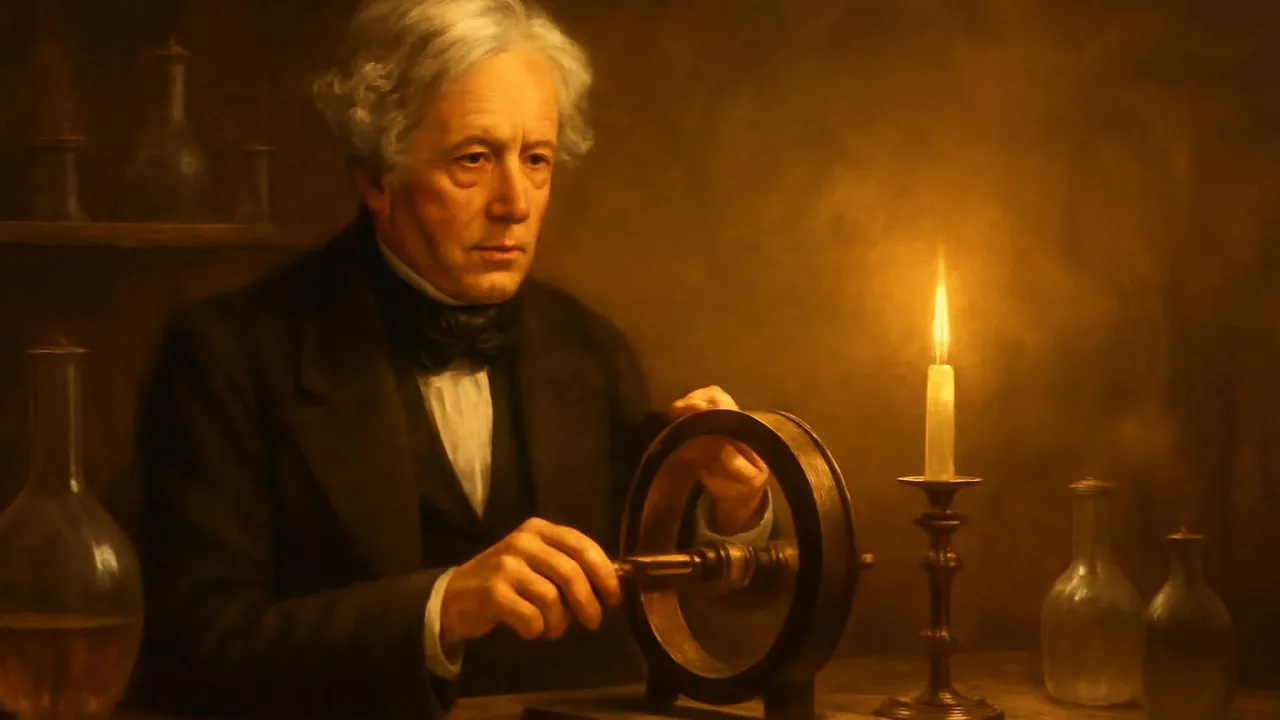
Michael Faraday taught himself science by reading and doing experiments at home.
✨ Word Sparks (Grade 2 Glossary)
Tap 🔊 to hear
experiment
A test to see what happens.
electricity
Energy that makes lights and machines work.
discovery
Finding something new or important.
🪝
Can a simple magnet make electricity move?
1
Curious Beginnings
Michael worked in a bookshop and read science books every day. He wanted to learn how everything worked, so he asked many questions. His favorite book was about and magnets.
2
Hands-On Science
Michael did with wires and magnets in his free time. He watched how wires moved when magnets were near them. He kept trying until he saw something new happen.
3
A Big Discovery
One day, Michael made a wire spin around a magnet. This was the first electric motor, and it changed how people used power. His helped bring to the world.
Faraday’s experiments led to the invention of electric motors and generators.
✨ Word Sparks (Grade 3 Glossary)
Tap 🔊 to hear
electromagnetism
How electricity and magnets work together.
generator
A machine that makes electricity.
laboratory
A place where scientists do experiments.
🪝
What would you discover if you mixed curiosity with science?
1
A Bookbinder’s Curiosity
Young Michael Faraday spent his days binding books and reading about science. He was fascinated by electricity and magnets, and he dreamed of being a scientist. Even though his family was poor, he never stopped asking questions.
2
Experiments at Home
Michael saved scraps from work to build simple experiments in his room. He used wires, magnets, and batteries to test his ideas. He noticed that moving a magnet near a wire made the wire move. This was his first step toward discovering .
3
A Chance in the Laboratory
Michael wrote careful notes and sent them to a famous scientist, Humphry Davy. Davy invited Michael to work in his , where Michael learned even more about chemistry and physics. There, Michael invented the first electric motor by making a wire spin around a magnet.
4
Changing the World
Faraday’s work helped people understand how to use electricity for light and machines. His discoveries led to the invention of electric and motors. Michael Faraday showed that curiosity and hard work can change the world. Today, we use his ideas every time we turn on a light.
Faraday’s law of electromagnetic induction is the reason we have electric power plants today.
✨ Word Sparks (Grade 4 Glossary)
Tap 🔊 to hear
apprentice
A person learning a skill from a teacher.
induction
Making electricity by moving a magnet.
perseverance
Not giving up, even when it’s hard.
🪝
Imagine discovering that moving a magnet could light up the world—how would you feel?
1
From Bookbinding to Science
As a young in a London bookshop, Michael Faraday devoured every science book he could find, sparking his lifelong curiosity. Despite having little formal education, he taught himself by reading and experimenting with simple materials. His fascination with electricity and magnetism grew as he watched famous scientists give lectures and demonstrations. Faraday’s determination to learn opened doors that would change his life and the world.
2
Experimenting with Electromagnetism
Faraday’s early experiments involved wrapping wire around magnets and observing their effects. He noticed that moving a magnet near a wire could make electricity flow, a breakthrough known as electromagnetic . This discovery led him to invent the first electric motor, which transformed electrical energy into movement. Faraday’s careful experiments and notes helped other scientists understand the connection between electricity and magnetism.
3
Turning Points in the Laboratory
After impressing the famous chemist Humphry Davy with his detailed notes, Faraday became his assistant at the Royal Institution. There, he worked on groundbreaking research in both chemistry and physics, including discovering benzene and improving glass for telescopes. His most important achievement was showing how to generate electricity using magnets, laying the foundation for modern power plants.
4
A Legacy That Lights Our Lives
Michael Faraday’s discoveries changed how people everywhere use energy, powering homes and cities with electricity. His inventions made possible everything from electric lights to trains and computers. Faraday’s story proves that curiosity, , and hands-on learning can lead to discoveries that benefit the entire world. Today, his name lives on in science classrooms and power stations across the globe.
1. What did Faraday discover happens when you move a magnet near a wire?
2. Why is Faraday’s work important today?
🤯 Mind-Blowing Fact • Grade 5
Faraday’s experiments with electromagnetic induction directly led to the invention of the electric generator, powering the modern world.
✨ Word Sparks (Grade 5 Glossary)
Tap 🔊 to hear
apparatus
A set of tools for doing experiments.
transformer
A machine that changes electricity’s strength.
capacitance
How much electric charge something can hold.
🪝
How could a self-taught bookbinder revolutionize the way the world uses energy?
1
A Humble Beginning Fueled by Curiosity
Picture a young apprentice in early 1800s London, surrounded by stacks of books and the scent of leather bindings. Michael Faraday, born into a poor family, found his passion for science while working as a bookbinder’s assistant. He read every scientific text he could find, carefully copying notes and diagrams to deepen his understanding. Despite lacking formal schooling, Faraday’s relentless curiosity and determination set him on a path to discovery. His early experiments with simple batteries, wires, and magnets were the seeds of scientific greatness.
2
From Observations to Experiments: The Birth of Electromagnetism
Faraday’s fascination with electricity and magnetism led him to attend public lectures by the renowned scientist Humphry Davy. Inspired, Faraday built his own at home, wrapping wires around magnets and observing how electric currents behaved. In 1821, he created the first electric motor by making a wire rotate around a magnet, demonstrating that electricity could produce continuous motion. This breakthrough marked the beginning of the field of electromagnetism, which explores the relationship between electric currents and magnetic fields. Faraday’s detailed experiments and notebooks became invaluable resources for scientists around the world.
3
Electromagnetic Induction: Lighting Up the World
Faraday’s most significant discovery came in 1831, when he demonstrated electromagnetic induction—the process of generating electricity by moving a magnet through a coil of wire. This principle is the foundation of modern electric generators and , which power everything from city lights to smartphones. Faraday’s law of induction mathematically describes how a changing magnetic field can create an electric current. His experiments proved that electricity could be produced on a large scale, forever changing industry, transportation, and daily life.
4
A Legacy of Scientific Integrity and Inspiration
Faraday’s contributions extended beyond physics to chemistry, where he discovered benzene and improved the process of electroplating. He was known for his clear, exciting science lectures, especially his famous Christmas Lectures for young people at the Royal Institution. Faraday refused to patent his inventions, believing that scientific knowledge should benefit everyone. His humility, perseverance, and commitment to public education made him a role model for generations of scientists.
5
Enduring Impact: The Faraday Effect and Beyond
Today, Michael Faraday’s name is honored in scientific units, such as the ‘farad’ for electrical , and in the Faraday Effect, which describes how light changes in a magnetic field. His discoveries underpin the entire electrical age, powering homes, hospitals, and technology worldwide. Faraday’s story demonstrates that passion, hard work, and a questioning mind can overcome any obstacle. Every time you flip a light switch or charge a device, you are experiencing the legacy of Michael Faraday’s brilliant mind.