🦴 PREHISTORIC
🦴 Troodon formosus • Troodontidae
VA Science SOL 2.5, 3.4, 3.5, 5.8 (Fossils, Adaptations & Earth History)
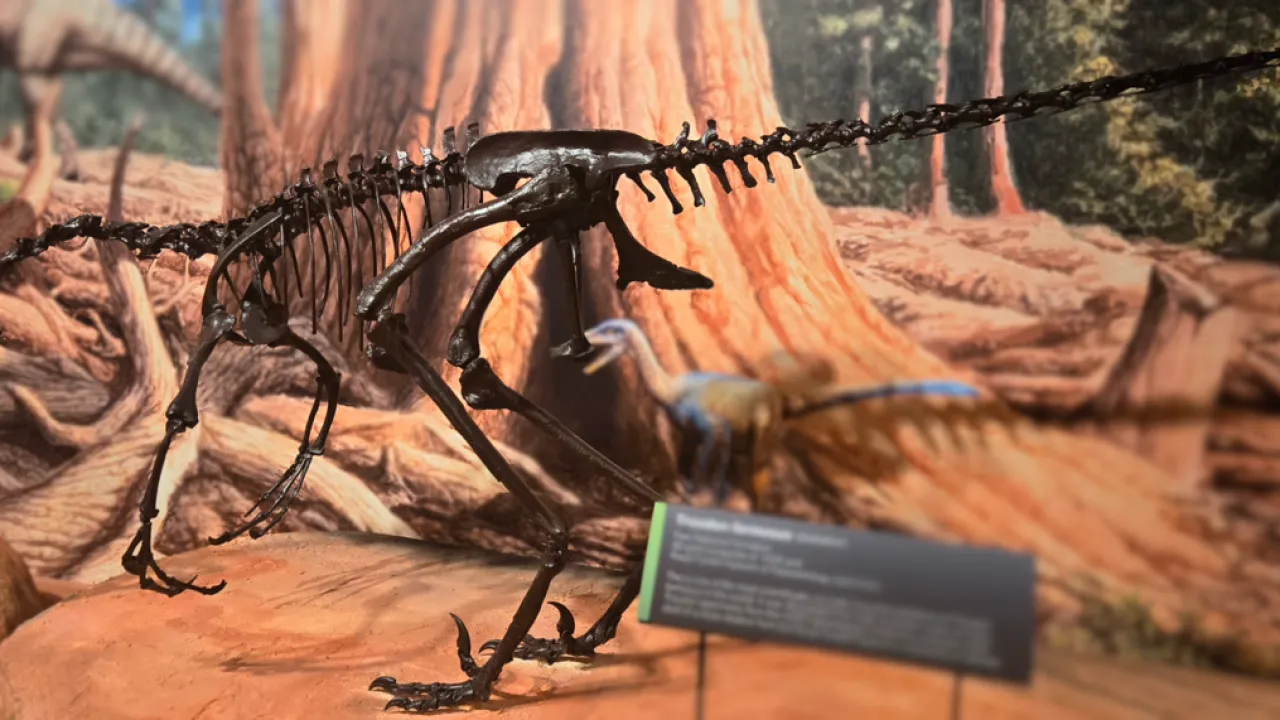
Troodon
The Owl-Eared, Big-Brained Night Hunter of the North
Grade 1 • Early Reader • 67 words
🌋 Geologic Period & RegionLate Cretaceous (77–66 MYA) • Montana, Alberta & Alaska
📏 Size & Weight6.5–8 ft (2–2.4 m) long • 80–110 lbs (35–50 kg)
🦴 Diet & FossilsOmnivore / Carnivore • Judith River & Two Medicine Formations
⚡ Survival SuperpowerLargest brain-to-body ratio among dinosaurs, forward-facing night eyes, and owl-like asymmetrical ears
🤯 Mind-Blowing Fact • Grade 1
Troodon was the very first dinosaur ever named in North America—all from one single bumpy tooth found in Montana in 1855!
✨ Word Sparks (Grade 1 Glossary)
Tap 🔊 to hear
plumage
a coat of warm bird-like feathers
pinpoint
to find the exact spot right away
twilight
dim evening light right after sunset
🪝
Which feathered dinosaur had huge night-vision eyes and one of the biggest dinosaur brains?
1
Smart Feathered Hunter
Rustle, tiptoe, pounce! Under bright moonlight steps a quick, feathery dinosaur. Troodon had one of the biggest brains for its body size of any dinosaur!
2
Owl Eyes and Ears
Big forward-facing eyes spotted tiny animals in dim light. Even cooler, one ear sat higher than the other—just like an owl's—to quiet squeaks!
3
Caring Nest Dad
Warm feathers helped parents sit gently on tidy rings of upright eggs to keep them cozy.
1. Why was having one ear higher than the other helpful for Troodon?
2. What part of Troodon was discovered first in Montana back in 1855?
🤯 Mind-Blowing Fact • Grade 2
Bone tests on a fossilized troodontid parent sitting on a nest in Montana revealed no female egg-laying calcium layer—meaning Dad was brooding the clutch!
✨ Word Sparks (Grade 2 Glossary)
Tap 🔊 to hear
brood
to sit warmly over eggs until hatching
sickle
a curved hook-shaped claw held up
depth
judging exactly how far away things are
🪝
How could one little tooth keep paleontologists guessing for more than a hundred years?
1
Mystery of the Bumpy Tooth
Hold a magnifying glass up to a tiny fossil tooth from Montana! Its edges carry extra-large, hook-like bumps unlike typical meat-eaters. When Joseph Leidy named Troodon formosus in 1856, people thought it was a lizard—and later confused its teeth with dome-headed plant-eaters until full jaws solved the puzzle!
2
Built Like a Ground Hawk
Troodontids stood about waist-high to a grown-up, wrapped in warm feathers with nimble grasping hands and a raised claw on each second toe. Forward-pointing eyes gave them 3D perception for snatching lizards, mammals, insects, and even seeds or fruit!
3
Super Dads on the Nest
Fossilized adults preserved right on top of egg clutches had bone chemistry matching males—showing dinosaur dads brooded the eggs just like modern ostriches and emus!
1. Who likely sat on troodontid egg nests to keep them warm?
2. How did forward-facing eyes help Troodon hunt?
🤯 Mind-Blowing Fact • Grade 3
Alaskan troodontids grew roughly twice as large as their Montana cousins because their giant night-vision eyes let them outcompete other hunters during dark Arctic winters!
✨ Word Sparks (Grade 3 Glossary)
Tap 🔊 to hear
cerebrum
thinking and sensing part of brains
binocular
using both eyes together for depth
clutch
a full group of eggs laid together
🪝
Why did Troodon grow nearly twice as big in snowy ancient Alaska as it did in sunny Montana?
1
Thriving in Polar Darkness
Picture winter twilight settling over northern Alaska seventy million years ago! While sun-loving reptiles vanished from the freezing north, big-eyed troodontids flourished! Fossil teeth from Alaska's Prince Creek Formation are nearly double the size of southern Troodon teeth—because huge night-adapted eyes let them rule months of polar winter darkness while bigger tyrannosaurs struggled in the gloom.
2
Record-Breaking Braincase
Casts of the brain cavity inside troodontid skulls show an enlarged and optic lobes, giving them an intelligence ratio comparable to modern ground birds like emus and bustards.
3
Half-Buried Egg Bouquets
At Montana's Egg Mountain, troodontids built neat earthen rims and tucked up to twenty-four narrow eggs half-upright in dirt while brooding their exposed tops with feathered bellies!
4
What's in a Name?
Today scientists debate whether complete Canadian skeletons belong directly to Troodon formosus or close twin Stenonychosaurus—proving paleontology never stops sharpening its detective work!
1. Why did troodontids grow extra large in Late Cretaceous Alaska?
2. How were troodontid eggs arranged inside their Montana nests?
🤯 Mind-Blowing Fact • Grade 4
Because birds lay one egg per day from a single oviduct while crocodiles lay a whole clutch at once, paired Troodon eggs caught the exact halfway step—two oviducts laying two eggs per day!
✨ Word Sparks (Grade 4 Glossary)
Tap 🔊 to hear
denticle
one tiny bump along a serrated tooth
asymmetrical
unevenly placed on left and right sides
maniraptoran
feathered dinosaur group closest to birds
🪝
Why do coarsely serrated Troodon teeth look halfway between a raptor's knife and an iguana's leaf shredder?
1
America's First Named Dinosaur—and Longest Mystery
Collected by Ferdinand Hayden in Montana's Judith River badlands in 1855 and named Troodon formosus by Joseph Leidy in 1856, this small theropod holds the honor of being North America's oldest valid dinosaur name. For over a century, its curved teeth bearing oversized, upward-hooked serrations () baffled experts—leading Charles Gilmore in 1924 to mistake them for plant-eating pachycephalosaur teeth before complete jaws revealed a bird-like !
2
Sensory Suite of a Nocturnal Specialist
Braincase CT reconstructions of North American troodontids (including skeletons often classified as Stenonychosaurus inequalis) reveal extraordinary sensory hardware. Their encephalization quotient—measuring brain volume relative to body mass—topped non-avian dinosaurs, matching living ratites. Forward-angled eye sockets provided wide binocular overlap, while asymmetrically positioned middle-ear cavities pinpointed rustling mammals and lizards vertically and horizontally in darkness.
3
Omnivorous Flexibility
Why did a swift hunter have coarse, leaf-shredder-like tooth serrations and a U-shaped jaw? Biomechanical studies suggest troodontids were clever omnivores—snapping up small vertebrates and eggs while also crunching nuts, seeds, and soft plants when prey grew scarce!
4
Evolutionary Bridge Toward Birds
Laid two at a time with hard, bird-like dual shell layers and brooded by males, troodontid nests showcase modern avian habits evolving inside non-flying dinosaurs.
1. What does laying eggs in neat pairs tell scientists about troodontid biology?
2. Why might Troodon teeth have evolved extra-large, coarse serrations?
🤯 Mind-Blowing Fact • Grade 5
Isotope temperature tests on troodontid eggshells proved the lower half of each egg stayed at soil temperature while the exposed top half matched warm-blooded bird brooding heat!
✨ Word Sparks (Grade 5 Glossary)
Tap 🔊 to hear
scotopic
vision specialized for very dim light
endocranial
inside the brain cavity of skulls
medullary
special calcium bone formed by egg-laying females
🪝
How did North America's first named dinosaur spark insights into polar gigantism, paternal care, and taxonomic precision?
1
From Isolated Tooth to Taxonomic Debate
In 1856, anatomist Joseph Leidy described a single recurved tooth bearing unusually large apical denticles from Campanian strata of Montana's Judith River Formation as Troodon formosus. Over the twentieth century, Dale Russell and Philip Currie linked isolated Judith River teeth to slender maniraptoran braincases and skeletons earlier named Stenonychosaurus inequalis from Alberta's Dinosaur Park Formation. In 2017, Evans, Zanno, and colleagues argued that isolated holotype teeth cannot distinguish individual species across formations—reviving Stenonychosaurus for Canadian skeletons while retaining Troodon formosus as the historic flagship of family Troodontidae.
2
Neuroanatomy and Owl-Like Acoustic Localization
casts of troodontid braincases yield an encephalization quotient roughly six times higher than typical ornithischians, placing them solidly within the lower avian range alongside ratites. Enlarged, forward-canting orbits maximized low-light sensitivity and binocular stereopsis, while asymmetrical subotic recesses and middle-ear pneumatic chambers replicated the vertical sound-triangulation mechanics of modern barn owls (Tyto alba).
3
Polar Gigantism in the Prince Creek Formation
Remarkably, troodontid teeth recovered at seventy to eighty degrees north paleolatitude in Alaska's Prince Creek Formation measure twice the crown height of Montana specimens—indicating four-meter polar individuals! Histological studies by Anthony Fiorillo suggest visual superiority allowed Arctic troodontids to outcompete tyrannosaurids during four-month polar winter darkness.
4
Reproductive Biology Between Reptiles and Birds
Clutches from Montana's Two Medicine Formation (Prismatoolithus levis) preserve paired, asymmetrically tapered eggs implanted semi-vertically in mud rims. Absence of calcium bone in brooding adults reported by David Varricchio in 2008 points directly to paternal incubation—an ancestral paleognath-style reproductive strategy.
5
Dietary Versatility
Combining a retractable pedal digit-two sickle claw, semi-lunate wrist bones, and coarsely denticulated crowns, troodontids thrived as intelligent nocturnal mesopredators and omnivores right up to the end-Cretaceous boundary.