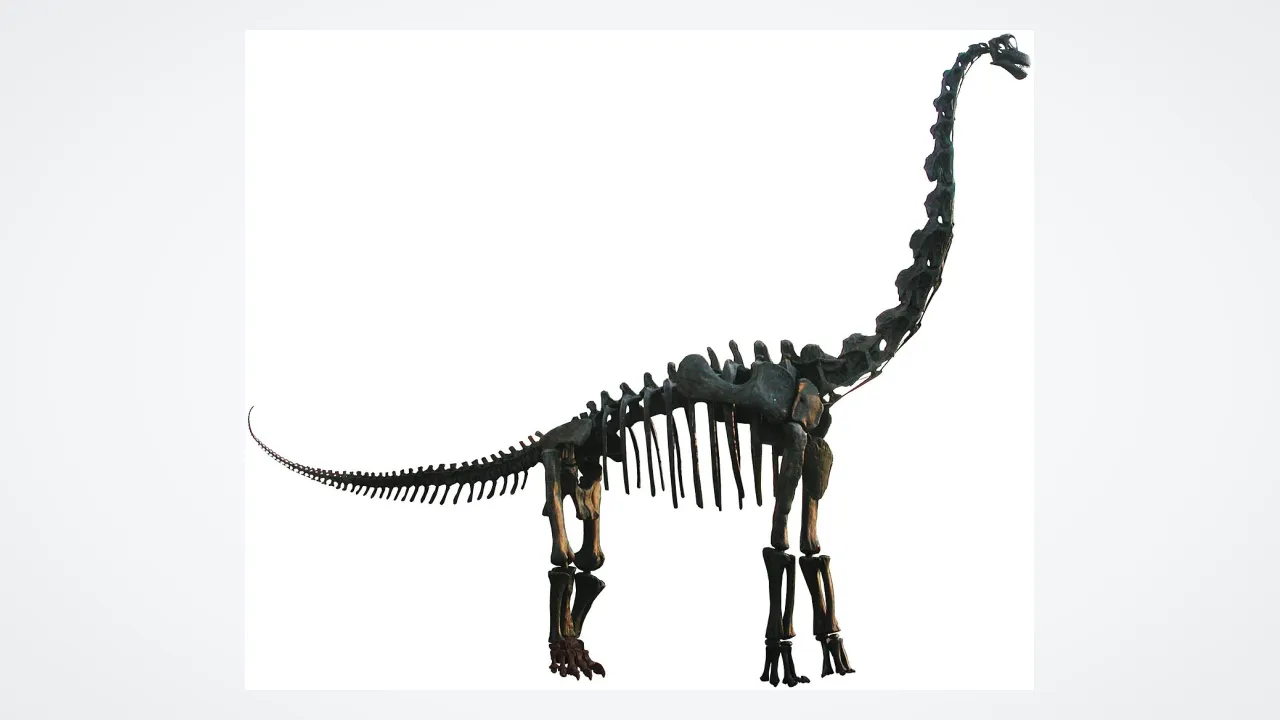
Brachiosaurus means 'arm lizard' because its front arm bones were longer than its back leg bones!
✨ Word Sparks (Grade 1 Glossary)
Tap 🔊 to hear
Canopy
High leafy roof at the top of trees
Posture
The way an animal holds its standing body
Conifer
Cone-bearing evergreen tree with needle leaves
🪝
What dinosaur could peek right into a four-story window?
1
High Up in the Treetops
Rustle, crunch! Forty feet above the ground, green pine needles vanish from a tall tree. A super-long neck reaches higher than a four-story building! Say hello to gentle Brachiosaurus.
2
Long Front Legs
Most big dinosaurs had taller back legs. Not this giant! Its front legs grew longer than its back legs, tilting its body up like a giraffe.
3
Eating All Day Long
Feeding such a huge belly took lots of leaves every single day. It snipped branches whole and swallowed them without chewing!
1. Why does the name Brachiosaurus mean 'arm lizard'?
2. How high could Brachiosaurus reach to munch tree leaves?
🤯 Mind-Blowing Fact • Grade 2
A grown-up Brachiosaurus ate around four hundred to eight hundred pounds of tree leaves every single day!
✨ Word Sparks (Grade 2 Glossary)
Tap 🔊 to hear
Sauropod
Giant plant-eating dinosaur with a long neck
Air Sacs
Hollow pockets that lighten bones and aid breathing
Ginkgo
Ancient tree species with fan-shaped green leaves
🪝
How could Brachiosaurus lift a thirty-foot neck without tipping forward?
1
Skyscraper of the Ancient Plains
Imagine looking straight up at a dinosaur taller than three giraffes stacked on top of one another! One hundred fifty million years ago, Brachiosaurus strolled across sunny river plains in Colorado and Utah. It weighed as much as seven elephants!
2
Built-In Air Pockets
Solid neck bones thirty feet long would have been way too heavy to lift. Instead, its neck bones had hollow pockets filled with connected to its lungs! That clever lightweight design made raising its head easy.
3
Four Hundred Pounds of Salad
Spoon-shaped teeth stripped leaves and conifer needles straight off high branches, sending up to four hundred pounds of greens into its giant stomach every day.
1. What made the huge neck bones of Brachiosaurus light enough to lift?
2. What shape were the teeth of Brachiosaurus?
🤯 Mind-Blowing Fact • Grade 3
Scientists proved Brachiosaurus could not use its head as an underwater snorkel because deep water pressure would have squeezed its lungs shut!
✨ Word Sparks (Grade 3 Glossary)
Tap 🔊 to hear
Savanna
Open plain with scattered trees and seasonal rain
Browser
Herbivore that feeds on high leaves and twigs
Pressure
Pushing force of air or water on surfaces
🪝
Why did scientists once mistakenly think Brachiosaurus lived underwater like a giant snorkel?
1
High Browser of the Morrison Formation
Picture seasonal dotted with tall monkey-puzzle trees and winding rivers during the Late Jurassic Period. Rising forty feet above the ferns walked Brachiosaurus altithorax, an eighty-two-foot sauropod whose sloped shoulders gave it effortless access to the highest forest canopy.
2
Solving the Underwater Myth
Notice the tall arch of bone atop its skull where huge nasal openings sat. Early scientists thought Brachiosaurus stood at the bottom of deep lakes using its nostrils like a snorkel! Later physics calculations proved deep water would have crushed its chest and lungs, confirming it walked firmly on dry land.
3
Super-Powered Heart
Pumping oxygen-rich blood twenty-five feet uphill from chest to brain required an enormous muscular heart—likely weighing hundreds of pounds—and tight leg skin that prevented blood from pooling near its ankles.
4
Sharing the Buffet
Because Brachiosaurus grazed high treetops while Stegosaurus and Diplodocus ate lower ferns, several giant herbivores could share the same valley peacefully without running out of food.
1. Why could Brachiosaurus share habitats peacefully with Diplodocus and Stegosaurus?
2. What ruled out the old idea that Brachiosaurus walked deep underwater using its nose like a snorkel?
🤯 Mind-Blowing Fact • Grade 4
Thanks to internal air chambers, some three-foot-long Brachiosaurus neck vertebrae were more than sixty percent empty space by volume!
✨ Word Sparks (Grade 4 Glossary)
Tap 🔊 to hear
Pneumaticity
Presence of hollow air spaces inside solid bones
Humerus
Long bone of the upper arm or forelimb
Ferment
Break down tough plants using helpful gut microbes
🪝
How did Elmer Riggs discover a dinosaur in Colorado with 'arms' longer than its hind legs?
1
Discovery in Grand River Valley
In July 1900, Field Museum paleontologist Elmer S. Riggs and his assistant Menke uncovered gigantic vertebrae and limb bones eroding from rocky bluffs near Fruita, Colorado. When Riggs measured the six-foot-eight-inch upper arm bone () beside the thigh bone (femur), he was astonished: the forelimb was longer! In 1903 he named the creature Brachiosaurus altithorax, meaning 'deep-chested arm lizard.'
2
Skeletal Pneumaticity and Bird-Style Breathing
Weighing thirty-five to fifty tons, Brachiosaurus avoided collapsing under its own mass through skeletal . Up to sixty percent of each three-foot-long cervical vertebra consisted of air-filled chambers linked to pulmonary air sacs. Like modern birds, this flow-through breathing system sent fresh oxygen across the lungs during both inhalation and exhalation.
3
No Chewing Required
With a tiny head at the tip of a thirty-foot crane-like neck, heavy chewing muscles would have made the skull far too cumbersome. Instead, Brachiosaurus cropped conifer shoots cleanly and let colossal gut bacteria tough plant fibers inside a barrel-shaped torso over several days.
4
An African Twin: Giraffatitan
For decades, museum skeletons from Tanzania were labeled Brachiosaurus brancai, until detailed bone comparisons in 2009 placed the African cousin in its own closely related genus, Giraffatitan.
1. Why didn't Brachiosaurus chew its food in its mouth like cows or horses do?
2. What does the species name altithorax highlight about Elmer Riggs's Colorado discovery?
🤯 Mind-Blowing Fact • Grade 5
Modern anatomical studies show that although Brachiosaurus had skull openings high on its forehead, its actual fleshy nostrils sat right near the front tip of its snout!
✨ Word Sparks (Grade 5 Glossary)
Tap 🔊 to hear
Gigantothermy
Staying steadily warm simply through immense body size
Hydrostatic
Relating to fluid pressure caused by gravity's pull
Metacarpals
Long bones of the hand or front foot
🪝
How did Brachiosaurus overcome gravity to pump blood twenty-five feet uphill and fuel a forty-five-ton body?
1
Unearthing a Morrison Formation Titan
One hundred fifty-four million years ago, Western North America's Morrison Formation stretched across seasonal floodplains interlaced with gallery forests of araucarian conifers, tree ferns, and cycads. When Field Museum curator Elmer S. Riggs excavated articulated dorsal vertebrae, ribs, humerus, and femur near Grand Junction, Colorado, in 1900, he unveiled a sauropod built like a living suspension crane—twenty-five meters (82 feet) long and towering twelve meters (40 feet) above the floodplain.
2
Cardiovascular Engineering Against Gravity
Raising a brain eight meters vertically above the heart creates an immense challenge. Comparative physiologists estimate Brachiosaurus maintained arterial blood pressure exceeding 400 millimeters of mercury—more than triple human levels—powered by a four-chambered heart with thick left-ventricular walls, paired with one-way venous valves that prevented dangerous pressure spikes whenever it lowered its head to drink.
3
Fleshy Snout and Resonating Crest
In 2001, paleobiologist Lawrence Witmer demonstrated that while the bony nasal arch sat high above the eyes, fleshy nasal passages actually ran forward to nostrils positioned near the front of the snout, possibly supporting inflatable skin chambers for low-frequency vocal calls.
4
Columnar Limbs and Weight Distribution
Unlike whip-tailed diplodocids whose center of mass rested over the hind hips, Brachiosaurus carried heavy weight over vertical, pillar-like forelimbs whose arranged in a tight horseshoe arch above fleshy heel pads that cushioned every multi-ton footstep.
5
Gigantothermy and Metabolic Efficiency
Because a forty-five-ton body retains internal heat efficiently due to a low surface-area-to-volume ratio—a phenomenon termed —adult Brachiosaurus sustained warm, active core temperatures while consuming remarkably less food per kilogram than modern mammals.