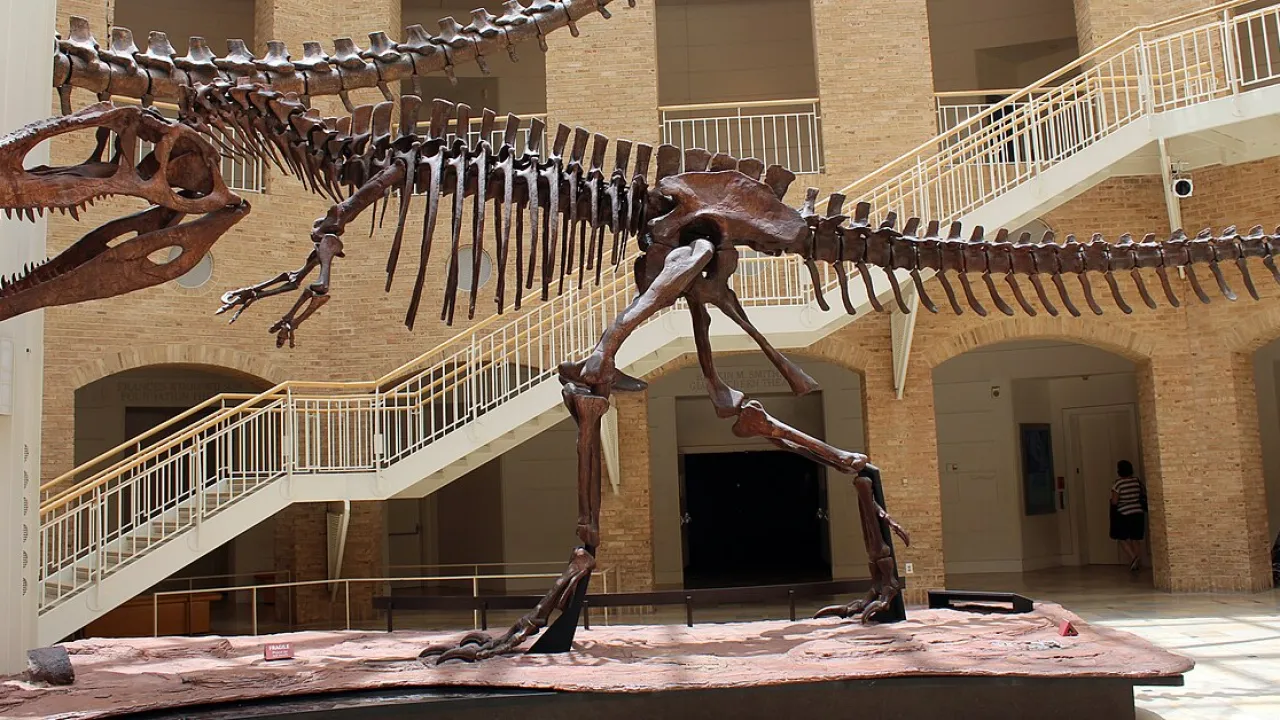
⚡ Survival SuperpowerFive-foot skull lined with flat serrated shark-like slicing teeth for hunting giant sauropods
🤯 Mind-Blowing Fact • Grade 1
A grown-up Giganotosaurus skull stretched over five feet long—taller than most elementary school kids!
✨ Word Sparks (Grade 1 Glossary)
Tap 🔊 to hear
Colossal
Extraordinarily huge and heavy in size
Jagged
Having sharp, uneven saw-like edges
Stride
To walk forward with long, strong steps
🪝
What giant southern hunter had a head taller than your teacher?
1
Boom Across the Red Rocks!
Thump, rumble! Across warm river plains in South America a hunter. Its giant head alone measures more than five feet long! Meet the mighty Giganotosaurus.
2
Teeth Like Shark Blades
Open wide! Flat, teeth line its huge jaws like great white shark teeth. Those thin, sharp blades were built for slicing.
3
Living Among Giant Long-Necks
Even bigger plant-eating dinosaurs shared its home! Three strong claws on each hand helped this giant hunter stay balanced and grip.
1. What ocean animal had teeth shaped very much like Giganotosaurus teeth?
2. On which continent did Giganotosaurus live?
🤯 Mind-Blowing Fact • Grade 2
Amateur fossil hunter Rubén Carolini spotted the first Giganotosaurus leg bone sticking out of Argentine scrubland while riding his homemade dune buggy in 1993!
✨ Word Sparks (Grade 2 Glossary)
Tap 🔊 to hear
Amateur
Someone exploring for fun rather than paid work
Titanosaur
Colossal armored family of long-necked plant-eating dinosaurs
Badlands
Dry rocky hills carved by wind and rain
🪝
How did an auto mechanic riding a dune buggy discover one of the biggest meat-eaters ever?
1
A Lucky Desert Ride
Imagine driving a dune buggy across dusty red hills in Argentina and spotting a giant shinbone sticking out of the dirt! In 1993, fossil fan Rubén Carolini made that exact discovery. Scientists named the forty-two-foot giant Giganotosaurus carolinii—meaning giant southern lizard—in his honor!
2
Longer Than T. rex!
Living thirty million years before Tyrannosaurus Rex, Giganotosaurus grew slightly longer from nose to tail, though its skull was narrower and lighter. Bumpy ridges ran right along its nose bones.
3
Land of the Biggest Dinosaurs
Patagonia back then was home to Earth's largest long-necked , giving Giganotosaurus plenty of giant neighbors!
1. Who discovered the first Giganotosaurus bone in Argentina in 1993?
2. When did Giganotosaurus live compared to North America's Tyrannosaurus Rex?
🤯 Mind-Blowing Fact • Grade 3
Unlike round bone-crushing tyrannosaur teeth, Giganotosaurus had flat eight-inch slicing blades paired with a pointed bony 'chin' on its lower jaw!
✨ Word Sparks (Grade 3 Glossary)
Tap 🔊 to hear
Carcharodontosaur
Giant theropod family with flat shark-like serrated teeth
Reinforced
Strengthened with extra bone to prevent bending
Braided River
Wide shallow river splitting around sandy islands
🪝
Why did Giganotosaurus and Tyrannosaurus Rex evolve completely different kinds of teeth?
1
Apex Predator of the Candeleros Formation
Step into ninety-eight-million-year-old valleys in Neuquén, Argentina. Towering conifers shade herds of massive sauropods while an eight-ton Giganotosaurus carolinii patrols the riverbank, balancing its five-foot-three-inch skull with a muscular tail.
2
Slicers Versus Bone-Crushers
Compare Giganotosaurus with Tyrannosaurus Rex and you see two brilliant evolutionary designs! T. rex evolved thick round teeth to crush armored ceratopsians. Giganotosaurus belonged to Carcharodontosauridae—the 'shark-toothed lizards'—evolving flat, eight-inch oval blades serrated along both edges to slice cleanly without getting stuck in tough sauropod hides!
3
Pointed Chin Brace
Look at the front tip of its lower jaw: a downward-pointing bony 'chin' the jaw joint against twisting forces during powerful slicing bites.
4
Banana-Shaped Brain
CT scans of its braincase revealed a slender, banana-shaped brain with huge smell centers that tracked quarry across wide floodplains.
1. Why were flat, double-serrated blade teeth ideal for Giganotosaurus?
2. What unusual feature reinforced the front tip of the Giganotosaurus lower jaw?
🤯 Mind-Blowing Fact • Grade 4
Before Giganotosaurus was announced in 1995, scientists believed for ninety years that Tyrannosaurus Rex was the single largest land carnivore that ever lived!
✨ Word Sparks (Grade 4 Glossary)
Tap 🔊 to hear
Femur
Heavy upper thigh bone supporting body weight
Rugose
Wrinkled, bumpy bone texture that anchored horn sheaths
Bonebed
Rock layer preserving skeletons of multiple animals together
🪝
Did giant shark-toothed cousins of Giganotosaurus ever gather in groups around colossal titanosaurs?
1
Rewriting the Record Books in 1995
For ninety years after Tyrannosaurus Rex was named in 1905, paleontologists assumed North America's famous king was unrivaled in size among land carnivores. That changed in 1995 when Argentine paleontologists Rodolfo Coria and Leonardo Salgado published Giganotosaurus carolinii—seventy percent complete, including skull bones, hips, spine, and a longer than T. rex's!
2
Clues From Closest Cousin Mapusaurus
A few years later, Coria and Philip Currie excavated a remarkable nearby containing at least seven individuals of Mapusaurus—a cousin nearly identical to Giganotosaurus—all of different ages! Finding juveniles and adults together suggested giant carcharodontosaurs may have occasionally teamed up in loose mobs to tackle seventy-ton titanosaurs like Argentinosaurus.
3
Rugose Nasal Bosses
Thick, roughened bone bumps along the top of the Giganotosaurus snout anchored tough keratinous horn coverings used for vivid species recognition, visual intimidation, or head-to-head pushing contests between rival territorial adults.
4
Speed Check by Biomechanics
In 2001, physicists Rodolfo Blanco and Ernesto Mazzetta calculated leg stability and balance, concluding an eight-ton Giganotosaurus could safely run up to thirty-one miles per hour before risking a dangerous fall—plenty fast enough to overtake lumbering sauropods across open floodplains!
1. What discovery involving close cousin Mapusaurus gave clues about how giant Patagonian predators might have interacted?
2. Why did Giganotosaurus have bumpy, rugose bone ridges along the top of its snout?
🤯 Mind-Blowing Fact • Grade 5
Microscopic growth rings in giant shark-toothed theropod bones reveal they kept growing for thirty-five to forty-five years—living nearly fifteen years longer than Tyrannosaurus Rex!
✨ Word Sparks (Grade 5 Glossary)
Tap 🔊 to hear
Symphysis
Fused front joint where left and right jaws meet
Cenomanian
Earliest geological stage of the Late Cretaceous Period
Phylogenetic
Relating to evolutionary family tree relationships among species
🪝
Why did Giganotosaurus take more than thirty years to reach full adult size while Tyrannosaurus Rex grew up in twenty?
1
Cenomanian Giants of the Neuquén Basin
Ninety-nine to ninety-six million years ago during the early Late Cretaceous ( stage), Patagonia's Candeleros Formation supported Earth's heaviest terrestrial ecosystem—including rebbachisaurid sauropods and colossal basal titanosaurs such as Andesaurus. Unearthed near Villa El Chocón and described by Rodolfo Coria and Leonardo Salgado in 1995, the holotype of Giganotosaurus carolinii (`MUCPv-Ch1`) measured roughly 12.5 meters long, while an isolated dentary jawbone (`MUCPv-95`) belonged to an individual eight percent larger—approaching 13.2 meters (43 feet)!
2
Allosaurid Heritage and Cranial Pneumatics
Phylogenetically nested within Allosauroidea rather than Coelurosauria, Giganotosaurus inherited extensive skull fenestrae and pneumatic sinuses that lightened its 1.6-meter cranium. Whereas T. rex maximized posterior crushing force, finite-element tests by François Therrien show Giganotosaurus concentrated slicing force at the front of its reinforced mandibular to inflict rapid, deep lacerations.
3
Protracted Multi-Decade Growth Strategy
In 2020–2022 histological studies of carcharodontosaurid limb bones (including close kin Meraxes gigas), researchers counted annual Lines of Arrested Growth and discovered a startling contrast with tyrannosaurs: instead of reaching adult mass in a teenage sprint before age twenty, giant carcharodontosaurs grew steadily across thirty-five to forty-five years!
4
Endocranial Neurobiology and Low-Frequency Hearing
CT endocasts published by Paulina Carabajal reveal a nineteen-inch brain cavity housing roughly 275 milliliters of volume, prominent optic lobes, and semicircular canals holding the massive head steady at a gentle ten-degree downward tilt.
5
Mid-Cretaceous Turnover
Around ninety million years ago, shifting global sea levels, volcanic greenhouse warming, and changing plant communities extinguished giant carcharodontosaurs worldwide, clearing ecological space for fast abelisaurids across southern Gondwana and bone-crushing tyrannosaurids across northern continents.