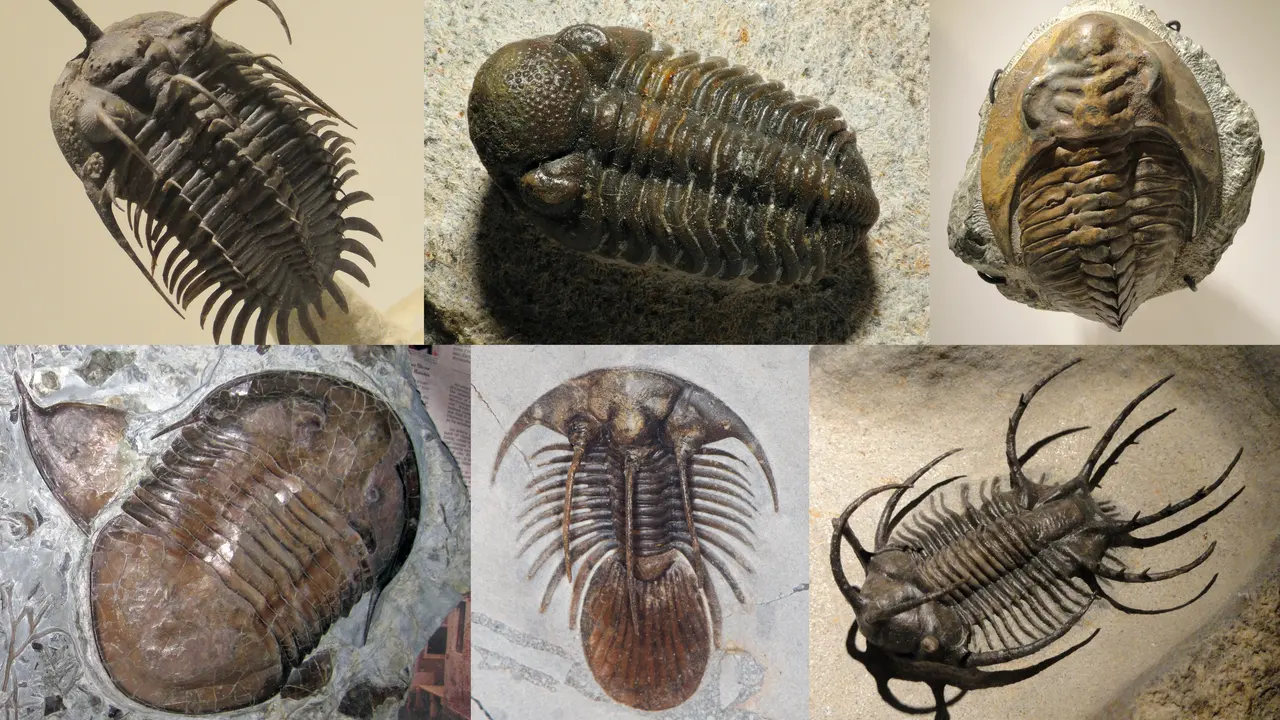
1. Why is this ancient sea creature called a Trilobite?
2. What surprising material formed the lenses inside a trilobite's eyes?
🤯 Mind-Blowing Fact • Grade 2
Some fancy Devonian trilobites sprouted curving pitchforks, tridents, and looping spines all over their shells to keep hungry fish from swallowing them!
✨ Word Sparks (Grade 2 Glossary)
Tap 🔊 to hear
calcite
Clear natural mineral found in seashells
antennae
Long front feelers that touch and smell
species
Specific kinds of animals within a group
🪝
How could one ocean family include poppy-seed pygmies AND platter-sized giants?
1
Twenty Thousand Different Kinds!
Imagine diving into ancient seas anytime between 521 and 252 million years ago! Everywhere you looked—from sunny coral reefs to pitch-black deep mud—lived trilobites! Scientists have already named more than 20,000 different of these armored arthropods.
2
Tiny Specks to Giant Platters
The smallest trilobites could sit comfortably on a pencil tip at one millimeter long! Meanwhile, the largest , Isotelus rex from Manitoba, Canada, stretched twenty-eight inches—wider than a welcome mat!
3
Antennae and Feathery Gills Below
Underneath its hard mineral back shield waved two flexible feelers and dozens of jointed walking legs paired with feathery gills.
1. About how many different species of trilobites have paleontologists discovered?
2. Why did some Devonian trilobites grow wild tridents and curving spikes on their armor?
🤯 Mind-Blowing Fact • Grade 3
Physicist Christiaan Huygens and philosopher René Descartes invented the exact same two-lens optical math in the 1600s that Phacops trilobites had already built into their eyes 400 million years earlier!
✨ Word Sparks (Grade 3 Glossary)
Tap 🔊 to hear
cephalon
The armored front head shield of a trilobite
thorax
Flexible middle body section with hinged rings
pygidium
Fused rear tail shield of a trilobite
🪝
Why do people confuse head-to-tail segments with why a trilobite is called 'three-lobed'?
1
Side-to-Side Lobes AND Head-to-Tail Shields
Here's a classic paleontology brainteaser! A trilobite does have three parts from front to back: a head shield (), a bendable middle (), and a fused tail plate (). Yet 'trilobite' actually refers to its three lengthwise columns—a left pleural lobe, a central axial lobe, and a right pleural lobe!
2
Seeing Through Solid Calcite
While insects build compound eyes out of soft chitin protein, trilobites crystallized pure calcium carbonate—the exact mineral in limestone—into thousands of clear hexagonal lenses! Because crystal can't squish to focus close-up or far away, clever species like Phacops built two-layered 'doublet' lenses that focused everything simultaneously!
3
Conga Lines Across Ancient Mud
Fossils in Morocco and France preserve long single-file queues of trilobites marching nose-to-tail across the seafloor! Guided by antennae touching the neighbor ahead, they likely migrated away from deep storms or gathered safely to molt.
4
Surviving Three Mass Extinctions
Tough trilobites weathered multiple global crises for 270 million years before the final few species perished in the Great Dying 252 million years ago.
1. How did Phacops trilobites focus clearly when rigid crystal lenses couldn't bend?
2. What do single-file fossil queues of Moroccan trilobites show about their behavior?
🤯 Mind-Blowing Fact • Grade 4
In New York's famous 'Beecher's Trilobite Bed,' glittering golden iron pyrite ('fool's gold') replaced every delicate walking leg, antenna, and gill feather in 3D!
✨ Word Sparks (Grade 4 Glossary)
Tap 🔊 to hear
index fossils
Widespread fossils used to date rock layers
biramous
Two-branched limb with walking leg and gill
pyrite
Shiny gold-colored iron mineral preserving fossils
🪝
How do geologists use evolving trilobite shells as 'atomic clocks' to date rock layers around the world?
1
Nature's Premier Index Fossils
Step up to a Paleozoic cliff in Utah, Wales, Morocco, or China and tap open gray limestone: out pops a trilobite! Because trilobites calcified their dorsal exoskeletons early in the Cambrian (521 MYA), spread rapidly across global oceans, and evolved new species every million years or so, geologists rely on them as ''—matching exact time zones across distant continents!
2
Holochroal vs. Schizochroal Crystal Optics
Most trilobites carried holochroal eyes—up to 15,000 tiny calcite prisms packed wall-to-wall beneath one smooth cornea, aligned precisely along calcite's optical c-axis so images didn't split double! Later phacopid trilobites evolved schizochroal eyes: fewer, larger separated lenses equipped with internal magnesium-rich correction bowls that erased spherical aberration and granted depth perception in dim water.
3
Facial Sutures for Easy Molting
Look closely at a trilobite's cheeks and you'll spot fine hairline seams called facial sutures. Whenever a growing trilobite needed to molt, those pre-scored seams cracked neatly apart so the soft animal could wriggle free without tearing its crystal eyes!
4
Pyritized Legs in 'Beecher's Trilobite Bed'
Normally soft legs rot away, leaving only top shells. Yet in New York's Ordovician Frankfort Shale, fool's gold (iron ) replaced delicate antennae and (two-branched) legs—each carrying a walking branch below and a feathery gill branch above!
1. What made trilobites such useful 'index fossils' for geologists dating rocks?
2. Why did trilobites have fine seam lines called facial sutures across their head shields?
🤯 Mind-Blowing Fact • Grade 5
In 2023, synchrotron X-ray scans of a 465-million-year-old Czech trilobite preserved its entire final meal inside its stomach—packed with crushed shells of tiny ostracods, snails, and sea stars!
✨ Word Sparks (Grade 5 Glossary)
Tap 🔊 to hear
birefringent
Splitting light rays into twin double images
enrollment
Curling the segmented body into an armored ball
coaptation
Interlocking notches that snap rolled armor shut
🪝
How did birefringent calcite crystallography, enrollment locks, and 270 million years of adaptation forge paleontology's greatest arthropod success story?
1
Paleozoic Dominance Across Ten Orders
Appearing abruptly in Tommotian–Atdabanian strata 521 million years ago already differentiated into distinct provincial faunas, Class Trilobita radiated into ten taxonomic orders, over 150 families, and more than 22,000 described species! Spanning planktonic millimeter-scale agnostids, blind abyssal sediment-plowers like Trinucleus, pelagic huge-eyed swimmers like Opipeuterella, and the 72-centimeter Ordovician giant Isotelus rex, trilobites anchored marine food webs throughout the entire Paleozoic Era.
2
Solving Birefringence and Spherical Aberration
Pure calcite is strongly —splitting incoming light rays into confusing double images along most angles except its single crystallographic c-axis! Trilobites grew every ommatidial prism with its c-axis oriented strictly perpendicular to the lens surface, transmitting crisp single images. Even more astonishingly, Devonian phacopina evolved schizochroal doublet lenses possessing a sinuous intralensar boundary where high-magnesium calcite corrected light refraction—matching optical formulas independently derived by René Descartes (1637) and Christiaan Huygens (1690)!
3
Sphaeroidal Enrollment Coaptation
As nautiloids, eurypterids, and Devonian gnathostomes intensified predation pressure, trilobites perfected sphaeroidal : tucking the pygidium tightly beneath the cephalic rim and locking complementary tongue-and-groove coaptative notches (vincular furrows) so predators faced an impenetrable calcite sphere bristling with deterrent spines in genera like Walliserops and Koneprusia.
4
Biramous Appendages and Gut Preservation
Exceptional pyritized specimens from New York's Beecher's Bed (Triarthrus) and 2023 synchrotron scans of Czech Bohemolichas with shell-packed digestive tracts reveal conserved ventral anatomy: uniramous sensory antennae followed by serial biramous limbs pairing a jointed endopodite (bearing gnathobasic food grinders) with a filamentous exopodite gill branch.
5
Attrition and Permo-Triassic Extinction
Trimmed progressively by Late Ordovician and Late Devonian mass extinctions until only one order—Proetida—endured through Carboniferous and Permian reefs, the last surviving trilobites (such as Phillipsia and Pseudophillipsia) succumbed to ocean acidification, warming, and anoxia during the End-Permian catastrophe 252 million years ago.