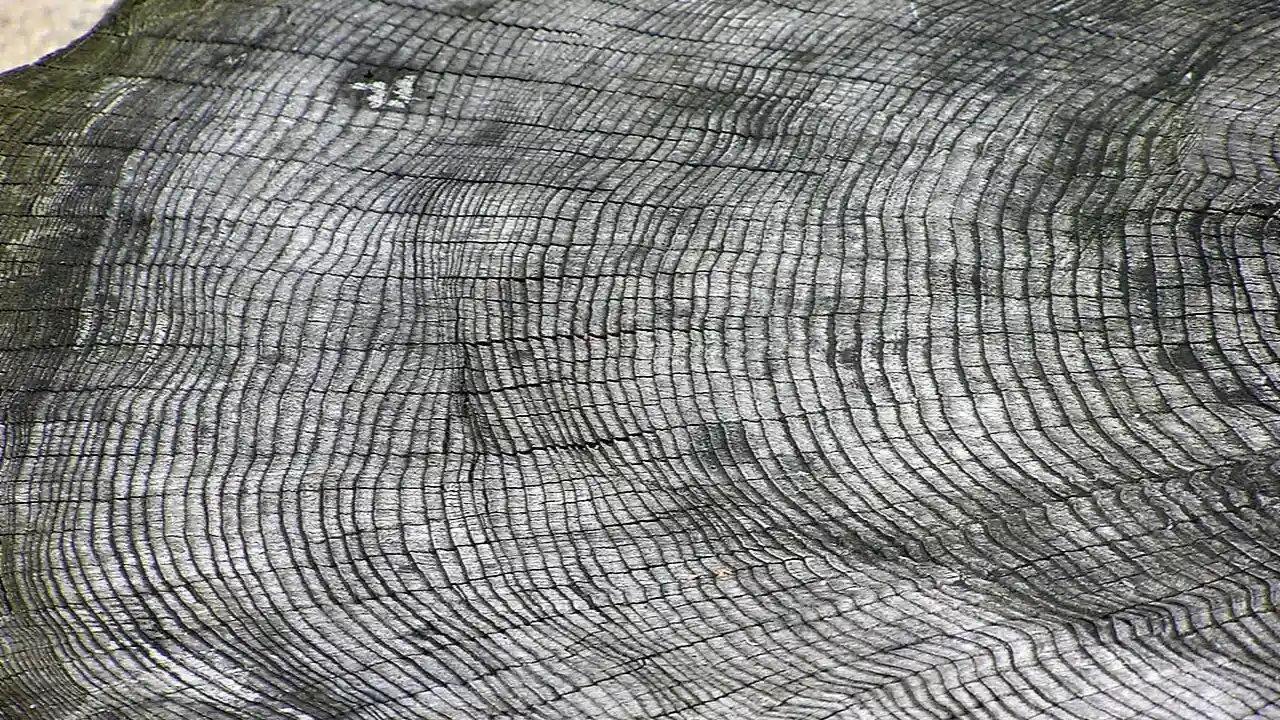
1. What kind of weather helps a tree grow a nice wide ring?
2. If a tree stump has ten yearly rings, how old was the tree?
🤯 Mind-Blowing Fact • Grade 2
Gnarled bristlecone pine trees high in California's White Mountains have over 4,800 yearly rings, making them older than Egypt's Great Pyramid!
✨ Word Sparks (Grade 2 Glossary)
Tap 🔊 to hear
Drought
A long time with very little rain
Earlywood
Pale, fast-growing wood made in spring
Latewood
Dark, dense wood made in late summer
🪝
Why does a tree grow light-colored wood in spring and dark-colored wood in late summer?
1
Two Bands Make One Year
Run your fingertip across a smooth wooden stump and trace its bullseye circles! Trees do not stretch upward from the ground like grass; instead, they add a fresh layer of wood right under their bark every year.
2
Spring Speed, Summer Slowdown
In wet spring weather, the tree builds big, pale cells to carry lots of water upward, creating a light band. By late summer, growth slows down and cells pack tightly together, forming a thin dark band. One light band plus one dark band equals one year!
3
Weather Clues and Fire Scars
Wide rings tell us rain was plentiful, while narrow rings point to dry . Dark healed marks can even show the exact year a small forest fire swept past!
1. Where does a tree add its newest ring each year?
2. What does a group of very skinny rings usually tell scientists?
🤯 Mind-Blowing Fact • Grade 3
Tree rings in ancient Virginia bald cypress trees helped historians discover that Jamestown colonists arrived in 1607 during the worst seven-year drought in nearly eight centuries!
✨ Word Sparks (Grade 3 Glossary)
Tap 🔊 to hear
Dendrochronology
Science of dating events using tree rings
Increment Borer
Pencil-thin tool extracting safe wood cores
Crossdating
Matching ring patterns between younger and older wood
🪝
How can scientists match tree-ring barcodes from old cabin logs to stretch a weather calendar back thousands of years?
1
Meet Dendrochronology
Say this fun science word out loud: den-dro-kroh-NOL-uh-jee! 'Dendro' means tree, and 'chronology' means studying time. Dendrochronologists read annual growth rings like nature's wooden calendar to uncover ancient weather and history.
2
Sampling Without Harming Trees
To study a living oak or pine, scientists twist a hollow hand tool called an into the trunk. Out slides a pencil-thin wooden core! That tiny hole seals safely with natural sap, just like tapping a maple tree for syrup.
3
Matching Nature's Barcode
Every tree in the same region experiences the same wet years and dry years, creating matching patterns of wide and narrow rings. By overlapping ring patterns from living trees with beams inside historic barns and fallen logs, scientists build timelines spanning millennia!
4
Why Tropical Trees Look Different
Trees near the equator often have faint or missing rings because warm rain falls all year without cold winters to pause growth.
1. How do scientists collect a ring sample from a living tree without cutting it down?
2. What amazing Virginia history clue did ancient bald cypress tree rings reveal?
🤯 Mind-Blowing Fact • Grade 4
Experts even used tree-ring crossdating on the spruce wood front of Antonio Stradivari's most famous 'Messiah' violin to verify when the alpine tree it came from grew!
✨ Word Sparks (Grade 4 Glossary)
Tap 🔊 to hear
Cambium
Thin living layer under bark making wood
Xylem
Woody plant tubes carrying water upward
Dormancy
Winter rest period when growth pauses
🪝
How did an astronomer searching for sunspot cycles invent the science of matching ancient wooden beams?
1
The Living Cambium Engine
Just beneath a tree's protective bark lies a paper-thin cylinder of dividing cells called the vascular . Every spring in temperate climates, lengthening daylight and melting snow trigger the cambium to produce large, thin-walled vessels—pale earlywood—that pump mineral-rich water up to unfurling leaves. As late-summer soil moisture drops, the cambium switches to thick-walled, dark latewood cells before winter creates a crisp yearly boundary.
2
A. E. Douglass and Crossdating
In the early 1900s, Arizona astronomer Andrew Ellicott Douglass wondered whether solar cycles influenced Earth's rainfall, so he began examining ponderosa pine stumps. He realized that neighboring trees recorded identical sequences of wide wet-year rings and narrow drought rings—like a regional Morse code! By crossdating living pines with roof timbers inside ancestral Puebloan cliff dwellings at Mesa Verde and Chaco Canyon, Douglass pinpointed the exact year ancient builders felled each beam.
3
Frost Rings, Volcanoes, and Insects
Tree rings archive far more than rainfall. When a huge volcanic eruption veils the stratosphere in ash and cools summer skies, high-altitude trees form frost-damaged cells during the growing season. Sudden clusters of ultra-thin rings can also reveal defoliation by spongy moths or spruce budworms.
4
Subfossil Logs and Millennial Timelines
By overlapping living trees, colonial cabin timbers, and water-preserved bog oaks in Europe, dendrochronologists have assembled continuous, year-by-year ring calendars reaching back more than 12,000 years into the end of the last Ice Age!
1. Which living layer just under a tree's bark builds new wood rings each year?
2. How did astronomer A. E. Douglass figure out the exact construction dates of ancient Southwestern cliff dwellings?
🤯 Mind-Blowing Fact • Grade 5
Thanks to the 993 CE solar-storm spike preserved inside wooden artifacts, scientists proved Vikings were chopping trees in North America in 1021 CE—471 years before Columbus!
✨ Word Sparks (Grade 5 Glossary)
Tap 🔊 to hear
Tracheid
Elongated water-conducting wood cell in conifers
Limiting Factor
Environmental condition restricting how fast organisms grow
Calibration
Adjusting scientific measurements against a known standard
🪝
How did sudden radioactive spikes inside eighth-century cedar rings solve mysteries of ancient solar superstorms and Viking voyages?
1
Cellular Anatomy of Annual Xylem
Peer through a stereomicroscope at a sanded increment core from a Rocky Mountain bristlecone pine (Pinus longaeva), and four millennia of climate history resolve into cellular precision. Each growing season, the vascular cambium generates low-density spring with wide lumens optimized for hydraulic transport, followed by dense latewood tracheids reinforced with thick lignified walls for mechanical strength—ending abruptly at winter dormancy.
2
The Principle of Limiting Factors
Dendroclimatology relies on ecological : trees growing near arid desert margins sensitively track precipitation and soil moisture, whereas trees perched at cold alpine or Arctic treelines primarily record summer warmth. Simply counting rings can mislead if an extreme drought causes a tree to skip a ring locally ('missing ring') or a mid-summer dry spell creates a 'false ring,' which is why statistical crossdating across dozens of trees is essential.
3
Holocene Master Chronologies and Radiocarbon Calibration
By splicing living groves with historic architecture and subfossil oak and pine trunks preserved in oxygen-poor European river gravels, researchers constructed an unbroken master chronology exceeding 12,400 calendar years. Physicists analyze the carbon-14 inside those exact-year wood rings to calibrate radiocarbon dating worldwide, turning raw isotope ratios into accurate historical dates.
4
Miyake Events and Cosmic Timestamps
In 2012, Japanese physicist Fusa Miyake discovered a sharp carbon-14 surge inside cedar rings from the year 774 CE, triggered when an intense solar proton storm bombarded Earth's atmosphere. Using a similar cosmic timestamp from 993 CE, archaeologists proved that Norse explorers felled timber at L'Anse aux Meadows in Newfoundland in exact calendar year 1021 CE!
5
Modern Megadrought Reconstructions
Today, gridded tree-ring atlases across North America, Asia, and Europe reveal medieval megadroughts, volcanic summer cooling events like 536 CE and 1816's 'Year Without a Summer,' and how modern warming compares against thousands of years of natural hydroclimate variability.