🧬 HUMAN BODY
🧬 Trachea • Respiratory System
VA Science & Health SOL 1.1, 3.1, 4.2, 5.1 (Cells, Organs & Body Systems)
Trachea (Windpipe)
The Ring-Armored Air Tunnel Leading Into Your Lungs
Grade 1 • Early Reader • 77 words
🩺 Body System & LocationRespiratory System • Front of the neck down into the upper chest
🔬 Size / Cell Count~4–4.5 inches (10–11 cm) long • Armoured by 16–20 C-shaped cartilage rings
⚙️ Core JobFunnels warmed, filtered air between the throat and both lungs without collapsing
⚡ Body SuperpowerUses millions of microscopic sweeping hairs to escalator dust upward out of your airway
🤯 Mind-Blowing Fact • Grade 1
You take roughly 20,000 breaths through your windpipe every single day without even thinking about it!
✨ Word Sparks (Grade 1 Glossary)
Tap 🔊 to hear
Trachea
The sturdy windpipe carrying air to your lungs
Tunnel
An open tube that lets things pass through
Ridge
A small raised bump you can feel
🪝
What bumpy tube can you feel gently right in the front of your neck?
1
Your Built-In Air Tunnel
Touch the front of your neck very gently. Do you feel little ? That sturdy air tube is your windpipe, or ! Every breath you take zooms down this toward your lungs.
2
Rings Keep It Open
Soft straws can squish shut, so your windpipe wears strong bendy rings! These rings hold the wide open even while you twist your head or sleep.
3
Sweeping Out Dust
Inside, tiny hairs wave like little brooms to sweep dust away so clean air reaches your chest.
2. What do the tiny broom-like hairs inside your windpipe sweep away?
🤯 Mind-Blowing Fact • Grade 2
Your windpipe's rings are made of cartilage—the very same tough, bendy material that shapes the tip of your nose and your ears!
✨ Word Sparks (Grade 2 Glossary)
Tap 🔊 to hear
Cartilage
Firm, bendy body tissue softer than hard bone
Windpipe
Everyday word for your air-carrying trachea tube
Flex
To bend smoothly without snapping or breaking
🪝
Why are the rings around your windpipe shaped like the letter C instead of full circles?
1
Built Like a Vacuum Hose
Picture a bendy vacuum hose with ridges all along its outside! Your trachea—often called the —works the exact same way. Sixteen to twenty tough rings of wrap around it so your neck can bend freely without pinching off your air.
2
Room for Dinner Behind It
Each ring is shaped like the letter C, leaving a soft, flat gap along the back! Right behind your sits your food tube. When you swallow a big bite of pancake, that soft back wall inward slightly so food slides past comfortably.
3
Splitting Into Two Paths
Down inside your chest, the trachea splits like an upside-down letter Y, sending fresh air into both your left and right lungs.
1. Why are the cartilage rings of your trachea C-shaped with a soft back wall?
2. Which other body parts use flexible cartilage like your windpipe?
🤯 Mind-Blowing Fact • Grade 3
Microscopic cilia hairs inside your trachea wave upward 10 to 20 times every single second—even while you are fast asleep!
✨ Word Sparks (Grade 3 Glossary)
Tap 🔊 to hear
Cilia
Microscopic waving hairs that sweep mucus upward
Mucus
Slippery protective coating that traps dust and germs
Humidifier
Something that adds gentle moisture into dry air
🪝
How does a hidden microscopic escalator inside your neck clean the air you breathe?
1
Gateway to the Lungs
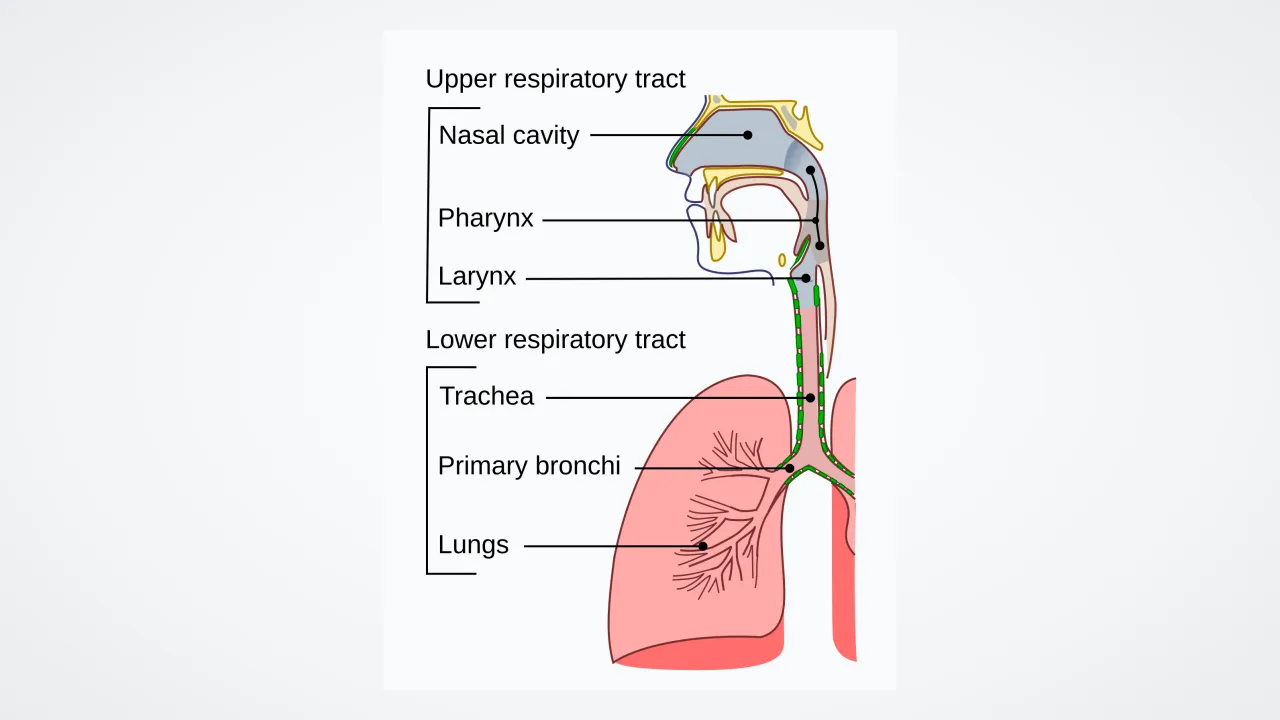
Inhale deeply through your nose, and air swirls down past your voice box into a four-inch highway called the trachea. About as wide as a garden hose, this sturdy airway bridges your upper throat and the branching tubes of your chest.
2
Warming and Moisturizing
Cold, dry winter air would irritate delicate lung tissue if it arrived raw. As air rushes down the trachea, blood-rich inner linings warm it right up to body temperature and add soothing moisture like a built-in .
3
The Mucus and Cilia Escalator
Lining the trachea's inner wall are special cells that coat the surface with sticky to trap pollen, smoke specks, and germs. Beneath that sticky blanket, millions of microscopic hair-like beat upward more than ten times every second—riding trapped dust up to your throat like a moving escalator!
4
Power of a Cough
If a big crumb or dust tickle touches the sensitive bottom fork of the trachea, nerves trigger a sudden cough that blasts air outward to clear the passage instantly.
Muscular food tube running right behind your windpipe
🪝
Why does sucking hard on a paper milkshake straw flatten it, yet inhaling hard never collapses your windpipe?
1
Defying Suction Pressure
When you inhale deeply after sprinting across a soccer field, chest muscles expand rapidly and drop air pressure inside your airways below outside atmospheric pressure. Without reinforcement, a soft fleshy tube would suck flat instantly—just like a soggy paper straw in a thick smoothie! Evolution solved this physics problem by wrapping the trachea in sixteen to twenty C-shaped rings of connected by elastic ligaments.
2
The Trachealis Muscle Adjustment
Spanning the open back gap of each C-ring—right against the neighboring —runs a band of smooth muscle called the trachealis. During relaxed breathing, the trachealis stays loose so the esophagus can bulge slightly forward whenever swallowed food passes. During a cough, however, the trachealis squeezes tight! Narrowing the trachea's diameter rockets outgoing air past 100 miles per hour, blasting irritants clear.
3
The Carina Sensor
At the level of your fifth thoracic vertebra, the trachea divides into right and left primary bronchi at a sharp internal ridge called the . Packed with ultra-sensitive nerve endings, the carina acts as a last-chance security alarm—triggering an unstoppable cough reflex if a single drop of water slips past your throat.
4
Goblet Cells on Duty
Meanwhile, goblet cells scattered along the lining secrete fresh mucin droplets around the clock, ensuring the mucociliary escalator never dries out.
1. How does the trachealis muscle at the back of your windpipe make a cough more powerful?
2. What happens at the ridge called the carina at the bottom of the trachea?
🤯 Mind-Blowing Fact • Grade 5
Every single ciliated cell lining your trachea wears a microscopic crown of about 200 synchronized cilia powered by molecular dynein motors!
✨ Word Sparks (Grade 5 Glossary)
Tap 🔊 to hear
Epithelium
Tightly packed cell sheet lining body surfaces
Mucociliary
Combining sticky mucus and waving cilia for cleaning
Lumen
The open hollow channel inside a tubular organ
🪝
Why did ancient Greek physicians mistakenly name your windpipe a 'rough artery'?
1
Biomechanics of a Flexible Conduit
Extending roughly ten to eleven centimeters from the cricoid cartilage of the larynx down to the mediastinum at vertebra T5, the adult human trachea balances two opposing engineering demands: radial rigidity against negative inspiratory pressure and longitudinal flexibility during neck extension and breathing. Sixteen to twenty incomplete rings of avascular hyaline cartilage resist inward collapse, while fibroelastic annular ligaments between rings let the tube stretch and recoil smoothly with every breath.
2
Pseudostratified Ciliated Epithelium
Histologically, the tracheal is carpeted by respiratory mucosa: pseudostratified ciliated columnar interspersed with mucus-secreting goblet cells and underlying seromucous glands. Each ciliated cell crowns its apex with roughly 200 motile cilia built around a '9+2' microtubule axoneme powered by dynein motor proteins. Beating in coordinated metachronal waves at 12 to 15 hertz, cilia tips hook into a viscous upper mucus gel layer while gliding freely back through a watery periciliary layer underneath—propelling trapped particulates steadily toward the pharynx at about one millimeter per minute.
3
Innate Antimicrobial Chemistry
Tracheal mucus is far more than passive flypaper. Epithelial cells infuse the airway surface liquid with lysozyme, lactoferrin, secretory IgA antibodies, and beta-defensins that punch holes in bacterial membranes before microbes ever reach bronchial branches.
4
From 'Rough Artery' to Modern Medicine
When ancient Greek anatomists dissected cadavers whose arteries had emptied of blood, they assumed arteries carried air too! Differentiating smooth blood vessels from the ridged windpipe, Erasistratus termed the windpipe 'tracheia arteria'—literally 'rough air-pipe'—giving rise to our modern word trachea.
5
Tissue-Engineered Airway Frontiers
Today, biomedical engineers study 3D-bioprinted cartilage scaffolds seeded with a patient's own stem cells to repair damaged tracheal segments while preserving natural clearance.