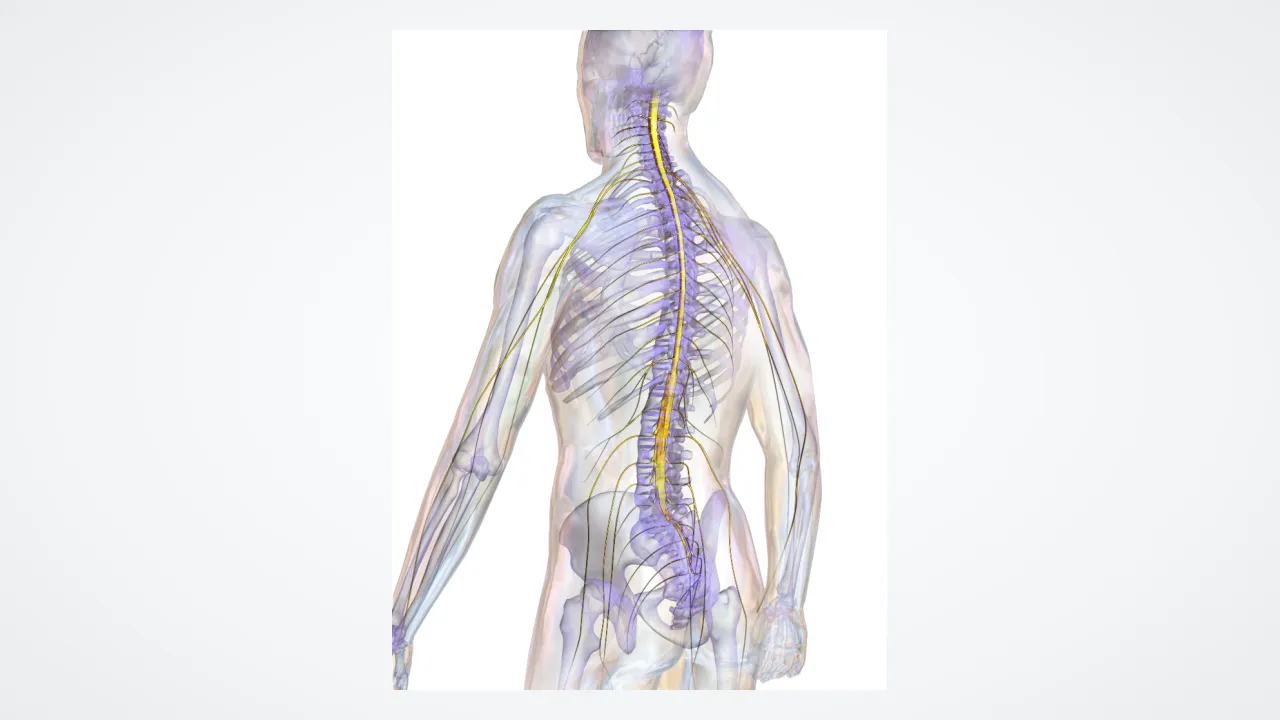
1. What protects your soft spinal cord inside your back?
2. Which way do messages travel inside your spinal cord?
🤯 Mind-Blowing Fact • Grade 2
Thirty-one pairs of branching nerves exit the sides of your spinal cord like highway off-ramps to reach every muscle and patch of skin!
✨ Word Sparks (Grade 2 Glossary)
Tap 🔊 to hear
vertebrae
Small ring bones stacked into your backbone
delicate
Soft and easy to bump without protection
reflex
An instant automatic move that protects you
🪝
What busy two-way highway runs straight through a tunnel of bones in your back?
1
Zooming Up and Down
Imagine millions of tiny glowing cars racing up and down a two-way highway at super speed! Running from the bottom of your brain down your back, your spinal cord connects your thinking head to your arms, legs, and trunk.
2
Guarded by Bone Rings
Because nerve tissue is soft and , your body surrounds the spinal cord with thirty-three stacked bones called . Clear cushion fluid also floats around the cord like shock absorbers on a bicycle.
3
Quick Reflex Hero
If your finger brushes something prickly, your spinal cord does not even wait for your brain! It snaps an instant pull-back command to your arm muscles to keep you safe.
1. Besides strong vertebrae bones, what else cushions your spinal cord?
2. What happens when your finger touches a prickly thorn?
🤯 Mind-Blowing Fact • Grade 3
Your backbone grows faster than your spinal cord, so in adults the solid cord actually ends near your waist while nerve strands fan out below like a horse's tail!
✨ Word Sparks (Grade 3 Glossary)
Tap 🔊 to hear
meninges
Three protective layers wrapping brain and cord
cylinder
A smooth tube shape with round ends
insulated
Wrapped up so electrical signals stay fast
🪝
Why does slicing a model of the spinal cord reveal a butterfly hiding inside?
1
Partner in Command
Catch a flying frisbee on the playground and celebrate! Your eyes spotted it, your brain planned the leap, and your spinal cord delivered rapid-fire orders to dozens of arm and leg muscles at over two hundred miles per hour. Together, the brain and spinal cord form your central nervous system.
2
Triple-Layer Armor
Starting at an opening in the base of your skull, this pinky-thick travels down through the vertebral canal. Three tough wrapper membranes called , plus shock-absorbing cerebrospinal fluid, cushion it every time you jump or tumble.
3
The Butterfly Inside
Look at a cross-section model of the spinal cord and you will spot a gray butterfly shape in the middle surrounded by pearly white tissue! The inner gray matter processes local signals and reflexes, while the outer white matter acts like elevator cables.
4
Thirty-One Pairs of Off-Ramps
Along its length, thirty-one pairs of spinal nerves branch out through gaps between vertebrae, linking your neck, chest, arms, and legs to central command.
1. What two main organs team up to form your central nervous system?
2. What shape does the gray matter form in the center of the spinal cord?
🤯 Mind-Blowing Fact • Grade 4
Fastest position-sensing signals from your muscles race up myelinated spinal cord tracts at speeds reaching 268 miles (430 kilometers) per hour!
✨ Word Sparks (Grade 4 Glossary)
Tap 🔊 to hear
ascending
Traveling upward toward the brain from below
dorsal
Relating to the back side of something
ventral
Relating to the front or belly side
🪝
How does your spinal cord help you walk smoothly without making your brain think about every single step?
1
More Than Just a Telephone Cable
Stroll down a hallway while chatting with a friend and notice something amazing: you never have to consciously command 'lift left knee, swing right heel, balance hips.' That is because your spinal cord is far more than a passive wire! Embedded inside its neural circuits are rhythmic networks called central pattern generators that coordinate smooth, alternating walking motions automatically once your brain says 'go.'
2
White Tracts and Gray Horns
Stretching roughly forty-five centimeters in adults, the spinal cord reverses the layout of the brain: its white matter wraps around the outside while butterfly-shaped gray matter sits inside. The pearly white columns contain sensory tracts carrying touch, temperature, and body-position updates upward, alongside descending motor tracts delivering muscle commands downward. Myelin coatings give those fast axons their bright white sheen.
3
Dorsal In, Ventral Out
At each of its thirty-one segments, nerve roots follow strict one-way traffic rules. Sensory signals enter through the back—the root—into the butterfly's rear horns, while motor instructions exit through the front—the root—to power skeletal muscles.
4
The Horse's Tail Below
Because vertebral bones outgrow the cord during childhood, the solid cord tapers to a cone near the first lumbar vertebra, sending a wispy bundle of lower nerves called the cauda equina ('horse's tail') down to the legs.
1. Which one-way traffic rule do spinal nerve roots follow at every segment?
2. What are central pattern generators inside the spinal cord?
🤯 Mind-Blowing Fact • Grade 5
Your spinal cord noticeably widens in two spots—the cervical enlargement in your neck and the lumbosacral enlargement in your lower back—because controlling nimble hands and strong legs requires millions of extra neurons!
How do organized superhighways of white matter and local circuits of gray matter turn a seventeen-inch cord into a marvel of biological engineering?
1
Architecture of the Medulla Spinalis
Thread a piano concerto through your fingertips or sprint across a soccer pitch, and millions of action potentials stream seamlessly through the medulla spinalis. Exiting the skull through the foramen magnum as a direct continuation of the brainstem's medulla oblongata, the adult human spinal cord spans only forty-two to forty-five centimeters and weighs roughly thirty-five grams, yet it links the brain with nearly every tissue below the head.
2
Meningeal Shielding and the Conus Medullaris
Suspended inside the bony vertebral canal, the cord wears three concentric meningeal layers: the delicate pia mater clinging to its surface, the web-like arachnoid mater bathing it in buoyant cerebrospinal fluid, and the tough outer dura mater. Anchoring extensions called denticulate ligaments prevent side-to-side jostling. Because the vertebral column elongates faster than neural tissue during development, the cord terminates at the conus medullaris between vertebrae L1 and L2, trailing the leash-like cauda equina below.
3
The Bell-Magendie Law of Traffic
In the early nineteenth century, Scottish anatomist Charles Bell and French physiologist François Magendie independently proved one of neuroscience's foundational rules: dorsal spinal roots exclusively conduct sensory signals inward from dorsal root ganglia, whereas ventral roots carry motor commands outward from anterior horn motor neurons.
4
Specialized White-Matter Highways
Surrounding the central gray butterfly, myelinated axons sort themselves into precision-mapped columns. Dorsal columns ferry fine touch, vibration, and —your awareness of limb position—upward, while spinothalamic tracts relay temperature and sharp warning signals. Descending corticospinal tracts carry voluntary movement blueprints straight from the cerebral cortex to limb muscles, noticeably thickening the cord at its cervical and lumbosacral enlargements.
5
Modern Neuroplasticity Research
Because central nervous system glia normally inhibit axon regrowth after severe injury, bioengineers today are testing biodegradable scaffolds, stem-cell bridges, and epidural electrical stimulation to awaken spinal pattern generators and restore mobility.