2. When does your pituitary gland send out big bursts to help you grow?
🤯 Mind-Blowing Fact • Grade 2
Your skull has a special saddle-shaped bone pocket right behind your eyes built just to guard your tiny pituitary gland!
✨ Word Sparks (Grade 2 Glossary)
Tap 🔊 to hear
master
A leader that guides many other helpers
protect
To keep something safe from bumps
stretch
To reach out and grow longer
🪝
Why do scientists call one pea-sized spot the master gland of your body?
1
Tucked in a Bony Seat
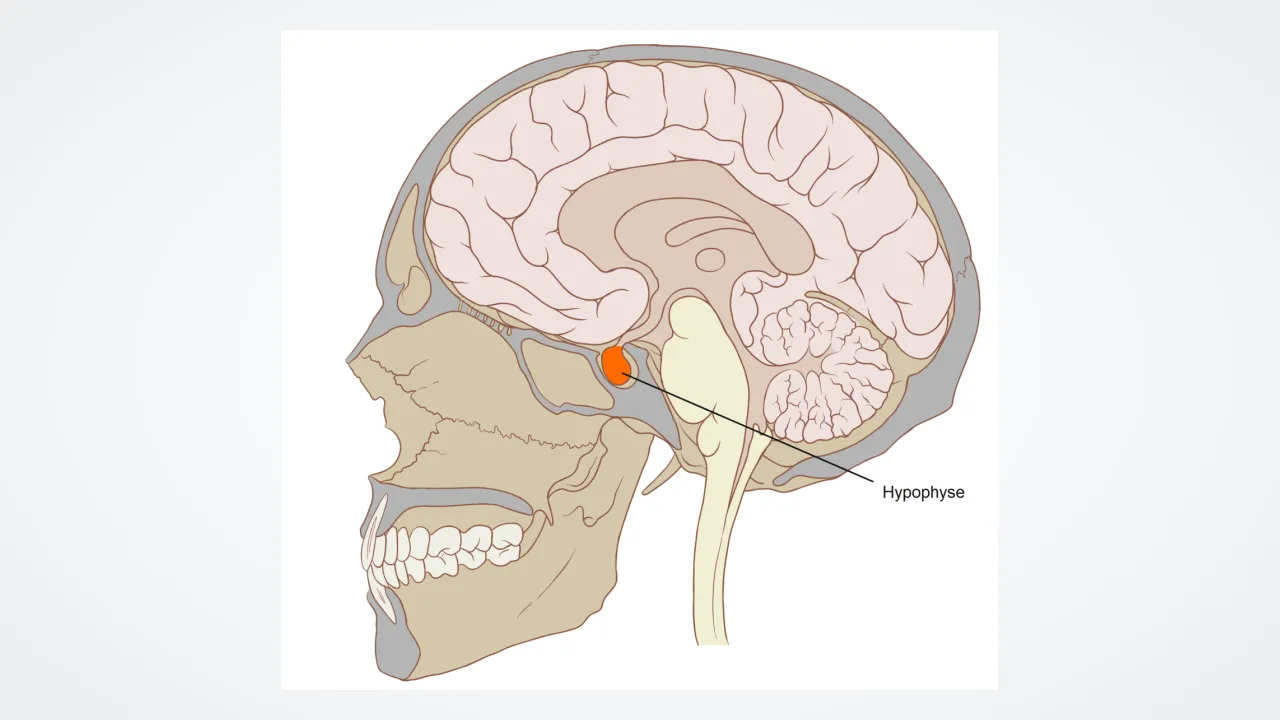
Picture a tiny green pea resting inside its own bony armchair right behind the bridge of your nose! That cozy skull pocket your pituitary gland, which hangs from the bottom of your brain by a thin stem.
2
Sending Chemical Letters
Instead of using wires, this busy gland mails chemical letters called hormones into your blood. Growth hormone travels to your leg and arm bones so you taller every year.
3
Leading the Team
Other pituitary hormones visit glands in your neck and above your kidneys to tell them when to work. Because it guides so many teammates, it earned the nickname gland!
1. How do pituitary hormones travel to your bones and organs?
2. Where is the pituitary gland safely tucked away?
🤯 Mind-Blowing Fact • Grade 3
Even though your pituitary gland weighs only half a gram—less than a single paperclip—its hormones touch nearly every tissue in your body!
✨ Word Sparks (Grade 3 Glossary)
Tap 🔊 to hear
lobe
A rounded section of a body organ
thyroid
A neck gland controlling body energy speed
tempo
The steady speed at which something moves
🪝
How can two halves of one tiny gland come from completely different parts of a growing baby?
1
Conductor of the Hormone Orchestra
Imagine an orchestra conductor waving a baton so violins, flutes, and drums all play at the right . Hanging just below your brain, the pea-sized pituitary gland conducts your endocrine system in the very same way, keeping energy, growth, and water levels in tune.
2
Safe in the Turkish Saddle
Because this half-gram gland is so important, your skull surrounds it with a curved bony pocket called the sella turcica, which means 'Turkish saddle' in Latin. Directly above it sits the hypothalamus, passing instructions down a slender stalk.
3
Two Lobes with Different Jobs
Look closely and you will discover the pituitary actually has two main halves, called ! The larger front lobe builds its own hormones, including growth hormone for your bones and -stimulating hormone to set how fast cells burn food energy.
4
Storing Water-Saving Helpers
Meanwhile, the smaller back acts like a storage warehouse. It holds hormones made upstairs in the hypothalamus and releases them into your blood to help your kidneys save water on hot, active days.
1. What does the Latin name 'sella turcica' describe?
2. Which lobe of the pituitary manufactures growth hormone for your bones and muscles?
🤯 Mind-Blowing Fact • Grade 4
Before birth, the front half of your pituitary gland actually starts out in the roof of your mouth and migrates upward to join the brain!
✨ Word Sparks (Grade 4 Glossary)
Tap 🔊 to hear
anterior
Located toward the front of an organ
metabolism
Chemical reactions turning food into usable energy
cartilage
Firm flexible tissue where young bones lengthen
🪝
Why is your master gland actually two distinct organs fused together like puzzle pieces?
1
Two Origins, One Tiny Organ
Before you were even born, a remarkable construction project happened inside your developing head. One small pouch of tissue grew upward from the roof of your embryonic mouth while another bud of nerve tissue grew downward from the base of your brain. When those two pieces met and locked together inside the sphenoid bone's sella turcica, they formed the two-part pituitary gland!
2
The Anterior Hormone Factory
Because the front lobe—the pituitary—grew from glandular tissue, it operates like a bustling chemical factory. Five specialized cell types manufacture six major hormones on command from the hypothalamus. Somatotrophs release growth hormone to lengthen growth plates near the ends of your bones, while thyrotrophs send thyroid-stimulating hormone to your neck to regulate .
3
Managing Stress and Energy
When you face a big challenge, corticotroph cells release adrenocorticotropic hormone, or ACTH. Racing through your bloodstream to the adrenal glands atop your kidneys, ACTH prompts the release of cortisol so your body has steady blood sugar and focus.
4
The Posterior Nerve Terminal
Unlike its busy neighbor, the posterior pituitary is packed with nerve endings stretching down from the hypothalamus. Instead of building new hormones, it stores and dispatches oxytocin and antidiuretic hormone, helping kidneys conserve water whenever dehydration threatens.
1. How do the anterior and posterior lobes of the pituitary differ before birth?
2. Where does ACTH travel after leaving the anterior pituitary?
🤯 Mind-Blowing Fact • Grade 5
Neurosurgeon Harvey Cushing discovered so much about the half-gram pituitary gland in 1912 that an entire endocrine condition—Cushing's syndrome—still bears his name!
✨ Word Sparks (Grade 5 Glossary)
Tap 🔊 to hear
hypophysis
The scientific anatomical name for pituitary gland
tropic
Describing hormones that activate other endocrine glands
chondrocyte
A specialized cell that builds bone-growing cartilage
🪝
How did scientists overturn a two-thousand-year-old myth about nasal mucus to uncover the body's master endocrine hub?
1
From Ancient Myth to Master Hub
Say the word 'pituitary' aloud and you are actually speaking ancient Latin for 'mucus'! Nearly two thousand years ago, the physician Galen guessed that this pea-sized structure beneath the brain drained waste fluids down into the nose. Modern endocrinology revealed a far grander truth: the , weighing barely 0.5 grams inside the sphenoid bone's sella turcica, governs growth, metabolism, stress adaptation, and fluid balance across the human body.
2
Embryology of Two Distinct Lobes
Microscopic anatomy explains why the gland performs two radically different styles of signaling. During early embryonic development, an upward pocket of oral ectoderm known as Rathke's pouch fuses with a downward extension of neuroectoderm from the diencephalon. That partnership yields the glandular adenohypophysis in front—comprising roughly eighty percent of the gland's mass—and the neural neurohypophysis behind.
3
Tropic Cascades and Negative Feedback
Most anterior pituitary secretions are '' hormones whose targets are other endocrine glands. Thyroid-stimulating hormone activates the thyroid, while adrenocorticotropic hormone stimulates the adrenal cortex. Crucially, this network polices itself through negative feedback loops: once rising thyroid hormone or cortisol levels reach sufficient concentrations in the blood, they signal both the hypothalamus and anterior pituitary to dial production back down.
4
Growth Plates and Liver Partners
Human growth hormone, a 191-amino-acid protein secreted in nighttime pulses by somatotroph cells, works both directly on tissues and indirectly through the liver. Stimulated liver cells release insulin-like growth factor 1 (IGF-1), which prompts inside epiphyseal growth plates to divide, lengthening childhood bones until those plates ossify in late adolescence.
5
Pioneering Pituitary Medicine
In the early 1900s, neurosurgeon Harvey Cushing mapped pituitary disorders and showed how minuscule shifts in hormone output reshape stature and energy. Today, synthetic bioidentical hormones engineered with recombinant DNA allow endocrinologists to safely treat growth or fluid-balance conditions worldwide.