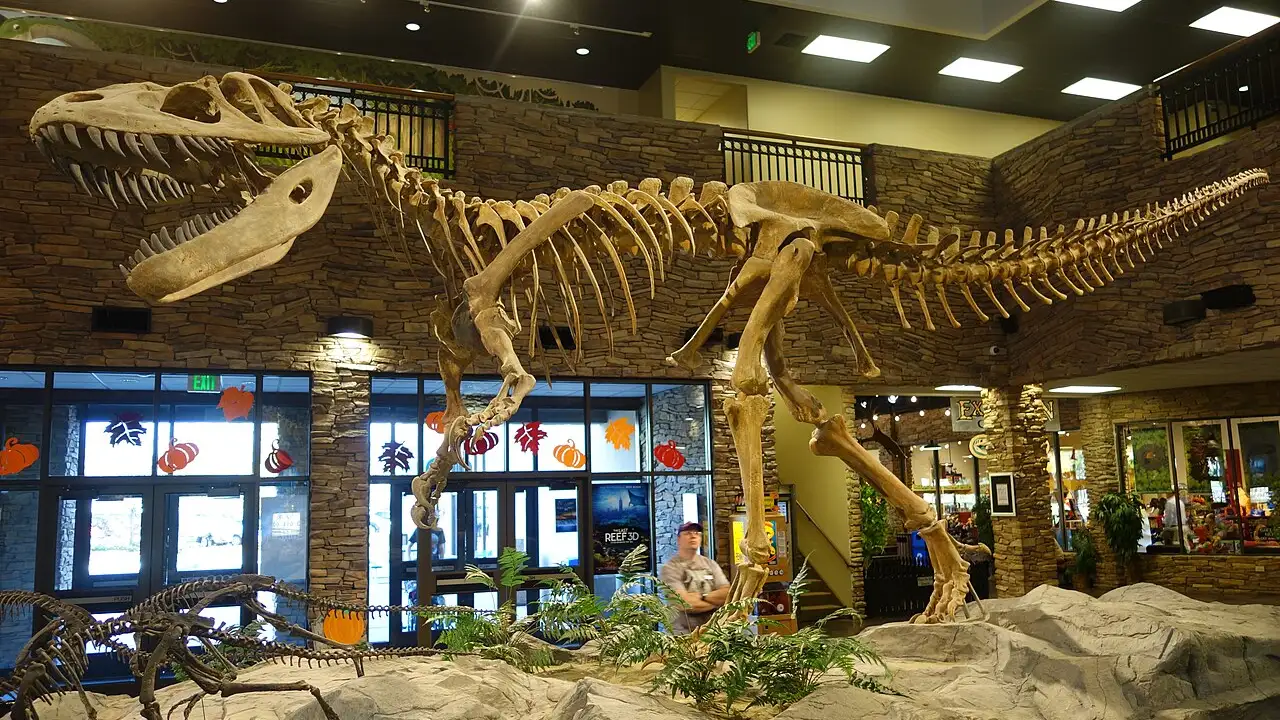
⚡ Survival SuperpowerFive-inch serrated dagger teeth paired with muscular short forearms and giant thumb claws
🤯 Mind-Blowing Fact • Grade 1
Scientists in Portugal found tiny fossilized Torvosaurus babies still curled inside their ancient eggs!
✨ Word Sparks (Grade 1 Glossary)
Tap 🔊 to hear
dagger
a long, sharp-pointed blade shape
continent
one of Earth's giant land areas
embryo
an unhatched baby growing inside eggs
🪝
Which Late Jurassic hunter had giant thumb claws AND teeth as long as bananas?
1
Savage Lizard Giant
Crunch, splash, thud! Along a shady Jurassic river stalks a massive predator. Torvosaurus means savage lizard, and it grew longer than a big moving truck!
2
Giant Thumb Claws
Its arms were short but super thick with muscle! Each hand carried a huge curved thumb claw for holding tight.
3
Across Two Continents
Fossils prove Torvosaurus lived in both western North America and coastal Portugal in Europe!
2. In which two parts of the world have Torvosaurus fossils been found?
🤯 Mind-Blowing Fact • Grade 2
Torvosaurus gurneyi was named in honor of artist James Gurney, creator of the beloved Dinotopia illustrated books!
✨ Word Sparks (Grade 2 Glossary)
Tap 🔊 to hear
estuary
wide river mouth meeting ocean tides
forearm
lower half of an arm
rival
another hunter competing for nearby food
🪝
Who was Europe's biggest land predator ever, and how did it share America with Allosaurus?
1
Europe's Record-Breaking Hunter
Stand back along a rocky Portuguese beach! One hundred fifty million years ago, thirty-six-foot Torvosaurus gurneyi patrolled ancient European estuaries. Weighing over four tons with a four-foot skull, it remains the largest land-living meat-eater ever unearthed in Europe!
2
Sharing With Allosaurus
Across the young Atlantic in Colorado and Utah, its twin species Torvosaurus tanneri lived beside Allosaurus. While common Allosaurus hunted across open dry plains, heavier Torvosaurus favored thick riverside woods and waterways.
3
Short Arms, Huge Power
Its were unusually short, yet thick bone ridges anchored bulging muscles and wickedly curved thumb hooks!
1. What size record does Torvosaurus gurneyi hold?
2. How did Torvosaurus avoid bumping constantly into Allosaurus in North America?
🤯 Mind-Blowing Fact • Grade 3
Fossilized Torvosaurus embryos found in Portugal are the oldest meat-eating dinosaur embryos ever discovered on Earth!
✨ Word Sparks (Grade 3 Glossary)
Tap 🔊 to hear
porous
having tiny holes letting air pass
root
deep base anchoring a tooth firmly
megalosaurid
family of stout, long-snouted Jurassic predators
🪝
What did fossilized embryos inside crushed eggs in Portugal reveal about baby Torvosaurus?
1
Cousin of Megalosaurus
Imagine a super-sized, four-ton upgrade of historic Megalosaurus! First discovered in Colorado's Dry Mesa Quarry in 1972 and named by Peter Galton and Dinosaur Jim Jensen in 1979, Torvosaurus was the heavyweight champion of the family—stretching over thirty-three feet from long snout to muscular tail.
2
Fewer Teeth, Bigger Blades
Compared with Allosaurus, Torvosaurus had a longer, straighter snout holding fewer—but much larger—teeth! Each thick, serrated blade grew up to five inches long, anchored by deep that withstood tremendous tugging forces against armored stegosaurs and young sauropods.
3
Rarest Prize in Paleontology: Embryos!
In 2013, Portuguese paleontologists announced fossilized dinosaur eggs from Lourinha containing tiny embryonic jawbones and serrated teeth matching Torvosaurus! These ultra-rare fossils are the oldest theropod embryos ever identified.
4
Single-Shell Egg Design
Microscope slices showed Torvosaurus eggs had a single mineral layer—more reptilian than later bird-like raptor eggs—meaning parents likely buried them in warm sand!
1. How did the teeth of Torvosaurus compare to those of Allosaurus?
2. What did the shell structure of Portuguese Torvosaurus eggs suggest about nesting?
🤯 Mind-Blowing Fact • Grade 4
Although Torvosaurus had arms shorter in proportion than Allosaurus, its upper arm bone was thicker than a human thigh and anchored enormous grappling muscles!
✨ Word Sparks (Grade 4 Glossary)
Tap 🔊 to hear
rift
gradual splitting apart of continental crust
leverage
mechanical advantage multiplying pulling force
ambush
a surprise lunge from hidden cover
🪝
How could two Torvosaurus species live on opposite sides of the young Atlantic Ocean 150 million years ago?
1
Transatlantic Giants of the Late Jurassic
During the Kimmeridgian and Tithonian stages 150 million years ago, North America and Europe had recently begun rifting apart as the young North Atlantic Ocean opened. Yet fossil hunters in Colorado, Wyoming, Utah, and coastal Portugal kept uncovering giant megalosaurid jaws that looked nearly identical! In 2014, paleontologists Christophe Hendrickx and Octavio Mateus proved the Portuguese fossils represented a distinct sister species, Torvosaurus gurneyi, showing an ancestral lineage split by rising seas.
2
Brawn Over Speed
While Allosaurus was relatively common and lightly built across the Morrison Formation, Torvosaurus accounted for a rarer, brawnier guild along wooded river corridors. Its humerus was remarkably stout, whereas its radius and ulna measured less than half the upper arm's length—creating a compact, high- grappling winch tipped with an enormous sickle-curved thumb ungual.
3
Heavy-Duty Cranial Bite
Lacking a tall bony crest, its elongated 115-centimeter skull concentrated bone thickness along the maxillae to anchor ten or eleven massive ziphodont teeth per side, capable of tearing hides on diplodocids, camarasaurids, and dacentrurine stegosaurs.
4
Embryonic Window Into Growth
Lourinha clutch fossils preserving embryonic maxillae and vertebrae prove megalosaurids laid thin, high-porosity eggs buried inside moist riverbank sediments.
1. Why did closely related species of Torvosaurus live in both Colorado and Portugal?
2. Why did having a very short forearm paired with a thick upper arm help Torvosaurus?
🤯 Mind-Blowing Fact • Grade 5
Scientists could tell the Portuguese and American species of Torvosaurus apart simply by counting tooth sockets in the upper jaw—Torvosaurus gurneyi packed fewer than eleven giant blades per side, while Torvosaurus tanneri held eleven or more!
✨ Word Sparks (Grade 5 Glossary)
Tap 🔊 to hear
allopatric
evolving into new species when separated geographically
riparian
living along wooded banks of rivers
conductance
ease with which gas passes eggshells
🪝
How did Torvosaurus rival the largest Late Jurassic allosaurids through megalosaurid jaw and forelimb engineering?
1
From Dry Mesa Quarry to Lourinha Cliffs
In 1972, Brigham Young University researchers James Jensen and Kenneth Stadtman excavated gigantic theropod forelimb and pelvic bones from Colorado's Dry Mesa Quarry within the Upper Jurassic Morrison Formation, naming Torvosaurus tanneri with Peter Galton in 1979. Decades later along coastal cliffs of Portugal's Lourinha Formation, giant maxillae led Christophe Hendrickx and Octavio Mateus in 2014 to establish sister species Torvosaurus gurneyi—confirming an eleven-meter, four-metric-ton European apex predator.
2
Diagnostic Cranial and Dental Divergences
Although transatlantic cousins shared elongated megalosaurine skulls approaching 1.15 meters, subtle osteological markers separate them: North American Torvosaurus tanneri carried eleven or more maxillary teeth and a prominent interdental wall style, whereas European Torvosaurus gurneyi possessed fewer than eleven broader, twelve-centimeter-crown blades lacking fused interdental plates in the same configuration—textbook speciation across the opening proto-Atlantic.
3
High-Leverage Forelimb Mechanics
Torvosaurus pushed megalosauroid forelimb specialization to an extreme. An exceptionally robust humerus paired with an ulna less than half its length created a high-mechanical-advantage lever system, driving a hypertrophied manual digit-one ungual sheath during close-quarters prey restraint.
4
Riparian Niche Partitioning
Stable-isotope and paleoenvironmental distributions across Morrison and Lourinha strata indicate Torvosaurus preferentially haunted forested corridors and coastal deltas—partitioning ecosystems alongside open-savanna Allosaurus and smaller Ceratosaurus so multiple multi-ton predators could coexist without constant direct conflict.
5
Oldest Diagnostic Theropod Embryos
Portuguese clutch ML 1188 preserved articulated embryonic bones inside single-layered, high- eggshells, proving basal tetanurans still utilized buried, substrate-warmed nests rather than open avian brooding. Rapid prenatal ossification of the serrated maxillae ensured hatchling Torvosaurus emerged ready to snap up small floodplain prey immediately.