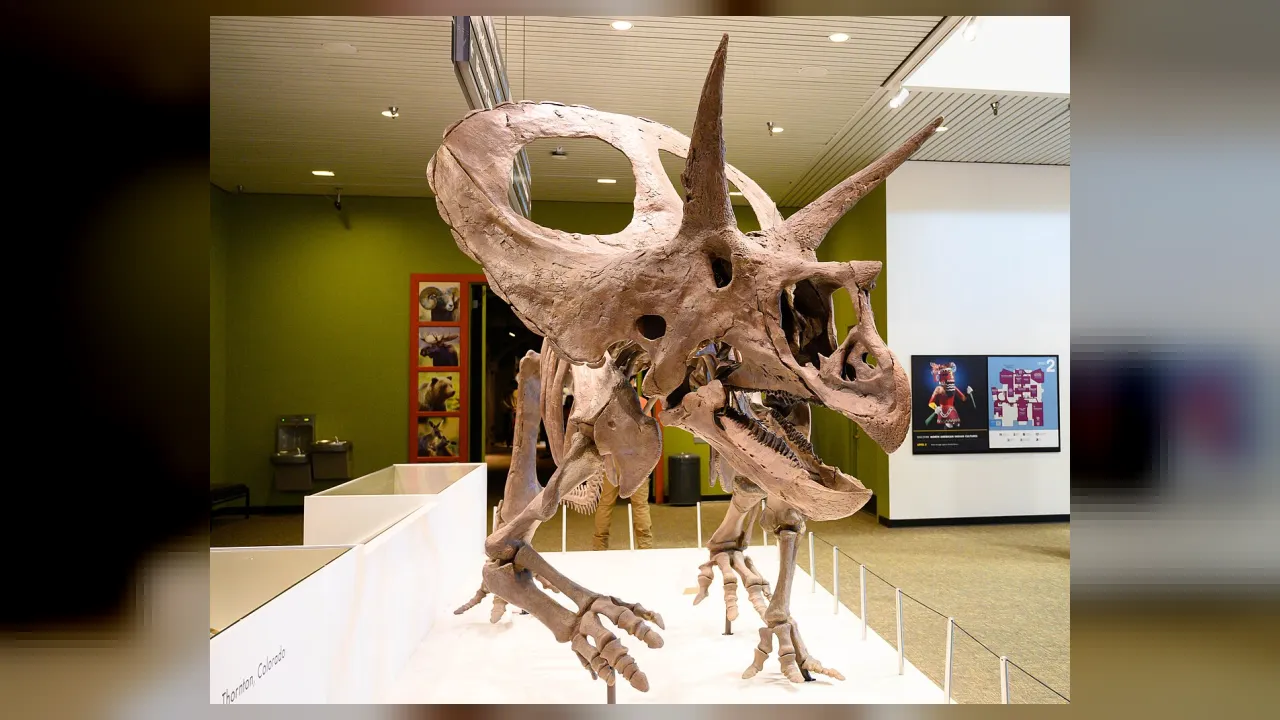
2. About how long could a single Torosaurus skull grow?
🤯 Mind-Blowing Fact • Grade 2
Only giant whales swimming in the ocean have ever grown skulls longer than land-dwelling Torosaurus!
✨ Word Sparks (Grade 2 Glossary)
Tap 🔊 to hear
Window
An open space inside a bony shield
Rim
The outer border edge of a frill
Contemporaries
Animals living at the exact same time
🪝
Why do so many people get fooled by the meaning of Torosaurus's name?
1
Giant of the Final Days
Boom, boom! Six tons of muscle and bone shake the ferns of ancient Montana 66 million years ago. Out walks Torosaurus, living alongside Triceratops and Tyrannosaurus rex at the very end of the Age of Dinosaurs! Its enormous skull reached nearly nine feet from beak to frill.
2
Not Named After a Bull
Because toro means bull in Spanish—and Torosaurus had big bull-like brow horns—almost everyone guesses its name means 'bull lizard.' Actually, paleontologist Othniel Charles Marsh named it 'perforated lizard' in 1891 for the two round holes in its sweeping neck shield!
3
Smooth Shield vs. Wavy Shield
Unlike Triceratops, which had a shorter solid frill with wavy bumps, Torosaurus carried a smooth-edged, super-long frill with two round .
1. How can you tell a Torosaurus skull apart from a Triceratops skull?
2. Which famous meat-eating dinosaur shared the same forests as Torosaurus?
🤯 Mind-Blowing Fact • Grade 3
Fossils of Torosaurus stretch all the way from Saskatchewan, Canada, down to Big Bend in southern Texas!
✨ Word Sparks (Grade 3 Glossary)
Tap 🔊 to hear
Hypothesis
A testable scientific idea explaining clues
Valid
Confirmed by evidence as real and separate
Ball-and-Socket
Round joint letting heavy heads pivot smoothly
🪝
Was Torosaurus really just a great-grandparent Triceratops, or its own distinct giant?
1
Record-Breaking Headgear
Imagine standing next to a dinosaur skull propped upright—and realizing you need a tall ladder just to touch the top of its frill! Measuring up to 8.9 feet (2.77 meters) long, the skull of Torosaurus rivals Pentaceratops and Eotriceratops as the longest head of any land animal ever.
2
Two Round Frill Windows
John Bell Hatcher discovered the first two skulls in Wyoming in 1891, and Othniel Charles Marsh named Torosaurus ('pierced lizard') for the twin circular fenestrae lightening its huge, fan-like shield. Ten to twelve flat, low bony plates smoothed out its upper frill rim.
3
The Great Triceratops Debate
In 2010, two paleontologists sparked headlines by suggesting Torosaurus was actually an elderly Triceratops whose solid frill stretched thin and opened two holes in old age!
4
Clues That Saved Torosaurus
Other scientists soon pointed out major differences: Torosaurus had way more edge bones around its frill, holes placed in a different bone zone, and young-adult Torosaurus skulls that already had holes—keeping Torosaurus on museum signs today!
1. How could Torosaurus turn and lift a skull that was nearly nine feet long?
2. What evidence convinced most paleontologists that Torosaurus is NOT just an old Triceratops?
🤯 Mind-Blowing Fact • Grade 4
A huge solid-rock ball joint at the base of Torosaurus's skull, as big as a cantaloupe, let this six-ton dinosaur pivot its nine-foot head smoothly in any direction!
✨ Word Sparks (Grade 4 Glossary)
Tap 🔊 to hear
Resorb
When body cells dissolve and recycle bone
Suture
Seam line where growing skull bones meet
Upland
Higher, drier land away from swampy rivers
🪝
How did a heated scientific debate over Torosaurus and Triceratops sharpen modern dinosaur bone detective work?
1
Titan of the Maastrichtian
During the final two million years of the Cretaceous Period (68 to 66 million years ago), six-ton Torosaurus latus roamed from Canada down to New Mexico and Texas. Though much rarer in Hell Creek rocks than its superstar neighbor Triceratops—which outnumbers it roughly twenty to one in lowland swamps—Torosaurus carried a sweeping, smooth-rimmed parietal shield that stretched its total skull length to an astonishing 2.77 meters (over 9 feet)!
2
Testing the 'Toroceratops' Hypothesis
Why hadn't anyone ever found a tiny baby Torosaurus skull? In 2010, John Scannella and Jack Horner proposed a bold ontogenetic hypothesis: as Triceratops reached extreme old age, bone cells resorbed thin patches in its solid frill to punch open twin fenestrae, transforming Triceratops into Torosaurus! If true, the two dinosaurs would merge under the older 1889 name Triceratops.
3
Anatomical Counter-Evidence
Nicholas Longrich, Andrew Farke, and Leonardo Maiorino tested that idea across dozens of skulls using morphometrics and bone . First, Triceratops carries five to seven wavy epiparietal bones plus a central midline bump, whereas Torosaurus carries ten to twelve flat plates with zero midline bone. Second, Yale specimen YPM 1831 represents an immature Torosaurus with unfused skull sutures that already displays full parietal fenestrae!
4
Upland Specialist
Why is Torosaurus rarer in lowland floodplains? Many researchers suspect Torosaurus preferred drier forests farther from rivers, where fossils preserve less frequently.
1. Why was Yale specimen YPM 1831 such a crucial clue in the Torosaurus vs. Triceratops debate?
2. Why might Torosaurus fossils be rarer than Triceratops in Hell Creek riverbeds?
🤯 Mind-Blowing Fact • Grade 5
Southern cousins called Torosaurus utahensis have been discovered in bonebeds containing multiple juveniles and adults together in Utah and Texas—areas where northern Triceratops never even lived!
✨ Word Sparks (Grade 5 Glossary)
Tap 🔊 to hear
Synonymy
Two scientific names referring to one species
Senescence
Advanced old age in a mature organism
Condyle
Rounded bone knob forming a smooth joint
🪝
How did cranial sutures, epiparietal loci, and upland biogeography resolve the famous taxonomic controversy surrounding Torosaurus?
1
Colossus of the Terminal Cretaceous
Excavated in 1891 by fossil-hunting legend John Bell Hatcher from the Lance Formation of southeastern Wyoming and named months later by Othniel Charles Marsh—from the Greek toreō ('to pierce' or 'perforate'), referencing its paired parietal fenestrae rather than Latin taurus—Torosaurus stood among the last and grandest chasmosaurine ceratopsids on Earth. Reaching 8.5 meters (28 feet) in body length and roughly six metric tons, Museum of the Rockies specimen MOR 1122 boasts a 2.77-meter skull, vying with Pentaceratops for the longest terrestrial vertebrate cranium ever evolved.
2
Biogeography From Saskatchewan to Texas
Spanning the late Maastrichtian (68 to 66 million years ago) right up to the Cretaceous-Paleogene boundary, Torosaurus split ecologically across two geographic species or populations: northern Torosaurus latus across the Hell Creek, Lance, and Frenchman formations, and southern Torosaurus utahensis from Utah, New Mexico, and Texas's Javelina Formation—making it far wider-ranging latitudinally than lowland-concentrated Triceratops.
3
The Ontogenetic Synonymy Challenge
In 2010, John Scannella and Jack Horner noted osteohistological remodeling inside thinning pockets on Triceratops parietals and hypothesized that Triceratops skulls elongated and perforated into 'Torosaurus' morphs at extreme —a proposal that gripped paleontology because taxonomy's rule of priority would sink Torosaurus (1891) into Triceratops (1889).
4
Falsifying Synonymy via Cranial Homology
Subsequent peer-reviewed investigations by Andrew Farke (2011), Nicholas Longrich and Daniel Field (2012), and Leonardo Maiorino (2013) refuted on multiple independent grounds. Triceratops possesses five to seven triangular epiparietals including a diagnostic midline locus, whereas Torosaurus bears ten to twelve flattened, non-midline osteoderms; the thinned ventral depressions on Triceratops squamosals and parietals do not match the anatomical position of Torosaurus fenestrae; and subadult Torosaurus skulls (such as YPM 1831 and ANSP 15192) exhibit open cranial sutures alongside fully formed fenestrae.
5
Niche Partitioning Before the Asteroid
Rather than representing a growth stage, Torosaurus maintained ancestral chasmosaurine fenestration for towering socio-sexual display across drier inland woodlands while Triceratops evolved a thickened, solid defensive shield in coastal swamps.