2. Where did Titanoboa spend most of its time moving easily?
🤯 Mind-Blowing Fact • Grade 2
Scientists first realized Titanoboa existed when a student spotted fossilized leaves in a Colombian coal pit, leading a team straight to giant snake backbones!
✨ Word Sparks (Grade 2 Glossary)
Tap 🔊 to hear
Cold-blooded
Relying on outside warmth to heat the body
Vertebra
One single bone link inside a backbone
Paleocene
Time period right after the dinosaurs vanished
🪝
How did a coal mine in South America uncover Earth's very first tropical rainforest—and its forty-five-foot ruler?
1
Born After the Dinosaurs Vanished
Travel back fifty-nine million years to northern Colombia, just a few million years after the asteroid wiped out giant dinosaurs! Warm, steamy swamps covered the land in Earth's oldest known tropical rainforest. Gliding beneath the murky water was Titanoboa, a 2,500-pound cousin of boa constrictors and anacondas.
2
Why Heat Made Snakes Huge
Snakes are , meaning they get their body warmth from the air and water around them. Because ancient Colombia was several degrees warmer than today's tropics, a cold-blooded snake could keep its metabolism running smoothly even at over forty feet long!
3
Slippery River Meals
Skull fossils full of needle-sharp, backward-pointing teeth surprised scientists by showing Titanoboa loved catching seven-foot-long armored lungfish!
1. Why was ancient Colombia's extra-warm climate so important for Titanoboa's giant size?
2. What surprising favorite meal did Titanoboa's fossilized skull and teeth reveal?
🤯 Mind-Blowing Fact • Grade 3
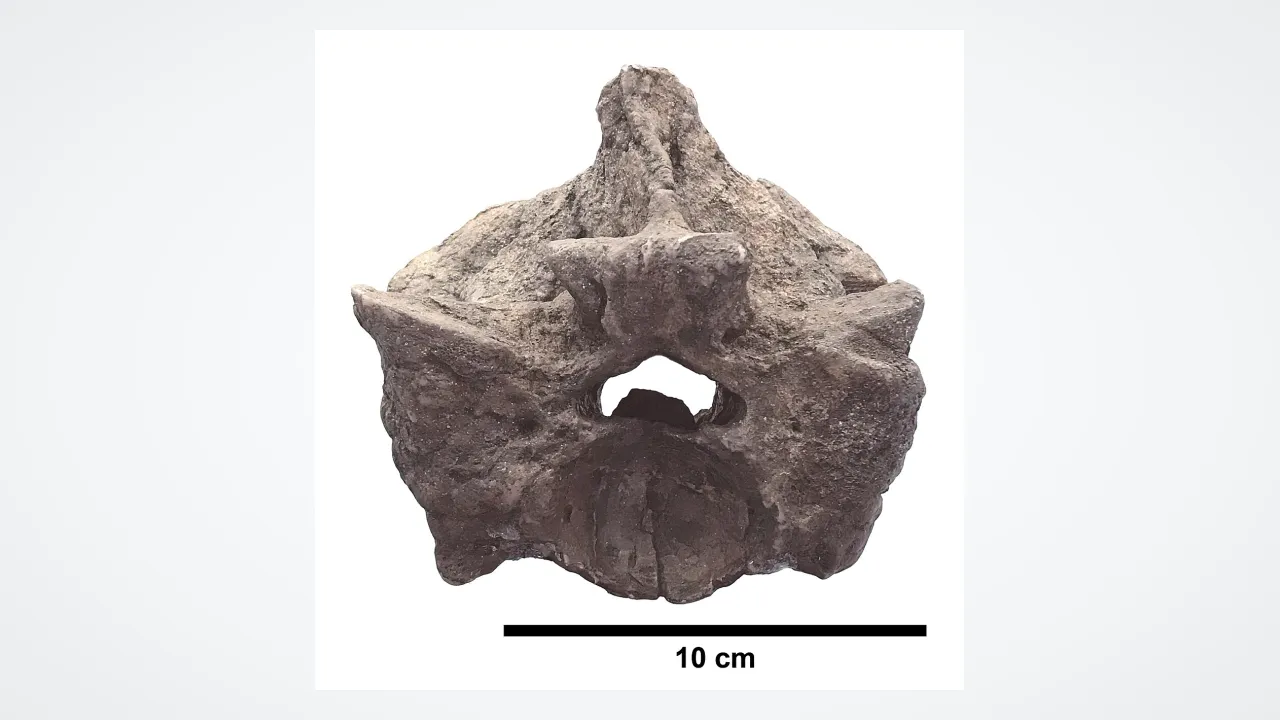
When paleontologists placed a single fossil backbone of Titanoboa side by side with a backbone from a twenty-foot modern green anaconda, the modern bone looked like a tiny toy!
✨ Word Sparks (Grade 3 Glossary)
Tap 🔊 to hear
Ectothermic
Warming the body using outside environmental heat
Constrictor
Non-venomous snake that wraps around prey
Lungfish
Freshwater fish able to breathe air with lungs
🪝
How can paleontologists use the size of a fossilized snake backbone as a giant ancient thermometer?
1
Treasure in Cerrejón Coal Mine
In 2002, Colombian geology student Fabiany Herrera found fossilized rainforest leaves inside the vast Cerrejón open-pit coal mine in northern Colombia. Soon paleontologists Jonathan Bloch, Carlos Jaramillo, and Jason Head uncovered massive vertebrae—each wider than a grapefruit—from twenty-eight individual giant snakes! Named Titanoboa cerrejonensis in 2009, adults measured roughly thirteen to fourteen meters (42–47 feet) long.
2
A Living Paleothermometer
Because (cold-blooded) reptiles depend on ambient heat to digest food and power cells, the maximum size a snake can reach is tied directly to average yearly temperature. Calculating backward from Titanoboa's size proved Paleocene equatorial rainforests averaged 30 to 34 degrees Celsius (86–93°F)—warmer than today's Amazon!
3
Finding the Rare Skull
Snake skulls are built from thin, loosely connected bones that almost always scatter after death. Miraculously, researchers later recovered three partial Titanoboa skulls measuring forty centimeters long.
4
Fish-Specialist Boa
Loosely hinged palatal teeth and slender, curved fangs matched aquatic fish-eating snakes, showing Titanoboa ambushed giant and osteoglossids alongside river turtles and crocodyliforms.
1. How did Titanoboa act as a 'paleothermometer' for scientists studying ancient climate?
2. Why are fossilized snake skulls much rarer than fossilized snake backbones?
🤯 Mind-Blowing Fact • Grade 4
Titanoboa stretched more than 250 individual backbone vertebrae from neck to tail—each central torso bone measuring nearly five inches wide!
✨ Word Sparks (Grade 4 Glossary)
Tap 🔊 to hear
Poikilotherm
Animal whose internal temperature varies with surroundings
Neotropical
Relating to tropical regions of Central and South America
Recurved
Curving backward toward the throat to hold prey
🪝
Why did finding Titanoboa's forty-centimeter skull completely flip scientists' expectations of how a one-ton boa hunted?
1
Rebirth of the Tropics After Chicxulub
Slip into the humid coastal swamps of Colombia's Cerrejón Formation fifty-eight million years ago, just eight million years after the Chicxulub asteroid ended the Mesozoic Era. Towering palms, legumes, and aroids formed Earth's earliest documented rainforest. Patrolling slow rivers where five-foot Carbonemys turtles and Acherontisuchus crocodyliforms swam was Titanoboa cerrejonensis—stretching ~13 to 14.3 meters and topping 1.1 metric tons.
2
Why Skull Anatomy Surprised Everyone
Because Titanoboa belonged to the subfamily Boinae—close cousin to modern boa constrictors and Madagascar boas—everyone initially pictured it coiling tightly around giant crocodiles to suffocate them. Then in 2013, Jason Head's team assembled rare cranial elements into a complete 40-centimeter skull reconstruction. Surprisingly, Titanoboa exhibited weakly fused palatine-pterygoid joints, reduced quadrate rotation, and unusually high numbers of slender, needle-sharp, posteriorly hooked teeth—classic hallmarks of piscivory (fish-eating), seen today only in small aquatic colubrid and file snakes!
3
Snapping Three-Meter Fish
Cerrejón rivers abounded with three-meter lungfish and arapaima-relative osteoglossomorphs coated in slick mucus. Buoyed effortlessly underwater, Titanoboa lunged upward to impale massive fish on rows of teeth and swallow them whole without needing prolonged constriction.
4
Climate Clues for a Greenhouse World
Proving that lush, diverse rainforests thrived alongside a fourteen-meter at 30–34°C challenged older computer models that predicted tropical forests would burn into deserts during greenhouse intervals.
1. Which skull features discovered in 2013 revealed that Titanoboa specialized heavily in catching large fish?
2. What important ecological lesson did the Cerrejón fossils teach climate scientists about Paleocene warmth?
🤯 Mind-Blowing Fact • Grade 5
Titanoboa evolved dedicated fish-eating jaw mechanics never seen in any other living or extinct member of the boa family—making it the world's only one-ton 'file-snake mimic'!
✨ Word Sparks (Grade 5 Glossary)
Tap 🔊 to hear
Kinesis
Flexible movement between separate bones inside a skull
Precloacal
Trunk vertebrae located ahead of the tail base
Dipnoan
Member of the ancient air-breathing lungfish lineage
🪝
How did Paleocene coal-mine stratigraphy, metabolic scaling laws, and rare cranial bones reveal an evolutionary one-off among boid snakes?
1
Unearthing the Cerrejón Paleobiota
Exposed across massive open-cast coal seams in Colombia's Ranchería Basin (La Guajira Peninsula), the middle-to-late Paleocene Cerrejón Formation (60–58 MYA) preserves the earliest known crown-group neotropical rainforest ecosystem. Following paleobotanist Fabiany Herrera's 2002 leaf discoveries, expeditions led by Carlos Jaramillo, Jonathan Bloch, and Jason Head recovered vertebrae and three skulls from at least twenty-eight individuals of Titanoboa cerrejonensis (described in Nature, 2009). Vertebral landmark regressions across extant boids establish adult body lengths of 12.8 to 14.3 meters and masses around 1,135 kilograms—eclipsing Eocene Gigantophis and Miocene Vasuki in overall bulk.
2
Poikilothermic Scaling and Paleothermometry
In terrestrial and semi-aquatic poikilotherms, basal metabolic rate rises exponentially with ambient temperature; consequently, achieving larger body mass without starving tissues requires warmer mean annual temperatures (MAT). Applying biophysical scaling curves anchored to living green anacondas (Eunectes murinus), Head and colleagues calculated that sustaining a 13-meter boid demanded an equatorial Paleocene MAT of 30 to 34°C (compared with ~26–27°C today), corroborated independently by leaf-margin paleobotanical proxies and high atmospheric CO2 (~1,000–2,000 ppm).
3
Cranial Kinesis and Piscivorous Convergence
Whereas extant large boines subdue endothermic mammals and reptiles via high-pressure constriction, cranial reconstruction of Titanoboa's 40-centimeter skull unveiled unexpected trophic specialization. Weakly articulated palatine-pterygoid joints, low-angled quadrate suspension, long dentaries, and densely packed, slender, strongly recurved marginal and palatal teeth decreased resistance against struggling, mucus-slick aquatic prey—converging directly on acrochordid file snakes and homalopsid water snakes.
4
Apex Dynamics in Coastal Alluvial Swamps
Buoyed inside turbid estuarine rivers alongside giant lungfish (Lepidosiren relatives exceeding two to three meters), osteoglossids, pelomedusoides turtles (Carbonemys cofrinii), and dyrosaurid crocodyliforms (Cerrejonisuchus and Anthracosuchus), Titanoboa functioned as the world's premier mega-piscivore, opportunistically taking aquatic reptiles as well.
5
Cooling Climates Cap Boid Gigantism
Following the Paleocene-Eocene Thermal Maximum, gradual Cenozoic global cooling and drainage reorganization lowered tropical river temperatures—shrinking boine size ceilings toward modern seven-meter Eunectes.