🎵 INSTRUMENTS
🎶 Tuned Hemispherical Kettle Membranophone (Hornbostel-Sachs 211.11)
VA Music, Fine Arts & Sound Physics SOL 5.5
Timpani (Kettledrums)
Copper Kettles That Sing Tuned Thunder
Grade 2 • Developing • 103 words
🎶 Instrument Family & OriginPercussion family; descended from Middle Eastern naqqara cavalry drums, entering European orchestras in the 1600s
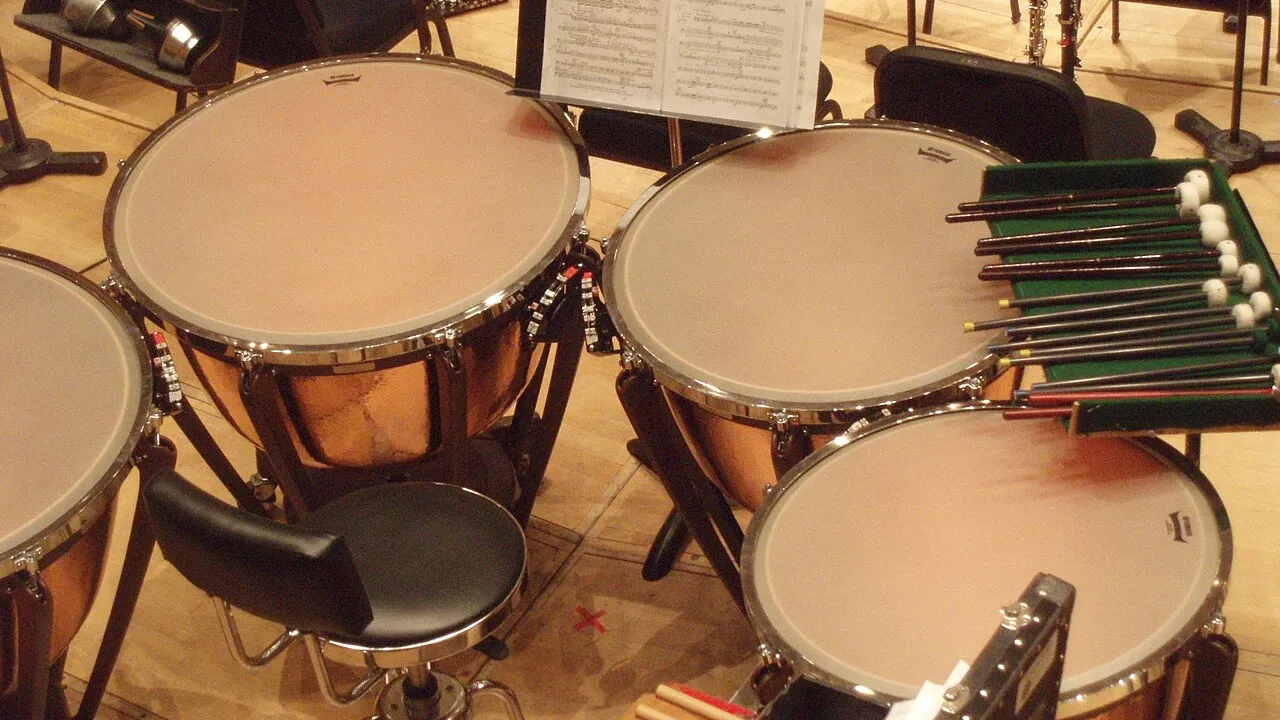
🪵 Materials & RangeHammered copper bowls (20–32 in / 51–81 cm across) with calfskin or Mylar heads; set of 4–5 spans ~2 octaves (D2 to C4)
🔊 How Sound Is MadeFelt-wrapped mallets strike near the rim while enclosed kettle air aligns vibrations into clear musical pitches
⚡ Signature Sound SparkChanges exact musical notes mid-song with the press of a foot pedal, booming like tuned thunder
🤯 Mind-Blowing Fact • Grade 1
Long ago, pairs of smaller kettledrums rode into parades strapped to the sides of horses and camels!
✨ Word Sparks (Grade 1 Glossary)
Tap 🔊 to hear
kettle
Deep round metal bowl shaped like pot
mallet
Stick with a soft round padded head
pedal
Foot lever pressed down to change pitch
🪝
Have you ever heard a shiny copper drum sing real musical notes?
1
Boom-BOOM-BAAH!
Boom-BOOM-BAAH! Four big shiny copper bowls gleam at the back of the stage! Soft fuzzy bounce off the tight drum tops. Out rolls a grand, singing rumble!
2
Drums That Sing Notes
Most drums only make taps or booms. These special bowl drums sing real low and high notes! Bigger bowls sing deeper than smaller ones.
3
Step on the Pedal!
A foot sits under each copper bowl. Pressing down stretches the top skin tighter. Tighter skin makes the drum note jump higher!
1. What happens to a kettledrum's note when the player presses down the foot pedal?
2. What shiny metal forms the big round bowls of orchestral timpani?
🤯 Mind-Blowing Fact • Grade 2
The magnificent three-note opening of *Also sprach Zarathustra* by Richard Strauss ends with a dramatic low-high-low timpani thunderbolt known around the world!
✨ Word Sparks (Grade 2 Glossary)
Tap 🔊 to hear
membrane
Thin stretched skin vibrating across a drum
timpanist
Musician who plays and tunes the timpani
roll
Fast alternating mallet strokes blending into rumble
🪝
Why does a timpanist never hit the exact center of the drumhead?
1
Thunder With a Melody!
Listen as two soft felt mallets blur into a rising that shakes the concert hall like summer thunder! Arranged in a curved half-circle around one busy musician stand four or five gleaming copper kettledrums of graduated sizes.
2
Aim Near the Rim, Not the Middle!
Surprisingly, striking dead center on a kettledrum makes a dull, clunky thud! Instead, players strike a sweet spot about three or four inches inside the metal rim, where the stretched rings with a clear, singing musical pitch.
3
Tuning on the Fly
During quiet orchestra moments, you might spot the leaning down to check pointer gauges while nudging foot pedals—retuning drums silently for the next big chord!
How does an empty copper bowl turn a noisy drum skin into a clear musical note?
1
From Desert Cavalry to Royal Courts
Imagine medieval horsemen galloping across Middle Eastern sands with paired bowl drums called booming from their saddles! European knights admired their royal thunder, and by the 1600s, larger copper kettledrums marched indoors alongside trumpets to crown the Baroque orchestra.
2
Secret of the Trapped Air Cushion
Stretch a flat drumhead in open air and its vibrations clash in messy, untuned patterns. Enclose that membrane over a round copper kettle, however, and the cushion of trapped air inside slows down the lowest vibration modes until the overtones line up into one clear, singing pitch!
3
Mechanical Pedals Change History
Early players had to twist six or eight T-shaped screws by hand just to change one note. In the late 1800s, German inventors linked every to a balanced foot pedal, unlocking instant pitch changes—and even spooky sliding glissandos!
4
Choosing the Right Mallet
Timpanists keep an entire tray of mallets wrapped in fluffy felt, firm flannel, leather, or bare wood to paint anything from misty rolls to gunshot cracks.
1. What acoustic job does the enclosed air inside a timpani's copper bowl perform?
2. Before foot pedals were invented in the 1800s, how did players retune a kettledrum?
🤯 Mind-Blowing Fact • Grade 4
In Béla Bartók's *Music for Strings, Percussion and Celesta*, the timpanist slides the foot pedals continuously while rolling to create eerie, swooping drum glissandos!
✨ Word Sparks (Grade 4 Glossary)
Tap 🔊 to hear
counterhoop
Outer metal ring clamping down the drumhead
tonic
Main home-base note of a musical key
Mylar
Weather-steady polyester film used for drumheads
🪝
Why did Beethoven shock 19th-century audiences by treating kettledrums like soloists instead of background noise?
1
Breaking the Tonic-Dominant Rule
Throughout the 1700s, Classical composers like Haydn and Mozart nearly always paired two hand-tuned kettledrums with two natural trumpets, tuning one drum to the home note () and the other a fourth lower (dominant). Then came Ludwig van Beethoven: he tuned timpani a dramatic octave apart in his Eighth and Ninth Symphonies and even opened his Violin Concerto with five quiet, soloistic timpani taps!
2
Circular Membrane Modes and Kettle Loading
When a circular membrane vibrates alone in open space, its natural frequencies follow complex Bessel-function ratios that sound fuzzy and unpitched. Mounting that membrane over a hemispherical or parabolic copper bowl with a tiny 2-centimeter bottom pressure-relief vent adds air-mass loading chiefly to radially symmetric modes, nudging the primary rim-struck diametric modes (1,1), (2,1), and (3,1) into clean 2:3:4 harmonic alignment!
3
Dresden Ratchets and Balanced Action Pedals
In 1881, Dresden Royal Orchestra machinist Carl Pittrich perfected a foot-clutch pedal mechanism attaching a master spider linkage under the bowl to every tension rod. Today, timpanists choose between classic clutch-ratchet Dresden pedals and spring-balanced Berlin/American pedals across four standard sizes: 32, 29, 26, and 23 inches (plus a high 20-inch piccolo timpano).
4
Calfskin Warmth Versus Synthetic Stability
Traditionalists prize natural calfskin or goatskin heads for velvety overtone complexity, though stage humidity swings make skin go flat in damp air and sharp under hot spotlights—leading many modern halls to use stable film.
1. Why is there a small dime-sized vent hole at the very bottom of a timpani's copper bowl?
2. How does hot, dry concert spotlighting affect a natural calfskin timpani head?
🤯 Mind-Blowing Fact • Grade 5
When you hear a timpani boom low A2 (110 Hz), the drumhead isn't bouncing up and down as one whole sheet—one half of the circle moves up while the opposite half moves down across an invisible center line!
✨ Word Sparks (Grade 5 Glossary)
Tap 🔊 to hear
nodal diameter
Still line dividing opposite vibrating drumhead halves
axisymmetric
Vibrating evenly around the exact circular center
bearing edge
Smooth rim lip where drumhead touches bowl
🪝
How does air-cavity baffling reshape inharmonic Bessel modes into a musical 2:3:4 harmonic spectrum?
1
Organology and Orchestral Range Architecture
Classified under Hornbostel-Sachs 211.11 as directly struck hemispherical kettle membranophones, modern orchestral timpani appear in graduated batteries of four or five drums—standard diameters of 81, 74, 66, 58, and 51 centimeters (32, 29, 26, 23, and 20 inches). Collectively spanning nearly two chromatic octaves from D2 (73.4 Hz, occasionally C2 at 65.4 Hz) to C4 (261.6 Hz), each drum tunes cleanly across a perfect fifth to major sixth via spider-linked tension rods.
2
Modal Physics: Taming Bessel Functions
An ideal tensioned circular membrane clamped at its rim vibrates in nodal circles (m) and (n) governed by roots of Bessel functions: relative to the (0,1) fundamental at 1.00f, upper modes sit at 1.59f (1,1), 2.14f (2,1), 2.30f (0,2), and 2.65f (3,1)—an inharmonic cluster devoid of clear pitch! Striking the head three to four inches from the suppresses axisymmetric (0,m) modes, while coupling the membrane to both external air radiation mass and the enclosed copper-kettle air volume preferentially lowers the (1,1) mode so that modes (1,1), (2,1), (3,1), and (4,1) lock into near-exact 2:3:4:5 harmonic ratios!
3
Psychoacoustics of the 'Principal Tone'
Fascinatingly, the perceived pitch of a timpano corresponds directly to the (1,1) mode—featuring one dividing the head into two out-of-phase halves—while Modes (2,1) and (3,1) sit a musical fifth (1.5x) and octave (2.0x) above it, prompting the human auditory system to hear a rock-solid tonal center.
4
American Versus German Seating and Mallet Craft
Two historic traditions divide concert halls worldwide: the American/French setup places the largest 32-inch bass kettle on the player's left like a piano keyboard, whereas the German/Viennese tradition reverses them with low notes on the right and retains rotary hand fine-tuners paired with heavy goat-parchment heads.
5
Second Conductor of the Symphony
Conductors often call the principal timpanist 'the second conductor' because crisp mallet articulation and harmonic bass timing lock ninety musicians into unified rhythmic momentum.