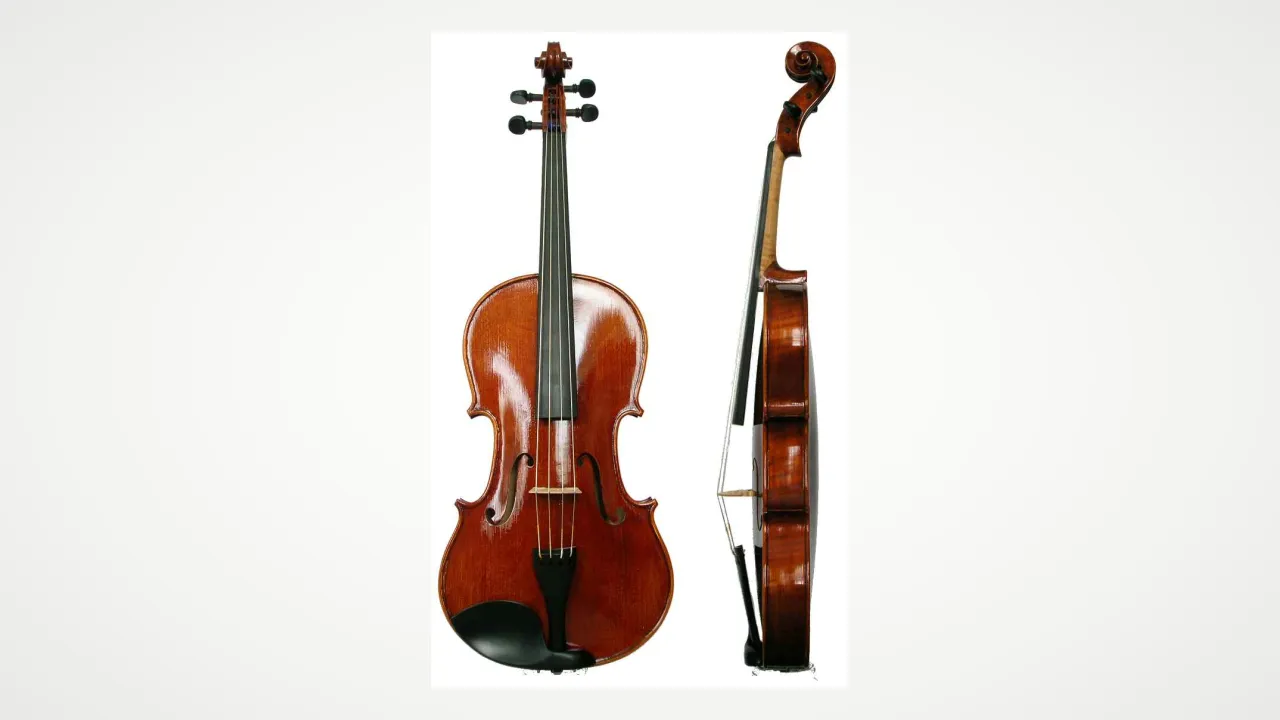
1. How does a viola compare in size and sound to a violin?
2. What fun secret hides inside the Italian names 'viola' and 'violin'?
🤯 Mind-Blowing Fact • Grade 2
Famous composers Wolfgang Amadeus Mozart, Ludwig van Beethoven, Johann Sebastian Bach, and Antonín Dvořák all loved sitting in the middle of string groups playing the viola!
✨ Word Sparks (Grade 2 Glossary)
Tap 🔊 to hear
alto
Warm middle singing voice below high soprano
clef
Symbol at line start naming musical pitches
ribs
Curved wooden side walls of string instruments
🪝
Why does only one instrument in the entire symphony orchestra read music using the special alto clef?
1
Spot the Difference!
Place a violin and a viola side by side on a velvet table and look closely! Both rest under the player's chin with four strings and an f-hole body, yet the viola stretches one to four inches longer with deeper wooden sides.
2
Hello, Deep C String!
While a violin has a squeaky-high E string on top, the viola trades that high string for a resonant low C string on the bottom! A slightly heavier horsehair bow coaxes rich, chocolatey notes out of those thicker strings.
3
A Secret Musical Map
Because its notes sit right between high treble and low bass, violists read their very own music symbol called the , where Middle C sits right on the center line!
1. Which deep lowest string gives the viola notes that a standard violin cannot reach?
2. Which special musical clef do viola players read most of the time?
🤯 Mind-Blowing Fact • Grade 3
If you inspect the heavy end of a viola bow (called the frog) next to a violin bow, the viola bow has a smoothly rounded corner while a violin bow has a sharp square corner—and the viola bow weighs about 10 grams more!
✨ Word Sparks (Grade 3 Glossary)
Tap 🔊 to hear
string quartet
Chamber group of two violins, viola, cello
frog
Heel block on bow held by fingers
timbre
Unique tone color distinguishing one instrument's voice
🪝
Why doesn't every full-size adult viola measure the exact same length like violins do?
1
An Ergonomic Puzzle
Stretch your left arm out as if holding an instrument on your shoulder! Standard adult violins all share a body length near 14 inches. Yet if luthiers scaled a viola up purely by math to match its lower strings, its body would measure 21 inches—far too long for human arms to reach!
2
Custom-Sized for Every Player
Instead, 16th-century Italian makers in Cremona and Brescia compromised cleverly: they built violas between 15 and 17 inches long with wider bouts and deeper maple ribs. Even today, adult violists shop for the exact inch size that fits their arm reach and tonal taste!
3
Why That 'Compromise' Sounds Magical
Tuned in fifths to C3, G3, D4, and A4—exactly five notes below a violin—those strings vibrate on a slightly compact wooden box. That acoustic mismatch softens bright, piercing upper tones and boosts smoky, earthy warmth!
4
Anchor of the String Quartet
Whether weaving pulsing inner rhythms in a (two violins, one viola, and one cello) or stepping forward for haunting solos, the viola supplies the emotional warmth orchestras rely on.
1. Why aren't violas built 21 inches long to match exact acoustic scaling below the violin?
2. Which four instruments make up a classic string quartet?
🤯 Mind-Blowing Fact • Grade 4
When Paganini asked French composer Hector Berlioz to write a flashy piece for his prized Stradivari viola in 1834, Berlioz created 'Harold in Italy'—turning the solo viola into a daydreaming traveler wandering through orchestral mountain scenes!
✨ Word Sparks (Grade 4 Glossary)
Tap 🔊 to hear
perfect fifth
Musical interval spanning five scale notes apart
contrapuntal
Weaving independent melodies together at once
fundamental
Lowest main vibration frequency of a note
🪝
How does breaking the 'perfect' mathematical scaling rule give the viola its unmistakable velvety, human-like timbre?
1
When Physics Meets Human Anatomy
Listen to a violist draw a heavier bow across the wound C3 string (130.8 Hz): out pours a dark, autumnal voice that sounds startlingly close to an expressive human contralto singer. Intriguingly, the viola owes this signature timbre to an intentional acoustic mismatch between string pitch and body volume.
2
Frequency Ratios and Resonant Peaks
Because the viola's four strings (C3–G3–D4–A4) sit a lower than the violin's—meaning every open string vibrates at two-thirds the frequency—strict acoustic scaling would require scaling body dimensions by 3/2 (1.5×) to align air-cavity and wood resonances identically. Instead, playable violas measure only 15% to 20% longer (38 to 43 cm) than a 35.5-cm violin.
3
Emphasizing Warm Overtones
Because its spruce soundboard and f-hole air cavity resonate at slightly higher pitches relative to its low strings, the viola radiates less energy on the pitch of its lowest notes and focuses richness into second and third harmonic overtones—filtering out shrill brightness while wrapping harmonies in dark velvet! Playing responsively requires thicker, higher-mass strings, wider finger spacings, and a 70-gram bow pressed with deliberate weight.
4
Stepping Into the Solo Spotlight
Once content weaving inner voices in Baroque Brandenburg Concertos and Romantic symphonies, the viola blossomed into a beloved solo voice thanks to 20th-century virtuosos Lionel Tertis, William Primrose, and composers Rebecca Clarke, William Walton, Béla Bartók, and Hector Berlioz (Harold in Italy).
1. Why does an A4 note (440 Hz) played on a viola sound darker and mellower than the exact same 440 Hz A4 note played on a violin?
2. Why do violists use a slightly heavier bow (~70 grams vs. ~60 grams for violin) and firmer arm weight?
🤯 Mind-Blowing Fact • Grade 5
In Hungarian and Transylvanian folk bands, musicians play a special three-stringed flat-bridged viola called a 'kontra' or 'brácsa'—bowing all three strings simultaneously to punch driving rhythmic chords like a percussion guitar!
✨ Word Sparks (Grade 5 Glossary)
Tap 🔊 to hear
alto clef
C-clef placing Middle C on center line
psychoacoustics
Science of how brains perceive musical sounds
linear mass density
Mass packed into each unit string length
🪝
How did acousticians, luthiers, and composers turn the viola's 500-year scaling paradox into an irreplaceable orchestral voice?
1
Etymological Matriarch of the String Family
Long before the diminutive word violino ('little viola') or violoncello ('little big violone') entered Renaissance Italian workshops around 1535, viola served as the foundational name for western bowed chordophones. Early Brescian and Cremonese luthiers—notably Gasparo da Salò, Andrea Amati, and Antonio Stradivari—crafted both compact contralto and expansive tenor violas to anchor Renaissance polyphony.
2
The Acoustic Scaling Paradox Quantified
Tuned in perfect fifths to C3 (130.8 Hz), G3 (196.0 Hz), D4 (293.7 Hz), and A4 (440.0 Hz), the viola's open strings vibrate at 2/3 the frequencies of the violin's. By Helmholtz cavity and plate-bending scaling laws, lowering main air resonance (A0) and primary wood modes proportionally by a fifth demands a 53-centimeter body—unplayable under the jaw! Keeping back lengths variable between 38 and 43 centimeters places A0 near ~230 Hz (around Bb3), well above the C3 fundamental.
3
Psychoacoustics of the Missing Fundamental and Formants
When a violist bows C3 at 130.8 Hz, the sub-scaled cavity radiates modest fundamental energy yet strongly amplifies higher harmonic partials (261.6 Hz, 392.4 Hz, and mid-frequency wood resonances between 800 and 1,800 Hz). Human auditory cortex reconstructs the pitch effortlessly via residue pitch perception while experiencing a dusky, poignant vowel-like warmth devoid of high-frequency glare—aided by tungsten- or silver-wound synthetic-core strings that pack high linear mass into manageable speaking lengths.
4
Ergonomic Innovations and Acoustic Experiments
Over the centuries, bold luthiers explored clever geometries to expand air volume without straining violists' left shoulders: Hermann Ritter's 48-cm viola alta admired by Richard Wagner, Lionel Tertis's wide-bouted 16.75-inch model, Carleen Hutchins's scientifically scaled 'violin octet' alto, and asymmetric cutaway designs by Hiroshi Iizuka and David Rivinus that preserve wrist health while maximizing bass projection.
5
Notation Mastery and Modern Repertoire
Reading predominantly in C3 —shifting seamlessly into treble clef for luminous high-register passages above C5—modern violists anchor symphonic inner architecture, folk transylvanian brácsa chordal rhythms, spectral contemporary scores, and towering concertos by Bartók, Hindemith, Walton, and Schnittke.
1. How do modern string engineers let a manageable 41-centimeter viola produce a deep, responsive C3 (130.8 Hz) without requiring a giant 53-centimeter body?
2. When a viola plays notes very high up on its A string, why do composers temporarily switch the sheet music from alto clef to treble clef?