1. What do classical guitar players usually use to pluck the strings?
2. What are the three clear upper strings made from?
🤯 Mind-Blowing Fact • Grade 2
Before smooth nylon strings were invented in the 1940s, classical guitarists played on strings twisted from sheep intestines!
✨ Word Sparks (Grade 2 Glossary)
Tap 🔊 to hear
melody
Main tune of a song you hum
fingerboard
Flat strip along neck beneath the strings
bridge
Wooden bar anchoring strings to guitar top
🪝
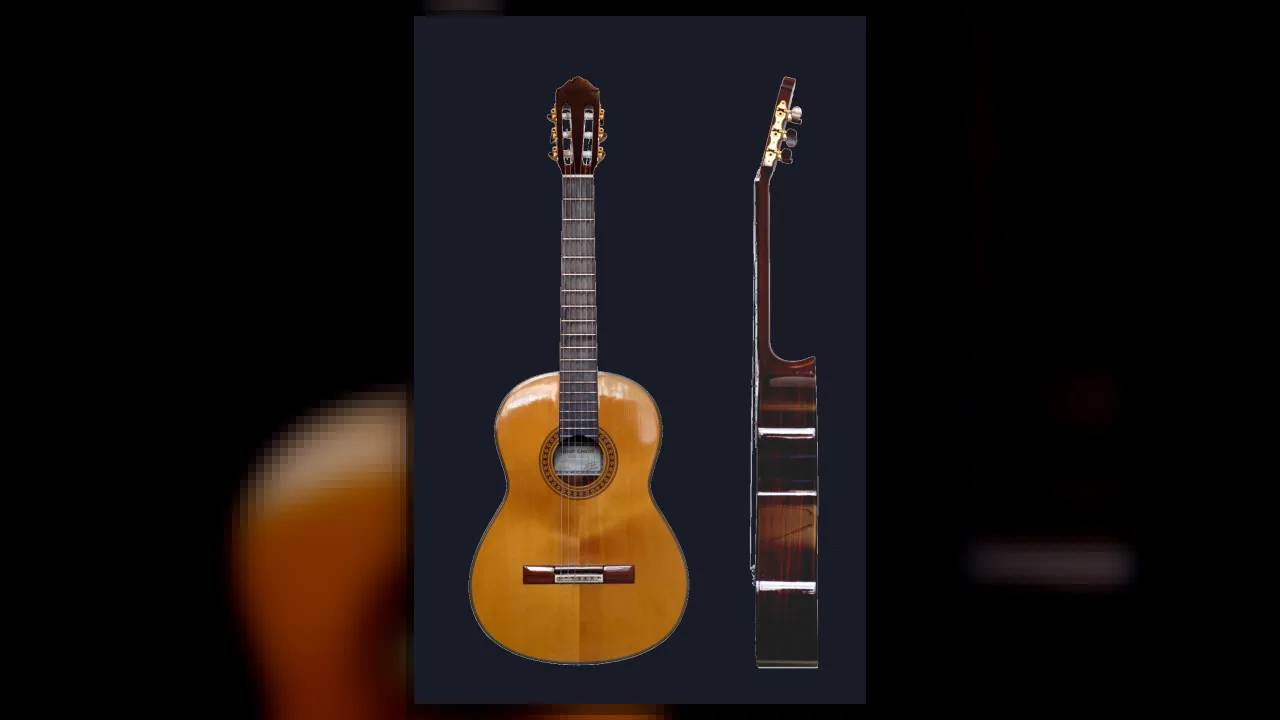
How can you spot the difference between a classical nylon guitar and a steel-string guitar just by looking?
1
Songs From Sunny Spain
Listen closely as five nimble fingers dance across six warm strings, playing a low bass beat and a sweet together! Born in sunny Spain, this guitar speaks with a softer, rounder voice than its steel-string cousin.
2
Wide Neck and Slotted Head
Look at the top of the neck and you will see two open slots with white rollers instead of solid wood. Its is extra wide and flat, giving every finger plenty of room to pluck clean notes without bumping neighbors.
3
Tied Knots, No Pins
At the bottom , strings are looped and tied in neat knots instead of held by plastic pins, and there is no pickguard on the wood. Because nylon pulls gently, the wooden top can be shaved super thin to sing sweetly!
1. Why is the neck of a classical nylon guitar wider than most other guitars?
2. How are strings fastened to the wooden bridge on a classical guitar?
🤯 Mind-Blowing Fact • Grade 3
A decorative rosette around a classical guitar's soundhole can contain over one thousand tiny hand-cut slivers of colored wood arranged like pixel art!
✨ Word Sparks (Grade 3 Glossary)
Tap 🔊 to hear
fan bracing
Spread-out wood strips under classical guitar tops
trebles
Higher-pitched strings or notes in music
timbre
Unique tone color of a musical voice
🪝
Why would putting steel strings onto a classical nylon guitar put its delicate wooden soundboard in danger?
1
A Miniature Finger Orchestra
What would happen if your thumb played the cello part while your other fingers sang like violins? Pluck a chord on a Spanish classical guitar and hear warm, velvety resonance bloom from cedar, spruce, and rosewood!
2
Low Tension and Fan Bracing
Six nylon strings pull with roughly half the tension of steel guitar strings—only about eighty-five pounds in total. Because that pull is gentle, luthiers shave the soundboard ultra-thin and glue delicate wooden strips underneath spread out like an open hand fan.
3
Clear Trebles and Silver Basses
Look closely at the six strings and you will notice two textures working together. The three high strings are smooth clear nylon, while the three lower bass strings hide fluffy nylon threads wrapped tightly in silver-plated copper wire for deeper pitch.
4
Seated Balance and Tone Colors
Concert players rest the guitar's waist on their raised left leg so both hands move freely across nineteen frets. Plucking near the bridge creates crisp, bright notes, while plucking over the soundhole produces dreamy, flute-like warmth.
1. Why can luthiers carve a classical guitar's soundboard much thinner than a steel-string guitar's top?
2. What lies hidden inside the three silver-looking bass strings of a classical guitar?
🤯 Mind-Blowing Fact • Grade 4
To prove that the wooden top—not the back and sides—creates most of a guitar's tone, Spanish builder Antonio de Torres once built a concert-sounding guitar whose back and sides were made entirely of papier-mâché!
✨ Word Sparks (Grade 4 Glossary)
Tap 🔊 to hear
bout
Rounded upper or lower curve of body
apoyando
Plucking stroke resting finger on next string
virtuoso
Musician with extraordinary technical skill and artistry
🪝
How did a nineteenth-century Spanish carpenter and a twentieth-century chemistry breakthrough team up across time to create the modern classical guitar?
1
Intimate Voice, Concert-Hall Reach
Hush falls over a recital hall as a single thumb stroke awakens a deep open E, followed by crystalline arpeggios rippling from shaped fingernails. Though unamplified and strung under modest tension, a master-built Spanish guitar projects poetic nuances to the farthest balcony.
2
Antonio de Torres Sets the Standard
Before the 1850s, European guitars had narrow waists and quiet voices easily drowned out in large rooms. Working in Seville and Almería, Spanish luthier Antonio de Torres Jurado enlarged the lower , standardized the vibrating string scale at 650 millimeters, and perfected symmetrical fan bracing—up to seven thin spruce struts radiating beneath an ultra-thin soundboard like spread fingers.
3
From Fragile Gut to Precision Nylon
For centuries, guitarists relied on twisted sheep-gut strings that frayed quickly and went out of tune whenever concert-hall humidity shifted. During World War II, scarcity of surgical gut inspired New York maker Albert Augustine, chemical company DuPont, and legendary Spanish Andrés Segovia to test precision-extruded nylon monofilaments, unveiling durable, pitch-stable nylon strings in 1948.
4
Two Right-Hand Strokes, Endless Color
Classical technique pairs left-hand accuracy across a fifty-two-millimeter ebony fretboard with two right-hand touches: tirando (free stroke), letting chords ring together, and (rest stroke), pressing through a string onto the next for bold singing melodies. Shifting right-hand position from sul ponticello near the bridge to sul tasto above the fretboard transforms metallic bite into harp-like sweetness.
1. Which nineteenth-century Spanish luthier established the body shape, 650-millimeter scale, and fan bracing of the modern classical guitar?
2. Why was the 1948 switch from animal gut to nylon strings such a major milestone for concert guitarists?
🤯 Mind-Blowing Fact • Grade 5
In classical guitar notation, right-hand fingers are marked with the Spanish initials p, i, m, and a—standing for pulgar (thumb), índice (index), medio (middle), and anular (ring)!
✨ Word Sparks (Grade 5 Glossary)
Tap 🔊 to hear
polyphony
Multiple independent melodies woven together simultaneously
sul tasto
Plucking near fingerboard for warm mellow tone
hygroscopic
Readily absorbing moisture from surrounding air
🪝
Why did Antonio de Torres's famous papier-mâché experiment prove that sub-two-millimeter soundboard dynamics govern the classical guitar's polyphonic voice?
1
Polyphony Beneath Five Fingertips
Listen as a soloist shapes three independent musical lines simultaneously—a resonant pedal bass at E2 (82.4 hertz), an inner harmonic accompaniment, and a singing upper voice soaring to B5 or C6 (987.8 to 1,046.5 hertz) on the nineteenth fret. Hector Berlioz famously likened this fan-braced chordophone to a miniature orchestra, prized for contrapuntal clarity and intimate timbral shading.
2
Torres Architecture and Fan-Strut Mechanics
Modern classical organology traces directly to mid-nineteenth-century Spanish master Antonio de Torres Jurado, who codified a 650-millimeter vibrating string length and expanded the lower bout to roughly 360 millimeters. Because rectified nylon trebles and silver-plated copper-over-multifilament-nylon basses exert only about 370 to 420 newtons of total tension, luthiers thin European spruce or western red cedar soundboards down to nearly two millimeters, supported by five to seven radial fan struts that foster responsive cross-grain dipole modes.
3
Right-Hand Nail Acoustics and Spectral Control
Without a plectrum, tone production hinges on microscopic interaction between fingertip flesh and a beveled fingernail ramp across four right-hand digits labeled p, i, m, and a (pulgar, índice, medio, anular). Plucking sul ponticello near the rosewood tie-block excites high-frequency harmonic partials for harpsichord-like brilliance, whereas plucking over the twelfth fret suppresses even-numbered harmonics where string antinodes peak, yielding warm, clarinet-like purity.
4
Segovia, Nylon, and Twentieth-Century Repertoire
Following the 1946–1948 collaboration among luthier Albert Augustine, DuPont chemists, and virtuoso Andrés Segovia that replaced sheep gut with uniform polyamide nylon, composers from Heitor Villa-Lobos and Joaquín Rodrigo—whose Concierto de Aranjuez pits delicate nylon sonorities against a full symphony orchestra—to Leo Brouwer expanded its concert literature.
5
Cousins in Wood: Classical Versus Flamenco
Though visually similar, Spanish flamenco guitars diverge subtly in acoustic engineering: built with ultra-light Spanish cypress backs and sides, shallower ribs, lower string action, and protective tap plates called golpeadores, they trade long classical sustain for explosive percussive attack and rasgueado strumming bursts.