2. What two ways can a musician make the strings sing?
🤯 Mind-Blowing Fact • Grade 2
Musicians rub hardened pine tree sap called rosin onto their bow hairs so the bow can gently grip the slick metal strings!
✨ Word Sparks (Grade 2 Glossary)
Tap 🔊 to hear
orchestra
A large group playing instruments together onstage
rosin
Sticky tree sap rubbed onto bow hair
f-holes
Letter-shaped openings carved in the wooden top
🪝
Why does the biggest instrument in the string family rest on a metal spike on the floor?
1
Thunder on a Spike
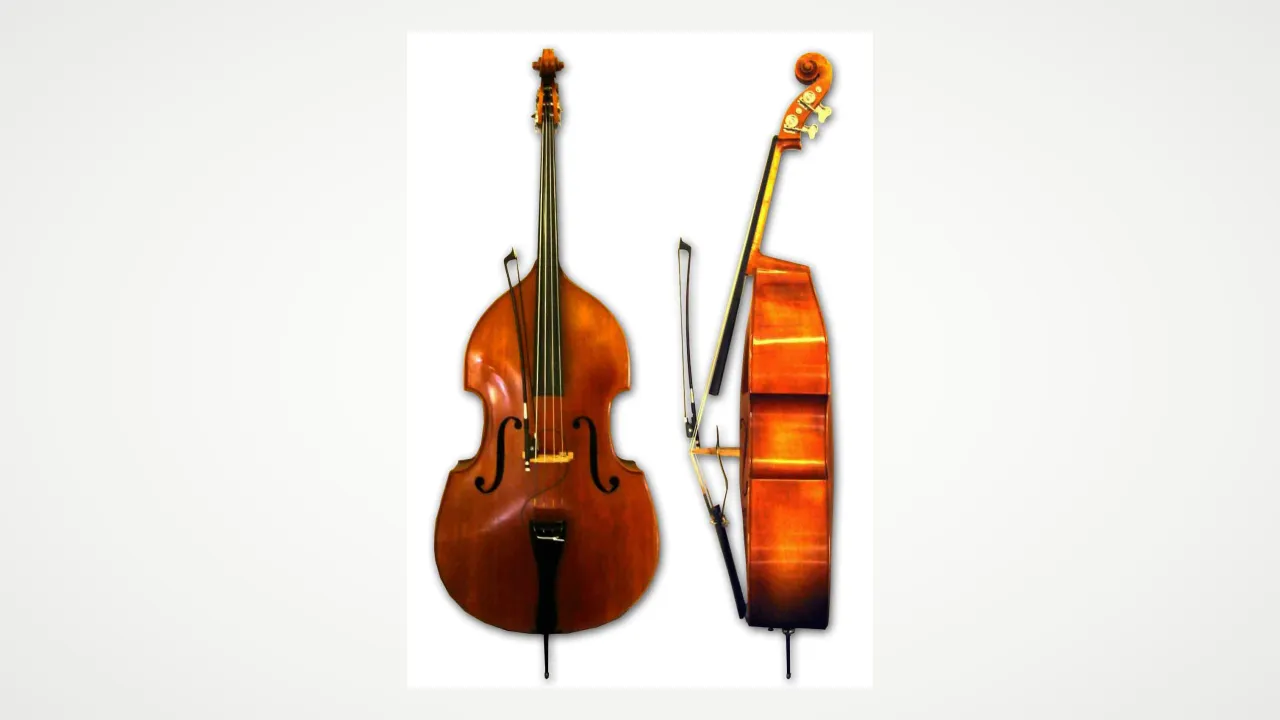
Close your eyes and listen for a low rumble that sounds like friendly distant thunder. Standing six feet tall on a sturdy metal spike, this giant holds the deepest voice in the orchestral string family!
2
Sloped Wooden Shoulders
Its hollow wooden body has sloped shoulders so the player can reach around to four thick strings. Musicians draw a sticky horsehair bow across the strings for smooth melodies, or pluck them with fingers for bouncy jazz beats.
3
Waves Through Curvy Holes
When a heavy string wiggles slowly, the carved spruce top shakes with it and pushes waves of air through two curvy . Without this steady low heartbeat, a big would sound light as a feather!
1. Why does the double bass have sloped wooden shoulders?
2. What rubbed onto the horsehair bow helps it grip the strings?
🤯 Mind-Blowing Fact • Grade 3
Unlike violins that use wooden pegs pushed into holes, the double bass needs strong brass gears at the top to hold its heavy string tension without slipping!
✨ Word Sparks (Grade 3 Glossary)
Tap 🔊 to hear
resonance
Rich echoing sound boosted inside hollow space
pizzicato
Plucking bowed instrument strings with your fingers
soundpost
Small wooden rod wedged inside string instruments
🪝
How can a single wooden post hidden inside a giant bass unlock enough acoustic power to fill a concert hall?
1
Growing a Giant String Voice
What would happen if you stretched a violin until it towered above your teacher? Step onto the concert stage and hear one deep pluck send a slow vibration rolling right through the wooden floorboards and into your sneakers!
2
Thick Strings and Low Pitch
Four heavy metal-wound strings stretch from the carved scroll down to the wooden bridge under strong tension. Because thick, long strings vibrate much more slowly than thin, short ones, this giant produces the lowest pitch in the orchestral string section.
3
Inside the Acoustic Chamber
String vibrations travel down through the bridge into a carved spruce soundboard and a hidden wooden rod called the . Acoustic inside the huge maple chamber amplifies a quiet string hum into a rich voice that fills a theater.
4
Arco Sweeps and Pizzicato Grooves
Classical players glide a rosined horsehair bow across the strings in a style called arco, while jazz and bluegrass players pluck crisp rhythms called . Pressing strings onto the smooth ebony fingerboard shortens their vibrating length to climb higher notes.
Why does the double bass look partly like a violin and partly like a Renaissance viol—and why is it tuned differently from both?
1
Felt Before It Is Heard
Before the main melody even begins, a velvety rumble rolls across the concert hall—so low you feel it in your ribs almost before your ears catch the note. Resting on an adjustable steel , this six-foot powerhouse towers over violins, violas, and cellos, anchoring symphonies, jazz trios, and bluegrass bands with majestic low-frequency energy.
2
A Clever Family Hybrid
Inspect its silhouette closely and you will uncover an intriguing historical blend. While its scrolled pegbox and graceful f-holes belong to the violin family, its sloped shoulders and angled back descend from Renaissance viols, allowing musicians to lean forward along the ebony fingerboard. Unlike smaller orchestral strings tuned in fifths, its four strings are tuned in fourths—E, A, D, and G—shortening the finger stretches required along its long scale.
3
Soundboard, Bass Bar, and Soundpost
Clever internal woodwork turns slow string oscillations into room-filling resonance. Bowed or plucked strings rock the tall maple bridge, feeding vibrations into the arched spruce soundboard. Beneath one bridge foot runs a lengthwise that spreads deep tones; beneath the other stands a wedged spruce soundpost linking front and back plates so the whole chamber breathes together.
4
From Symphony Halls to Walking Jazz
Across Europe, two bow styles emerged: the overhand French grip and the broader frog-held German grip, both relying on sticky rosin to tug and release strings. In early twentieth-century New Orleans, jazz pioneers set aside the bow for driving finger-plucked walking basslines, proving an orchestral giant could swing with unstoppable groove.
1. Why are double bass strings tuned in fourths instead of fifths like a violin?
2. How is the wooden soundpost held upright inside the body of a double bass?
🤯 Mind-Blowing Fact • Grade 5
In 1849, French luthier Jean-Baptiste Vuillaume built the Octobass—a colossal relative standing nearly thirteen feet tall whose strings had to be pressed with foot pedals and levers!
✨ Word Sparks (Grade 5 Glossary)
Tap 🔊 to hear
chordophone
Any instrument producing sound through vibrating strings
fundamental
Lowest main pitch produced by vibrating string
transposing
Sounding higher or lower than written notes
🪝
How does an acoustic chamber less than two meters tall radiate bass sound waves that stretch over eight meters through the air?
1
Forty-One Cycles Per Second
Imagine a musical string oscillating just forty-one times per second—a frequency of 41.2 hertz on an open E1 string—rippling outward from a carved wooden chamber nearly two meters tall. Commands of such subterranean depth belong to the contrabass, the foundational of the symphony orchestra whose written notes sound one full octave lower than notated on the bass-clef staff.
2
Organology of a Structural Hybrid
Organologists classify the modern instrument as a remarkable structural synthesis bridging two European string lineages. From the sixteenth-century viola da gamba family, it retains drooping shoulders for upper-register ergonomics, brass worm-gear tuning machines capable of withstanding heavy string tension, and tuning in perfect fourths (E1–A1–D2–G2). Simultaneously, its unfretted ebony fingerboard, overhanging plate edges, internal soundpost, and carved f-holes align acoustically with the violin family across a three-octave span.
3
Coupled Plates and Acoustic Mechanics
Radiating bass wavelengths exceeding eight meters in air demands sophisticated mechanical coupling inside a body much smaller than pure proportional scaling of a violin would dictate. Steel-core strings wrapped in nickel or chrome exert hundreds of newtons of downward force onto a tall maple bridge. One bridge foot drives a longitudinal spruce bass bar glued beneath the soundboard, while the opposite foot pivots over an unglued vertical soundpost, converting lateral string motion into efficient volumetric air pumping.
4
Sub-Contrabass Extensions and Bow Traditions
Because symphonic scores by Beethoven, Mahler, and Stravinsky frequently descend below E1, many orchestral basses incorporate either a fifth low string tuned to B0 (30.9 hertz) or a fingerboard C-extension descending to C1 (32.7 hertz). Performers alternate effortlessly between arco bowing—choosing either the overhand French bow or the deep-frogged underhand German bow—and resonant pizzicato, alongside percussive col legno and bell-like natural harmonics.
5
Symphonic Soloist to Jazz Vanguard
Over four centuries, this towering artisan creation evolved from doubling Baroque bass lines to conquering dazzling solo concertos under nineteenth-century virtuoso Giovanni Bottesini, before igniting a rhythmic revolution across twentieth-century America. When jazz innovators Jimmy Blanton, Charles Mingus, and Ron Carter propelled ensembles with agile walking pizzicato lines, and Appalachian bands pioneered percussive slap-bass syncopation, the contrabass proved equally vital in grand philharmonic halls and intimate clubs.