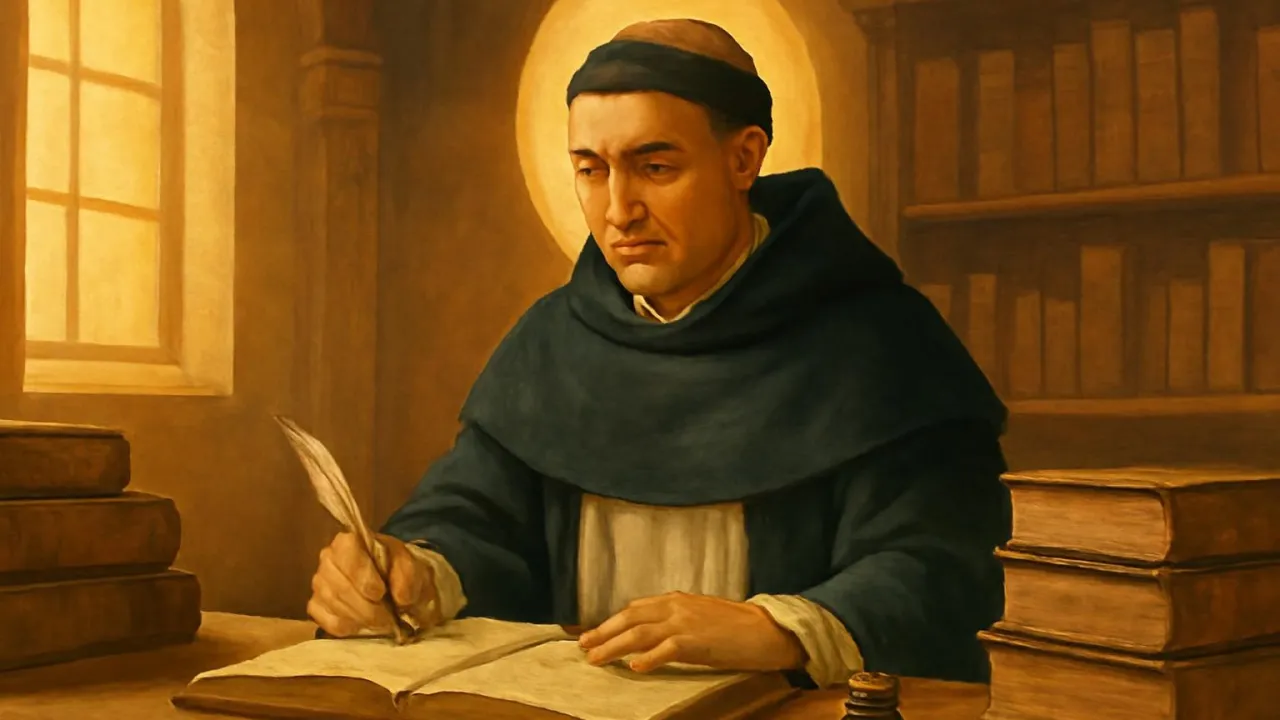
Thomas Aquinas’s ideas helped shape how schools teach philosophy and religion.
✨ Word Sparks (Grade 2 Glossary)
Tap 🔊 to hear
reason
Using your mind to solve problems
theology
Learning about faith and God
wisdom
Knowing what is good and true
🪝
Have you ever wondered how thinking and believing can work together?
1
A Boy Full of Questions
Thomas was always curious, asking questions about the world. He loved reading books and learning new things. His teachers saw he had a bright mind.
2
Studying and Writing
Thomas worked hard in the monastery, reading and writing every day. He wanted to understand how faith and could fit together. He wrote many ideas in his big book.
3
A Famous Book
His book, Summa Theologica, helped people think about faith and learning. People still read his ideas today and use them in schools. Thomas became famous for his wise thoughts.
Thomas Aquinas’s ideas were so important that he was called “Doctor of the Church.”
✨ Word Sparks (Grade 3 Glossary)
Tap 🔊 to hear
logic
Careful thinking to find answers
legacy
Something important left behind
philosophy
The study of big ideas and questions
🪝
Can you imagine using both your heart and mind to answer life’s biggest questions?
1
A Young Thinker
As a child, Thomas Aquinas was always full of curiosity and wonder. He asked questions about everything he saw, from nature to the stars above. His family sent him to a monastery, where he could learn from wise teachers. Thomas loved reading and thinking deeply about the world.
2
Learning in the Monastery
In the peaceful monastery, Thomas studied books about , science, and faith. He listened to his teachers and wrote down his own ideas in notebooks. He wanted to understand how reason and faith could work together. Thomas believed both thinking and believing were important for understanding life.
3
Writing a Masterpiece
Thomas wrote a huge book called Summa Theologica, sharing his thoughts with everyone. He explained how people could use and faith to answer big questions. His writing helped many people learn about and religion. Even today, students and teachers study his important ideas.
4
A Lasting Legacy
Thomas Aquinas became one of history’s most famous philosophers and theologians. His ideas changed how people thought about learning and believing. He showed that asking questions is a good way to learn. Thomas’s work still inspires thinkers all around the world.
Thomas Aquinas’s writings helped create the foundation for many modern universities’ study programs.
✨ Word Sparks (Grade 4 Glossary)
Tap 🔊 to hear
theologian
A person who studies faith and God
Aristotle
A famous ancient Greek thinker
Doctor of the Church
A special title for great teachers
🪝
How could someone in the Middle Ages help people see that faith and reason can work together?
1
A Childhood of Curiosity
Long ago in Italy, a young Thomas Aquinas filled his days with questions and wonder. He was sent to a monastery, where monks taught him about ancient books, philosophy, and religious faith. Thomas eagerly learned about the world, always searching for answers to life’s biggest mysteries. His early curiosity set the stage for a lifetime of deep thinking and learning.
2
The Scholar in the Monastery
Inside the quiet monastery walls, Thomas studied writings from Greek philosophers and Christian teachers. He worked tirelessly, blending ideas from with Christian beliefs to create something new. Thomas believed that reason and faith could help people understand the world together, not apart. His teachers noticed his careful thinking and encouraged him to write down his ideas.
3
Summa Theologica: A Book of Big Ideas
Thomas’s most famous work, Summa Theologica, became a guide for students and teachers across Europe. In it, he answered tough questions about God, nature, and how people should live. He used logic to explain faith, showing that asking questions was not a sign of doubt but a path to understanding. His book changed how philosophy and theology were taught in schools and universities.
4
A Legacy That Endures
Thomas Aquinas’s ideas shaped the way people think about faith, knowledge, and learning even today. He is remembered as a , a title given to great teachers. His work inspired centuries of philosophers, , and students worldwide. By connecting faith and reason, Thomas showed that asking questions can lead to wisdom and truth.
2. What did Thomas’s Summa Theologica help explain?
🤯 Mind-Blowing Fact • Grade 5
Thomas Aquinas wrote over 8 million words during his lifetime, including hundreds of essays and books.
✨ Word Sparks (Grade 5 Glossary)
Tap 🔊 to hear
Summa Theologica
Thomas’s most famous book of big ideas
rational thought
Thinking carefully to solve problems
legacy
What someone leaves behind for others
🪝
What happens when someone dares to ask how faith and logic might work together to solve life’s greatest mysteries?
1
A Childhood Full of Questions
In the rolling hills of 13th-century Italy, a young Thomas Aquinas was known for his endless curiosity and gentle spirit. From a very early age, he would ask his teachers and family questions about the world, nature, and the meaning of life. His family sent him to a Benedictine monastery, believing he would become a wise monk. There, Thomas discovered ancient books filled with the ideas of philosophers, which sparked his imagination and love for learning. This early passion for both faith and reason would shape his entire life’s work.
2
Scholarship and the Search for Truth
As Thomas grew older, he became a dedicated scholar, spending countless hours reading, writing, and debating with other students. He studied the works of Aristotle, a Greek philosopher whose logical methods fascinated Thomas. Rather than seeing faith and reason as opposites, Thomas believed they could work together to help people understand the universe. He wrote detailed notes and arguments, always searching for ways to connect religious belief with . His teachers recognized his brilliance and encouraged him to share his ideas widely.
3
The Creation of Summa Theologica
Thomas’s greatest achievement was writing , a massive book that explored questions about God, nature, and human life. In this work, he used logical arguments to explain complex religious ideas, making them easier to understand for students and scholars. He tackled topics such as the existence of God, the purpose of life, and the difference between right and wrong. Summa Theologica became one of the most influential philosophical texts in history, shaping how universities taught philosophy and theology for centuries. Thomas’s careful reasoning set a new standard for combining faith with intellectual inquiry.
4
A Lasting Legacy in Philosophy and Education
Thomas Aquinas’s ideas spread throughout Europe, inspiring generations of thinkers, teachers, and students. He was given the title Doctor of the Church, reserved for those whose writings greatly help others understand faith. His methods influenced the development of universities, encouraging open debate and the use of reason in religious studies. Today, his work is still read in philosophy and theology classes around the world. By blending faith and logic, Thomas showed that asking questions leads to deeper understanding and wisdom.
5
Inspiration for Future Thinkers
Thomas Aquinas’s life teaches us that curiosity, hard work, and respect for different ideas can change the world. He proved that it’s possible to unite belief and reason, making both stronger together. His courage to ask difficult questions opened doors for future scientists, philosophers, and leaders. Thomas’s reminds us that learning never ends and that our questions can help shape the future. By following his example, anyone can become a seeker of truth and understanding.