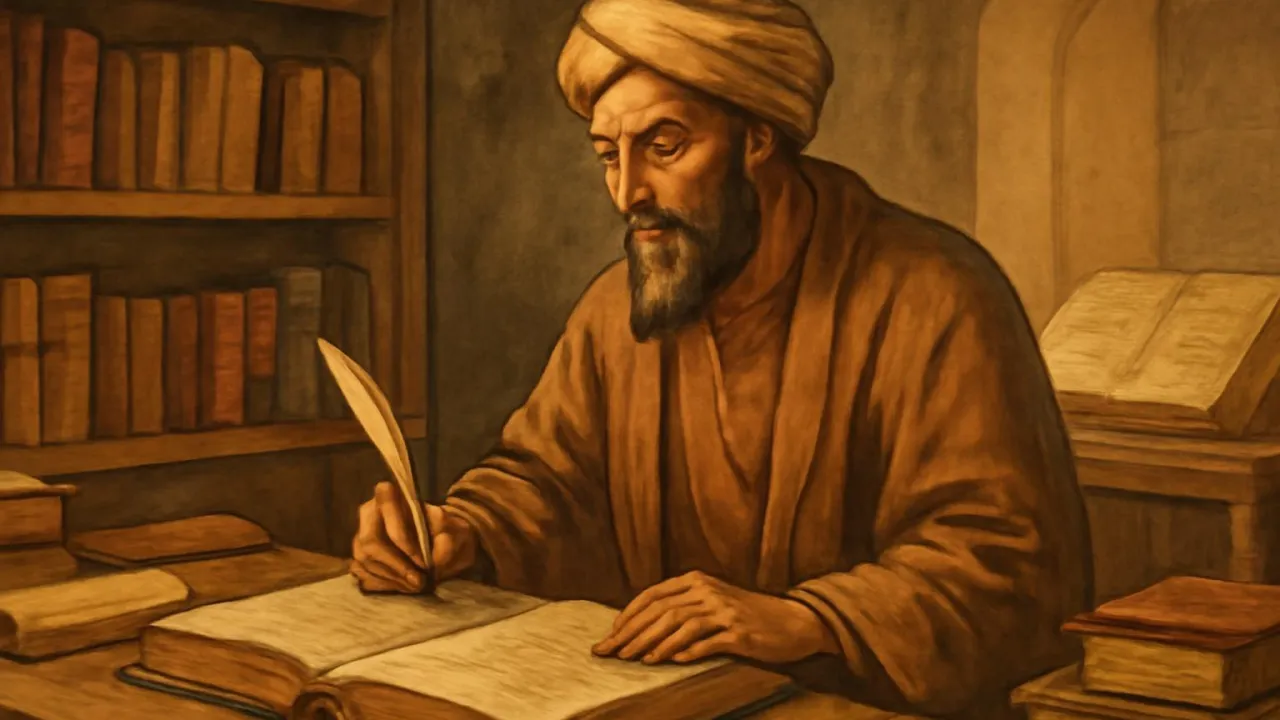
Ibn Khaldun’s book called the Muqaddimah is one of the first books about sociology.
✨ Word Sparks (Grade 2 Glossary)
Tap 🔊 to hear
curious
Wanting to learn or know more
society
A group of people living together
patterns
Things that happen the same way again
🪝
How can someone see patterns in the stories of many people?
1
A Boy Who Asked Why
Ibn Khaldun was about how people live and change. He read many books and asked questions. He wanted to understand the world better. His curiosity helped him think deeply.
2
Studying and Writing
He used his pen to write ideas about history and . He noticed that events happen again and again. He worked hard to explain why this happens. His writing helped others learn new things.
3
A Famous Achievement
Ibn Khaldun became known for his big idea about history’s . He is called the father of sociology today. His work helps people study how societies grow and change. His ideas are still important in many schools.
Ibn Khaldun was the first to explain how social cohesion affects the rise and fall of civilizations.
✨ Word Sparks (Grade 3 Glossary)
Tap 🔊 to hear
hypothesis
An idea to test or explain something
asabiyyah
Group feeling that helps people work together
perseverance
Trying hard even when things are tough
🪝
What if history is like a story that repeats its lessons over time?
1
A Young Thinker’s Curiosity
Ibn Khaldun was fascinated by how societies grow and change over time. He developed a that history follows certain patterns. His curiosity led him to study many books and write down ideas carefully. He believed understanding history could help people learn from the past.
2
Writing About Society
He used his knowledge to explain how social groups form and dissolve. Ibn Khaldun introduced the idea of ‘,’ meaning group solidarity or social cohesion. He showed how this feeling helps societies build strength and then lose power over time. His work combined philosophy, history, and sociology in new ways.
3
Overcoming Challenges
Living in a time of political change, Ibn Khaldun faced many obstacles. Despite these, he kept writing and teaching others his ideas. His helped him complete his famous work, the Muqaddimah. This book became a foundation for modern social sciences.
4
Changing How We See History
Ibn Khaldun’s philosophy changed how people think about history and society. He showed that history is not random but follows certain laws. His ideas influenced historians and sociologists for centuries. Today, his work still inspires those who study human culture.
1. What does ‘asabiyyah’ mean in Ibn Khaldun’s work?
2. How did Ibn Khaldun’s ideas change history study?
🤯 Mind-Blowing Fact • Grade 4
Ibn Khaldun’s Muqaddimah is still studied worldwide as a foundational social science text.
✨ Word Sparks (Grade 4 Glossary)
Tap 🔊 to hear
historiography
The study of how history is written
cohesion
The act of sticking together as a group
exile
Being sent away from home as a punishment
🪝
How did Ibn Khaldun’s ideas about society and history change the world forever?
1
Historical Context and Early Life
Ibn Khaldun lived during the 14th century when many empires rose and fell in North Africa. He was born into a noble family in Tunis and received a strong education in Islamic law, history, and philosophy. This background helped him observe social and political changes closely. He saw firsthand how societies could grow strong and then weaken.
2
Signature Ideas and Innovations
His most famous concept, ‘asabiyyah,’ explained how social creates group strength and unity. Ibn Khaldun also introduced a scientific approach to history, arguing that societies follow predictable cycles. He combined philosophy, economics, and sociology to explain these patterns. His Muqaddimah remains a pioneering work in social science.
3
Turning Points in His Career
Ibn Khaldun faced political and changing rulers but continued his scholarly work. These challenges deepened his understanding of power and society. He served as a judge and advisor, applying his theories in real life. His perseverance allowed him to complete his groundbreaking writings despite difficulties.
4
Global Impact and Legacy
Centuries later, Ibn Khaldun’s ideas influenced Western and Islamic scholars alike. His work laid the foundation for modern sociology, , and economics. Today, universities around the world study his theories. He is remembered as a visionary who saw the laws behind human society.
1. What does Ibn Khaldun’s idea of ‘asabiyyah’ explain?
2. What helped Ibn Khaldun continue his work during hard times?
🤯 Mind-Blowing Fact • Grade 5
Ibn Khaldun created one of the world’s first scientific theories explaining how societies rise and fall.
✨ Word Sparks (Grade 5 Glossary)
Tap 🔊 to hear
empirical
Learning by watching and testing things
civilization
A group of people with laws and culture
philosophy
Big questions about life and knowledge
🪝
What if understanding history could help explain how people and societies change over time?
1
A Life of Learning and Curiosity
Ibn Khaldun grew up in a world filled with change and challenge, inspiring his deep curiosity. He studied many subjects including law, history, and to understand human nature. His early experiences with political shifts helped him see patterns in society. This curiosity drove him to create new ideas about how people live and work together.
2
Innovative Ideas and Methods
He developed a method combining observation and to study society scientifically. Ibn Khaldun introduced ‘asabiyyah,’ the idea that social cohesion builds and then weakens them. His work explained history as cycles influenced by economics, politics, and culture. This approach was one of the earliest forms of social science.
3
Detailed Records and Breakthroughs
In his famous Muqaddimah, Ibn Khaldun analyzed population, taxation, and social solidarity’s effects on society. He linked social and economic factors to explain why rise and fall. His detailed observations made his work a pioneering example of research in social sciences. Many of his insights remain relevant for understanding societies today.
4
Enduring Legacy and Influence
Ibn Khaldun’s ideas influenced scholars across cultures and centuries, shaping sociology and historiography. His work bridges and study, inspiring modern social science. Universities worldwide study his theories to understand human behavior and history. He is remembered as a visionary thinker who changed how we study society.
5
Lessons for Today’s Learners
His life teaches the value of curiosity, perseverance, and connecting ideas across fields. Ibn Khaldun shows how looking for patterns helps solve complex problems in society. He encourages learners to think deeply and never stop asking questions. His story inspires young people to explore and understand the world around them.