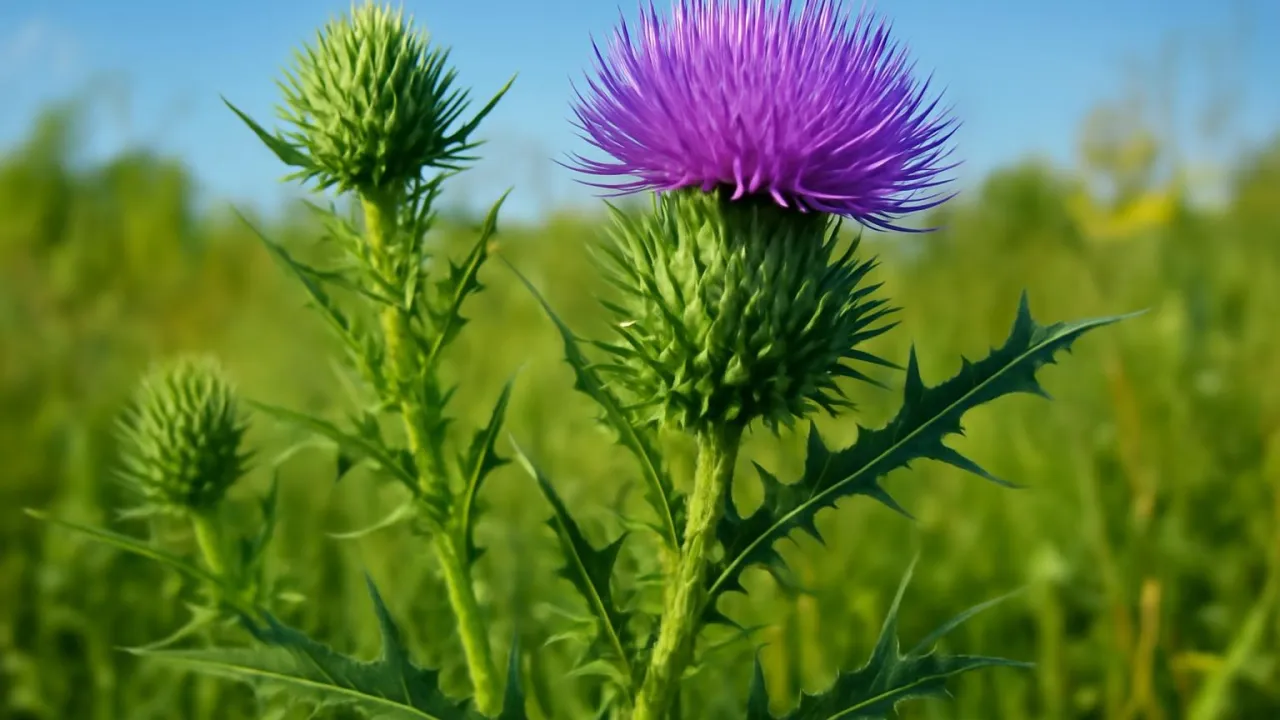
Thistle seeds can travel miles on the wind to grow new plants far away!
✨ Word Sparks (Grade 2 Glossary)
Tap 🔊 to hear
nectar
Sweet juice inside flowers for bees
defense
How plants protect themselves from harm
habitat
The place where a plant or animal lives
🪝
Have you ever seen a flower covered in tiny sharp spikes?
1
Thistle’s Sharp Defense
Thistles have sharp spikes on their leaves and stems to protect themselves from animals. These spikes make it hard for animals to eat them. The plants grow tall in sunny fields and meadows.
2
Where Thistles Grow
Thistles live in many places like fields, roadsides, and dry areas. They need lots of sunlight and well-drained soil to grow strong. Bees and butterflies visit thistles to drink sweet .
3
Thistle Life Cycle
Thistles produce fluffy seeds that the wind carries far away. These seeds land in the soil and grow into new thistle plants. This helps thistles spread quickly in their .
Thistle seeds use wind to travel far, helping the plant spread quickly across fields!
✨ Word Sparks (Grade 3 Glossary)
Tap 🔊 to hear
adaptation
A change that helps a plant survive
pollination
When insects help flowers make seeds
predator
An animal that eats other animals or plants
🪝
Did you know thistles use sharp spines to survive in the wild?
1
Thistle’s Protective Spines
Thistles have sharp spines covering their leaves and stems that act as a defense against . These spines make it difficult for animals to eat the plant, helping it survive. This allows thistles to grow in open fields where many animals roam.
2
Thistle’s Habitat and Growth
Thistles thrive in temperate regions with plenty of sunlight and well-drained soil. They often grow in disturbed areas such as roadsides and fields. Their deep roots absorb nutrients and water, helping them survive dry conditions.
3
Pollination and Seeds
Bees and butterflies visit thistle flowers to collect nectar, aiding . After pollination, thistles produce fluffy seeds that disperse by wind, a process called anemochory. This helps thistles colonize new areas quickly.
4
Thistle’s Role in Nature
Thistles provide food and shelter for many insects and birds. Their seeds are eaten by some birds, while the spiny leaves protect the plant from herbivores. Thistles also help improve soil by preventing erosion with their roots.
1. What helps thistles avoid being eaten by animals?
2. How do thistles spread their seeds?
🤯 Mind-Blowing Fact • Grade 4
Thistles help stop soil from washing away by holding it with their strong roots!
✨ Word Sparks (Grade 4 Glossary)
Tap 🔊 to hear
herbivore
An animal that eats only plants
pollinator
An insect that helps flowers make seeds
invasive
A plant that spreads fast and harms nature
🪝
How does a spiky thistle survive and help its ecosystem?
1
Defense and Survival
Thistles have evolved sharp spines on their leaves and stems to prevent from eating them, which increases their chances of survival. These spines act as a physical barrier, making it painful for animals to bite or touch the plant. This defense mechanism allows thistles to thrive in open habitats where many animals graze.
2
Habitat and Growth Conditions
Thistles commonly grow in temperate regions across Europe, Asia, and North America, favoring sunny fields and disturbed soils. They require well-drained soil and ample sunlight to grow tall and produce flowers. Their deep root systems help them absorb water and nutrients, enabling them to survive droughts and poor soil conditions.
3
Ecosystem Roles and Relationships
Thistles play important roles in ecosystems by providing nectar for such as bees and butterflies, which helps maintain biodiversity. Their seeds serve as food for birds, while their spiny leaves protect the plant from many . Additionally, thistles help prevent soil erosion by stabilizing the ground with their roots.
4
Human Impact and Distribution
Humans have spread thistles beyond their native ranges, sometimes causing them to become in new areas. While some thistle species are considered weeds, others are valued for their ecological benefits. Understanding their role helps balance control efforts with conservation.
Thistles can spread seeds miles away on the wind, helping them quickly colonize new habitats!
✨ Word Sparks (Grade 5 Glossary)
Tap 🔊 to hear
achenes
Small dry fruits with seeds inside
taproot
A long main root growing deep in soil
pappus
Fluffy parts that help seeds float in wind
🪝
What makes the thistle a fascinating plant in botany and ecology?
1
Taxonomy and Scientific Classification
Thistles belong to the genus Cirsium within the family Asteraceae, which includes many flowering plants. There are over 200 species of thistles worldwide, mostly native to temperate regions of Europe, Asia, and North America. Their classification helps scientists study their evolutionary relationships and ecological roles.
2
Physiological Adaptations and Defense
Thistles have evolved sharp, rigid spines on their leaves and stems as a physical defense against herbivory, reducing damage from grazing animals. Their deep systems allow them to access water in dry soils, supporting survival during droughts. The spines also reduce water loss by limiting leaf surface area exposed to air.
3
Reproductive Biology and Seed Dispersal
Thistle flowers attract a variety of pollinators, including bees and butterflies, through nectar production, facilitating cross-pollination. After pollination, they produce with fluffy structures that enable wind dispersal, allowing seeds to travel distances up to several miles. This dispersal strategy increases genetic diversity and colonization success.
4
Ecological Roles and Human Interactions
Thistles contribute to ecosystems by providing nectar for pollinators and seeds for birds, supporting food webs. While some species are considered invasive weeds that can disrupt agriculture, others are important for soil stabilization and habitat restoration. Human efforts balance controlling invasive thistles with conserving native species.
5
Quantitative Comparisons and Environmental Impact
Thistles can grow between 1 and 6 feet tall, with some species reaching up to 1.8 meters. Their seeds can travel several miles on wind currents, enabling rapid spread across landscapes. They thrive in temperatures ranging from 50 to 85 degrees Fahrenheit and can survive in soils with low nutrient levels, demonstrating remarkable resilience.