⚡ Survival SuperpowerThree-foot-long hand claws—the longest of any animal ever—on a peaceful feathered plant-eater
🤯 Mind-Blowing Fact • Grade 1
Each single hand claw on Therizinosaurus grew over three feet long—longer than a Little League baseball bat!
✨ Word Sparks (Grade 1 Glossary)
Tap 🔊 to hear
Scythe
Long curved farm blade used to cut plants
Shaggy
Covered in long, thick, fluffy hair-like feathers
Branches
Woody tree arms holding tasty green leaves
🪝
What fluffy, pot-bellied dinosaur had claws as long as baseball bats—just to pull down leaves?
1
Claws Longer Than Baseball Bats!
Swish, rustle! Three-foot-long claws reach up into a leafy green tree! Will this giant dinosaur hunt someone? Nope—it pulls down tasty to munch! Meet gentle Therizinosaurus.
2
Fluffy and Round
feathers covered its tall neck and big round belly. It stood sixteen feet tall on two wide, sturdy feet!
3
Biggest Claws Ever
No other animal in Earth's history ever grew longer claws! Those giant hooks also told hungry meat-eaters to keep away.
1. What did Therizinosaurus mainly eat despite having giant three-foot claws?
2. How do the hand claws of Therizinosaurus rank among all animals in history?
🤯 Mind-Blowing Fact • Grade 2
Because scientists first mistook its giant arm bones and claws for a sea turtle's flippers, its scientific name still translates to 'turtle-shaped scythe lizard'!
✨ Word Sparks (Grade 2 Glossary)
Tap 🔊 to hear
Ancestors
Earlier family members from millions of years before
Sloth
Slow-moving mammal using long claws to pull branches
Scythe Lizard
English meaning of the Greek name Therizinosaurus
🪝
Why did scientists first think Therizinosaurus claws belonged to a giant swimming turtle?
1
The Giant Turtle Mix-Up
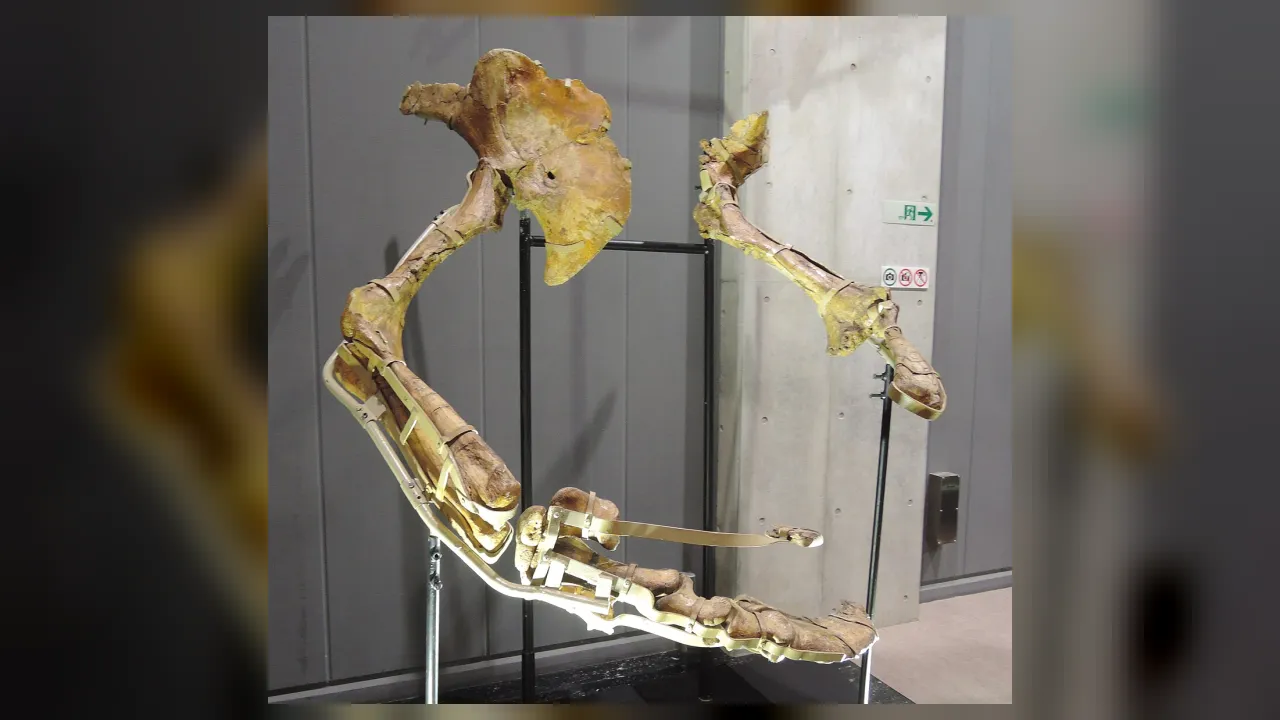
Imagine digging in Mongolia's Gobi Desert in 1948 and uncovering eight-foot arms tipped with three-foot curved claws! Without a skull or hips nearby, scientist Evgeny Maleev guessed the weird bones belonged to a giant sea turtle that used its claws to harvest seaweed. That is why its species name cheloniformis still means turtle-shaped!
2
Prehistoric Giant Sloth
Later fossils of cousin species solved the mystery: Therizinosaurus was a two-legged feathered dinosaur whose once ate meat before switching to plants! Like extinct giant ground , it sat back on wide four-toed feet while raking leafy branches toward its small beak.
3
Scaring Off Tarbosaurus
Sharing forests with T. rex's cousin Tarbosaurus meant waving six giant scythe claws kept predators at a respectful distance!
1. Why did Evgeny Maleev give Therizinosaurus the species name cheloniformis ('turtle-shaped') in 1954?
2. Which mammal lived a lifestyle very similar to Therizinosaurus?
🤯 Mind-Blowing Fact • Grade 3
Unlike almost all other theropods that walked on three toes, Therizinosaurus planted all four toes flat on the ground to support its heavy plant-digesting belly!
✨ Word Sparks (Grade 3 Glossary)
Tap 🔊 to hear
Protofeathers
Simple hair-like or quill-like early dinosaur feathers
Meandering
Winding back and forth in wide river curves
Boughs
Large main branches of a leafy tree
🪝
How did a dinosaur from the meat-eating theropod family turn into a peaceful salad lover?
1
Lush River Forests of the Nemegt
Seventy million years ago, Mongolia's Nemegt Basin was no barren desert—wide rivers watered tall araucaria trees, ginkgos, and lush horsetail marshes. Towering sixteen feet tall among the trees stood Therizinosaurus, weighing five tons—nearly as heavy as Tyrannosaurus Rex!
2
Trading Steak Knives for Salad Forks
Almost all theropods—like Velociraptor and Allosaurus—hunted meat, walked on three toes, and had narrow hips. Therizinosaurs flipped the rulebook! Their hips widened backward to make room for a huge plant-fermenting gut, all four toes touched the ground for sturdy support, and small leaf-shaped teeth sat behind a keratin beak.
3
Feathers Confirmed by Chinese Cousins
Exquisite fossils of smaller cousins like Beipiaosaurus found in China preserve long, quill-like , proving therizinosaurs wore shaggy coats!
4
Fragile Tips, Strong Display
Computer stress tests show those narrow, meter-long claws bent too easily to dig hard dirt, excelling instead at hooking leafy and dazzling rivals.
1. How did Therizinosaurus hips and belly change when its ancestors switched from meat to plants?
2. How do scientists know therizinosaurs wore shaggy feather coats?
🤯 Mind-Blowing Fact • Grade 4
2023 engineering simulations discovered that Therizinosaurus claws grew so extraordinarily long and slender mainly as dramatic display ornaments—like deer antlers—and light leaf-hooks!
✨ Word Sparks (Grade 4 Glossary)
Tap 🔊 to hear
Ungual
Final toe or finger bone supporting a claw
Convergent
Unrelated animals independently evolving similar body tools
Intimidation
Looking huge and impressive to deter hungry predators
🪝
What did 2023 biomechanical tests reveal about whether Therizinosaurus claws were weapons, digging shovels, or giant billboards?
1
Assembling the Bizarre Puzzle
For decades after the 1948 Gobi discovery of meter-long manual (claw bones), paleontologists argued over what creature owned them. Only in the late 1970s and 1980s, when Mongolian paleontologists Altangerel Perle and Rinchen Barsbold linked complete eight-foot forelimbs with related skeletons like Segnosaurus and Erlikosaurus, did science unveil the strangest theropod ever evolved.
2
2023 Stress-Testing the Three-Foot Claws
In 2014 and 2023, paleobiologists Stephan Lautenschlager and Zichuan Qin ran 3D finite-element simulations comparing all therizinosaur claws. While smaller early cousins had stout claws strong enough to hook and dig, the hyper-elongated, blade-thin claws of giant Therizinosaurus experienced dangerous bending stresses under heavy digging or slashing loads! Instead, sexual selection and visual stretched them to extreme lengths—much like peacock tails or elk antlers—alongside light branch-pulling.
3
Convergent Evolution with Pandas and Sloths
Like giant pandas—which belong to the meat-eating bear order Carnivora yet eat bamboo—Therizinosaurus kept its carnivorous theropod heritage while adapting wide feet, short shins, and fleshy cheeks to process lush Nemegt foliage.
4
High Reach Above Competitors
Combining a long swan-like neck, upright torso, and 2.4-meter arms gave Therizinosaurus a browsing reach over five meters high!
1. What did 2023 computer stress simulations conclude about the three-foot claws of Therizinosaurus?
2. How is Therizinosaurus evolutionarily similar to a modern giant panda?
🤯 Mind-Blowing Fact • Grade 5
Although paleontologists have found complete 8-foot arms, giant 3.3-foot claws, and hind-limb bones of Therizinosaurus, its actual skull is still waiting to be discovered somewhere in the Gobi Desert—so scientists model its head from its cousin Erlikosaurus!
✨ Word Sparks (Grade 5 Glossary)
Tap 🔊 to hear
Maniraptoran
Feathered dinosaur clade with long arms including birds
Opisthopubic
Hip structure with the pubis bone angled backward
Rhamphotheca
Horny keratin outer covering forming a bird-like beak
🪝
How does a three-foot bone core become an even longer scythe in life—and how did coelurosaurian anatomy reshape for herbivory?
1
Nemegt Ecosystem and Taxonomic Odyssey
Recovered in 1948 by a joint Soviet-Mongolian expedition in southwestern Mongolia's Nemegt Formation, the flattened seventy-centimeter bony claw cores of Therizinosaurus cheloniformis baffled anatomists for a generation. Once covered in living keratin sheaths, each claw exceeded one full meter (3.3 feet) along its outer curve! Associated 2.4-meter forelimbs described by Rinchen Barsbold in 1976 revealed a ten-meter-long, five-metric-ton closely related to oviraptorosaurs and birds.
2
Pelvic Retroversion and Tetradactyl Stance
Transitioning from hypercarnivory to high-fiber herbivory triggered sweeping skeletal remodeling. The pubis bone rotated backward ( pelvis)—independently mirroring birds and ornithischians—to accommodate an elongated hindgut fermentation chamber. Meanwhile, the first toe (hallux), usually raised as a tiny dewclaw in theropods, lengthened to contact the ground alongside the other three digits in a stable, plantigrade-like four-toed stance.
3
Cranial Insights from Erlikosaurus
Although no skull of Therizinosaurus itself has yet been recovered, intact crania of its Mongolian cousin Erlikosaurus andrewsi reveal an edentulous keratinous (beak) up front, inset tooth rows supporting fleshy cheeks, swollen pneumatic braincase bones that braced neck muscles, and keen olfactory and balance senses.
4
Peramorphic Claw Evolution
Morphometric evolutionary studies published in 2023 by Zichuan Qin and Michael Benton showed progressive claw lengthening across sixty million years of therizinosaur evolution, driven by peramorphosis—extended developmental growth rates amplifying visual display structures.
5
Deterrence Against Tarbosaurus bataar
Even if unsuited for forceful stabbing, rearing five meters tall with shaggy plumage flared and six meter-long keratinous blades extended created an unforgettable visual deterrent against Nemegt apex predator Tarbosaurus, allowing this peaceful feathered browser to flourish across Late Cretaceous river forests.