🦴 PREHISTORIC
🦴 Phorusrhacos longissimus • Phorusrhacidae
VA Science SOL 2.5, 3.4, 3.5, 5.8 (Fossils, Adaptations & Earth History)
Terror Bird (Phorusrhacos)
Eight-Foot Flightless Raptor of Ancient Patagonia
Grade 2 • Developing • 99 words
🌋 Geologic Period & RegionEarly–Middle Miocene (20–13 MYA) • Patagonia, South America
📏 Size & Weight8 ft (2.5 m) tall • ~290 lbs (130 kg)
🦴 Diet & FossilsApex Carnivore • Santa Cruz Formation fossils, Argentina
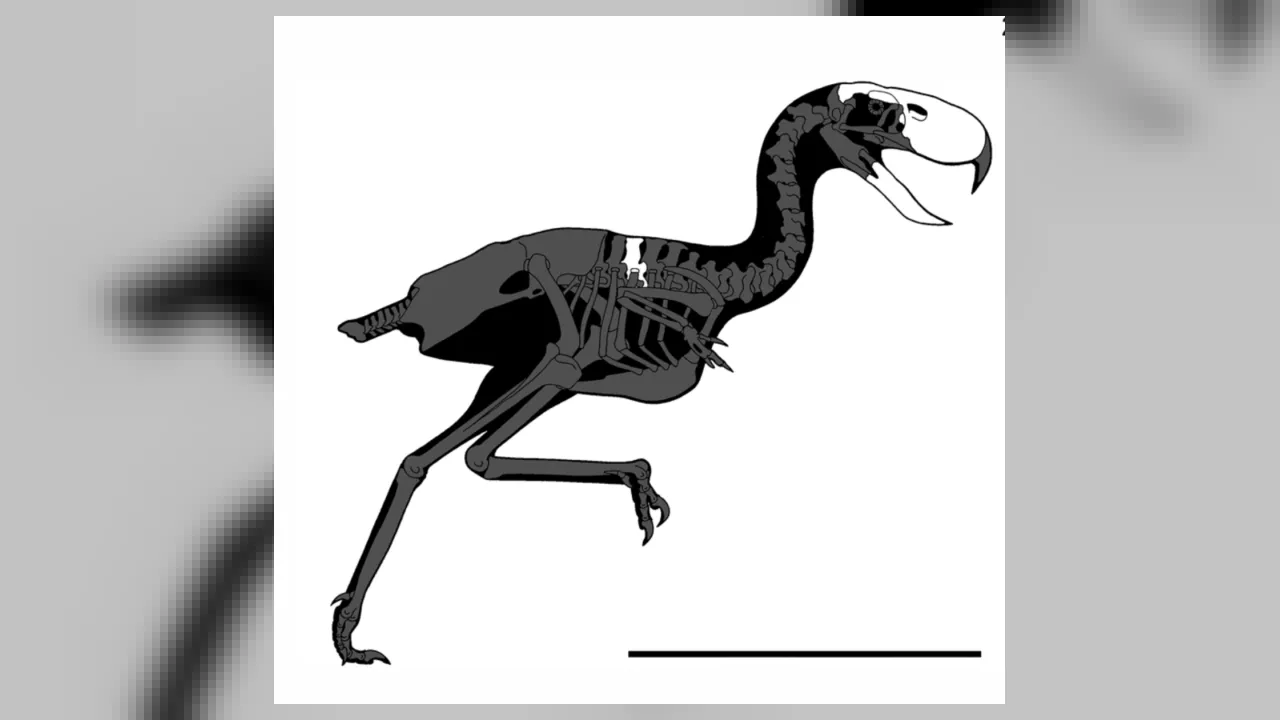
⚡ Survival SuperpowerTwo-foot-long hooked beak plus ostrich-fast sprinting legs
🤯 Mind-Blowing Fact • Grade 1
When scientists found the first two-foot jawbone of Phorusrhacos in 1887, it was so huge they thought it came from a giant mammal!
✨ Word Sparks (Grade 1 Glossary)
Tap 🔊 to hear
flightless
a bird that runs instead of flying
sprint
run at top speed for a burst
hooked
curved downward into a sharp point
🪝
What bird grew taller than a grown-up and ran fast as a horse?
1
Birds That Ruled Land
Thud, thud, thud! Across grassy plains in South America races a giant bird! Meet Phorusrhacos, a famous Terror Bird. It stood eight feet tall—taller than a doorway!
2
Built to Sprint
Tiny wings could not lift this heavy bird into the sky. Instead, long strong legs zoomed fast like an ostrich!
3
A Giant Hooked Beak
Its huge head held a curved beak like an eagle's beak. Sharp curved claws gripped the ground as it dashed across sunny plains.
1. How did Phorusrhacos move around since it could not fly?
2. How tall did Phorusrhacos stand?
🤯 Mind-Blowing Fact • Grade 2
South America's long-legged Seriema bird is the closest living relative of prehistoric eight-foot Terror Birds!
✨ Word Sparks (Grade 2 Glossary)
Tap 🔊 to hear
continent
one of Earth's giant landmasses
raptor
a hunting bird with a hooked beak
flexible
able to bend easily without breaking
🪝
Why did giant birds become top hunters in South America after the dinosaurs vanished?
1
An Island Continent
Millions of years ago, South America floated all by itself like a giant island! No lions, wolves, or bears lived there yet. Into that open job stepped Phorusrhacos and its Terror Bird cousins, becoming the top hunters of the grasslands!
2
Skull Like a Hatchet
Most birds have light skulls with joints, yet Phorusrhacos had fused skull bones two feet long! Its tall, narrow beak ended in a sharp downward hook like a giant hawk's.
3
A Living Walking Cousin
Want to meet a tiny living relative of Terror Birds today? Down in South America lives the three-foot-tall Seriema bird, which still chases lizards on long fast legs!
1. Why were Terror Birds able to rule South America for millions of years?
2. Which modern South American bird is the closest living cousin of Phorusrhacos?
🤯 Mind-Blowing Fact • Grade 3
Fossil inner-ear scans reveal Terror Birds heard low booming sounds best—meaning they likely rumbled like cassowaries instead of chirping!
✨ Word Sparks (Grade 3 Glossary)
Tap 🔊 to hear
Miocene
a warm geologic epoch before Ice Ages
theropod
two-legged dinosaur group that includes birds
vertically
straight up and down
🪝
Why did the scientist who discovered Phorusrhacos think its jaw belonged to a toothless sloth?
1
A Jawbone Puzzle in 1887
In 1887, Argentine paleontologist Florentino Ameghino examined a strange fossil jaw dug from rocks in Patagonia. Because no one imagined a bird with a two-foot skull, Ameghino assumed it came from a toothless mammal! Four years later, complete beaks and leg bones revealed the thrilling truth: Phorusrhacos was a colossal flightless bird!
2
Dinosaur Heritage Returned
Because birds are living dinosaurs, Terror Birds looked startlingly like miniature Tyrannosaurs reborn! Balanced by stiff hips and powerful thighs, Phorusrhacos sprinted nearly thirty miles per hour across brushy savannas.
3
Strike Fast Straight Down
X-ray scans of Terror Bird skulls show their beaks were super strong —from top to bottom—yet weak if twisted side to side. That meant Phorusrhacos struck downward swiftly with precision rather than shaking large animals.
4
Deep Booming Voices
Studies of fossilized inner ears show Terror Birds heard super-low-pitched sounds best, suggesting they communicated across wide grasslands with deep, booming rumbles!
1. How was a Terror Bird's skull strongest when striking?
2. What kind of sounds could Terror Birds hear best according to inner-ear fossils?
🤯 Mind-Blowing Fact • Grade 4
A seven-foot Terror Bird cousin named Titanis walleri marched all the way north into Florida and Texas!
✨ Word Sparks (Grade 4 Glossary)
Tap 🔊 to hear
dynasty
a long-ruling family line over ages
savannas
warm grasslands dotted with scattered trees
placental
mammals like cats and wolves nourishing young
🪝
Did any Terror Bird ever march north into the United States?
1
A Dynasty of Eighteen Species
Step onto the sunlit of Patagonia sixteen million years ago, where hoofed mammals like horse-like litopterns dash through tall grass while eight-foot Phorusrhacos patrols the horizon! Phorusrhacos was the flagship member of Phorusrhacidae, a remarkable of at least eighteen Terror Bird species ranging from dog-sized speedsters to ten-foot-tall Kelenken—holder of the largest bird skull ever discovered, measuring twenty-eight inches long!
2
Precision Neck Mechanics
When scientists ran CT scans and engineering stress tests on Terror Bird skulls and neck bones, they noticed an S-curved neck Divided into specialized muscle zones. Rather than clamping down with crushing jaw muscles like a crocodile, Phorusrhacos pulled its head back and used powerful neck muscles to snap its hooked beak straight downward—much like its living cousin, the red-legged seriema, subdues small prey on the ground.
3
Titanis Invades North America!
While Phorusrhacos lived during the Miocene Epoch, a later giant cousin named Titanis walleri actually crossed northward into North America! Fossil bones of seven-foot Titanis have been unearthed in Texas and Florida alongside Ice Age horses and mammoths.
4
Why Terror Birds Finally Vanished
Ground-nesting giant eggs and stiff competition from predators like jaguars, cougars, Smilodon, and bears—coupled with drying climates—gradually ended the sixty-million-year reign of Phorusrhacidae.
1. Which Terror Bird relative traveled north into Florida and Texas?
2. Which Terror Bird held the record for the largest bird skull ever found?
🤯 Mind-Blowing Fact • Grade 5
The largest Terror Bird skull ever found—belonging to Kelenken guillermoi—was discovered in 1999 by a fifteen-year-old Argentine high school student!
✨ Word Sparks (Grade 5 Glossary)
Tap 🔊 to hear
kinetic
having movable joints inside a bird skull
rostrum
the rigid upper beak projection of birds
cursorial
specially adapted with long legs for running
🪝
How did hollow-boned birds engineer skulls tough enough to serve as South America's apex predators for fifty million years?
1
Cenozoic Echoes of Theropod Dominance
After the Chicxulub asteroid ended non-avian dinosaurs sixty-six million years ago, isolated South America evolved an extraordinary ecological twist: avian dinosaurs reclaimed the apex land-predator throne! Phorusrhacos longissimus—named in 1887 by Argentine paleontologist Florentino Ameghino from Santa Cruz Formation beds in Patagonia—stood roughly 2.5 meters (8.2 feet) tall and weighed approximately 130 kilograms (290 pounds). Its scientific name combines Greek roots likely meaning 'rag-bearer' or 'wrinkle-jaw,' inspired by the rugose texture of the mysterious holotype mandible Ameghino initially mistook for an edentate mammal.
2
Finite-Element Analysis of an Avian Hatchet
Whereas living birds maintain skulls with flexible hinges that lighten weight for flight, phorusrhacids fused their cranial sutures into rigid, hollow-truss beams! In 2010, biomechanical finite-element modeling led by Federico Degrange demonstrated that while Terror Bird jaw adductors generated modest clamping force, the tall, laterally compressed possessed exceptional dorsoventral stiffness. Driven by enlarged cervical vertebrae, the skull withstood powerful vertical impacts while avoiding lateral twisting stresses that could buckle thin bone walls.
3
Cursorial Speed and Pedal Talons
Elongated tarsometatarsi—ankle-foot bones proportionally slender and rigid—allowed Miocene phorusrhacids to reach estimated sprint speeds of 48 kilometers per hour (30 mph). On the second digit of each three-toed foot curved an enlarged, sickle-like ungual claw capable of pinning swift native ungulates such as notoungulates and proterotheres.
4
Endocranial Scans and Acoustic Sensory Ecology
Micro-CT reconstructions of phorusrhacid inner-ear labyrinths published in 2015 revealed elongated cochlear ducts tuned below 2,000 hertz—indicating low-frequency booming calls used for long-distance territorial signaling and low-pitched footstep detection.
5
Rethinking Extinction Timing
Historically, textbooks blamed invading North American carnivorans during the Great American Biotic Interchange for wiping out Terror Birds overnight. Yet modern fossil dating shows most large Patagonian phorusrhacids declined millions of years earlier as Andean uplift cooled and dried Miocene grasslands—while North-bound Titanis proved giant phorusrhacids could hold their own beside wolves and saber-toothed cats until the Early Pleistocene!