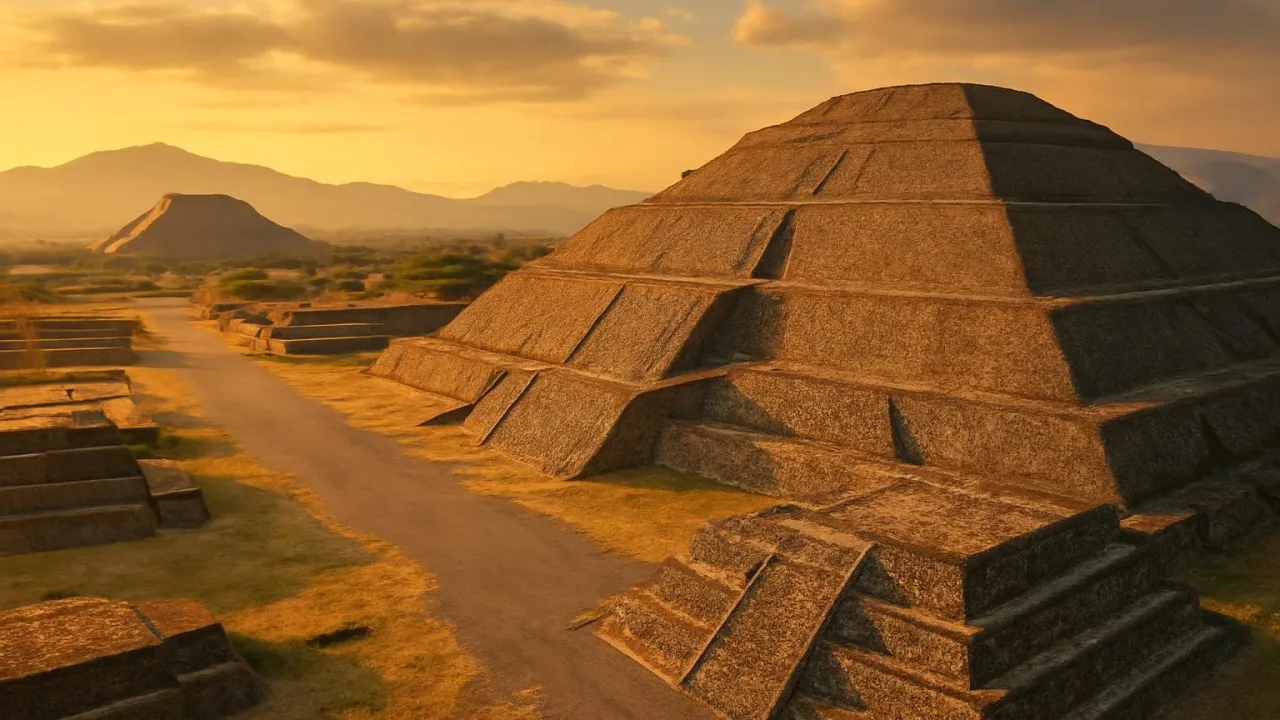
The Avenue of the Dead is a long road connecting the pyramids.
✨ Word Sparks (Grade 2 Glossary)
Tap 🔊 to hear
ancient
Very, very old
valley
Land between hills or mountains
honor
To show respect or celebrate
🪝
What would you see if you climbed to the top of a giant stone pyramid?
1
Climbing High in Teotihuacan
The Pyramids of the Sun and Moon rise high above the ground. Each pyramid has many wide stone steps you can climb. From the top, you can see the whole and the mountains.
2
Built by Ancient Hands
Long ago, people carried heavy stones to build these pyramids. They worked together to make perfect shapes that point to the sky. The pyramids were built to the sun, moon, and nature.
3
A Place for All to Visit
Today, visitors come from all over the world to explore Teotihuacan. Some people imagine what life was like here. Others just enjoy the amazing views and take pictures.
The pyramids’ stairs are so wide that hundreds of people can climb at once!
✨ Word Sparks (Grade 3 Glossary)
Tap 🔊 to hear
engineer
A person who designs and builds things
acoustic
How sound moves in a space
erosion
When wind or water slowly wears away stone
🪝
What secrets might echo between the ancient stones of Teotihuacan’s pyramids?
1
A City of Stone Giants
Teotihuacan was once a bustling city filled with people, markets, and music. The Pyramids of the Sun and Moon tower over the Avenue of the Dead, a grand road. Their massive stone steps echo with the footsteps of ancient builders. From the top, you can see the whole city and the distant mountains.
2
Building with Precision
Ancient carefully aligned the pyramids with the sun and sacred mountains. They used millions of stones, stacking them in layers to create strong, stable structures. The Pyramid of the Sun stands about 216 feet tall, while the Pyramid of the Moon sits at the north end. Their shapes create a sense of balance and harmony in the city.
3
A Place of Ceremony and Wonder
People gathered at the pyramids for ceremonies, music, and stories about the cosmos. The steps and plazas were designed to carry sound, creating natural effects. Today, visitors still feel amazed by the scale and mystery of these monuments. Many imagine what life was like during Teotihuacan’s golden age.
4
Teotihuacan’s Lasting Legacy
The pyramids have survived centuries of wind, rain, and sun. Their careful design helps protect them from and earthquakes. Teotihuacan is now a UNESCO World Heritage Site, recognized for its cultural importance. People from all over the world come to learn from its ancient stones.
1. Why did ancient engineers align the pyramids with the sun?
2. What helps the pyramids survive for so long?
🤯 Mind-Blowing Fact • Grade 4
The Pyramid of the Sun’s base is almost the same size as Egypt’s Great Pyramid at Giza!
✨ Word Sparks (Grade 4 Glossary)
Tap 🔊 to hear
cosmos
The universe and everything in space
platform
A flat, raised surface or stage
resonance
A strong, echoing sound
🪝
Imagine the thud of ancient drums and the sun’s first light hitting the top of a giant stone pyramid—what stories would these stones tell?
1
Teotihuacan: City of the Gods
Long before the Aztecs, Teotihuacan was a flourishing city with tens of thousands of people. The Pyramids of the Sun and Moon rise above the Avenue of the Dead, their massive steps echoing with the sounds of ancient ceremonies. These pyramids were not just monuments—they were the heart of a city built for both daily life and spiritual gatherings. The city’s layout was planned to reflect the , with the pyramids as its anchors.
2
Engineering Marvels of the Ancient World
Builders used volcanic stone, limestone, and adobe bricks to create stable, layered . The Pyramid of the Sun, at 216 feet tall, is one of the largest structures of its kind in the Americas. Engineers aligned the pyramids with the cardinal directions and sacred mountains, using careful measurements and astronomical observations. Their stepped design helps distribute weight, making them resistant to earthquakes and erosion.
3
Ceremony, Sound, and Cosmic Connection
The plazas and steps were designed for ceremonies, music, and storytelling, with acoustics that carried voices and drums. The alignment with the sun and moon was not accidental—it reflected the people’s deep connection to the and the cycles of nature. Large crowds could gather for festivals, their voices echoing up the pyramid steps. Even today, visitors can feel the special of this ancient place.
4
A Legacy That Inspires the World
Teotihuacan’s pyramids have stood for nearly two thousand years, surviving earthquakes and centuries of change. Their design has inspired architects and archaeologists around the globe, who study how ancient people achieved such precision without modern tools. As a UNESCO World Heritage Site, Teotihuacan welcomes visitors from every continent, sharing its mysteries and beauty with the world.
1. How did the builders make the pyramids strong against earthquakes?
2. Why do people from all over visit Teotihuacan today?
🤯 Mind-Blowing Fact • Grade 5
Archaeologists discovered a secret tunnel filled with treasures beneath the Pyramid of the Moon in 2018.
✨ Word Sparks (Grade 5 Glossary)
Tap 🔊 to hear
seismic
Related to earthquakes and ground movement
restoration
Fixing or repairing something to keep it safe
symbolism
When something stands for a bigger idea
🪝
What would you discover if you traced the sunrise’s path along the ancient stones of Teotihuacan’s pyramids?
1
Teotihuacan: Urban Planning and Cosmic Order
Teotihuacan, flourishing between 100 and 450 CE, was one of the largest pre-Columbian cities in the Americas, with an estimated population exceeding 100,000. The city’s grid-like layout was meticulously aligned with astronomical events, and the Pyramids of the Sun and Moon formed the spiritual and ceremonial axis of Teotihuacan. The Avenue of the Dead, a broad central boulevard nearly 1.5 miles (2.4 km) long, connected these monumental structures and organized the city’s neighborhoods. This intentional urban planning reflected the people’s belief in cosmic harmony and the power of sacred geography.
2
Engineering Techniques and Monumental Scale
The Pyramid of the Sun rises 216 feet (66 meters) high, with a base measuring 730 by 760 feet (222 by 233 meters), and was constructed using millions of volcanic stone blocks, adobe, and limestone. The Pyramid of the Moon, slightly smaller at 141 feet (43 meters) tall, anchors the northern end of the city. Both pyramids feature stepped platforms that distribute weight and resist activity, a remarkable feat of ancient engineering. Builders used simple tools, ramps, and human labor, yet achieved precision alignments with solar and lunar cycles.
3
Ceremonial Function and Acoustic Design
Archaeological evidence suggests the pyramids served as stages for rituals, astronomical observations, and public gatherings. The plazas and staircases were designed to amplify sound, creating powerful acoustic resonance during ceremonies involving music, chanting, and drums. The orientation of the pyramids aligns with the setting sun on key calendar dates, demonstrating advanced knowledge of astronomy and mathematics. These features reveal the importance of cosmic cycles in Teotihuacan’s spiritual and civic life.
4
Preservation, Erosion, and Modern Exploration
Despite centuries of erosion, earthquakes, and human activity, the pyramids remain largely intact due to their stepped design, robust materials, and strategic efforts. Archaeologists have uncovered murals, artifacts, and even hidden tunnels beneath the structures, offering insights into the city’s social, religious, and political life. Ongoing research and conservation protect Teotihuacan’s legacy for future generations, revealing new discoveries each year.
5
Global Impact and Enduring Mystery
Today, Teotihuacan is recognized as a UNESCO World Heritage Site and draws millions of visitors annually, inspiring architects, historians, and scientists worldwide. Its monumental scale, mathematical precision, and cultural continue to spark debate and wonder about its original builders, whose true identities remain a mystery. The pyramids’ alignment with celestial events and their influence on later Mesoamerican civilizations underscore their lasting significance in world history.