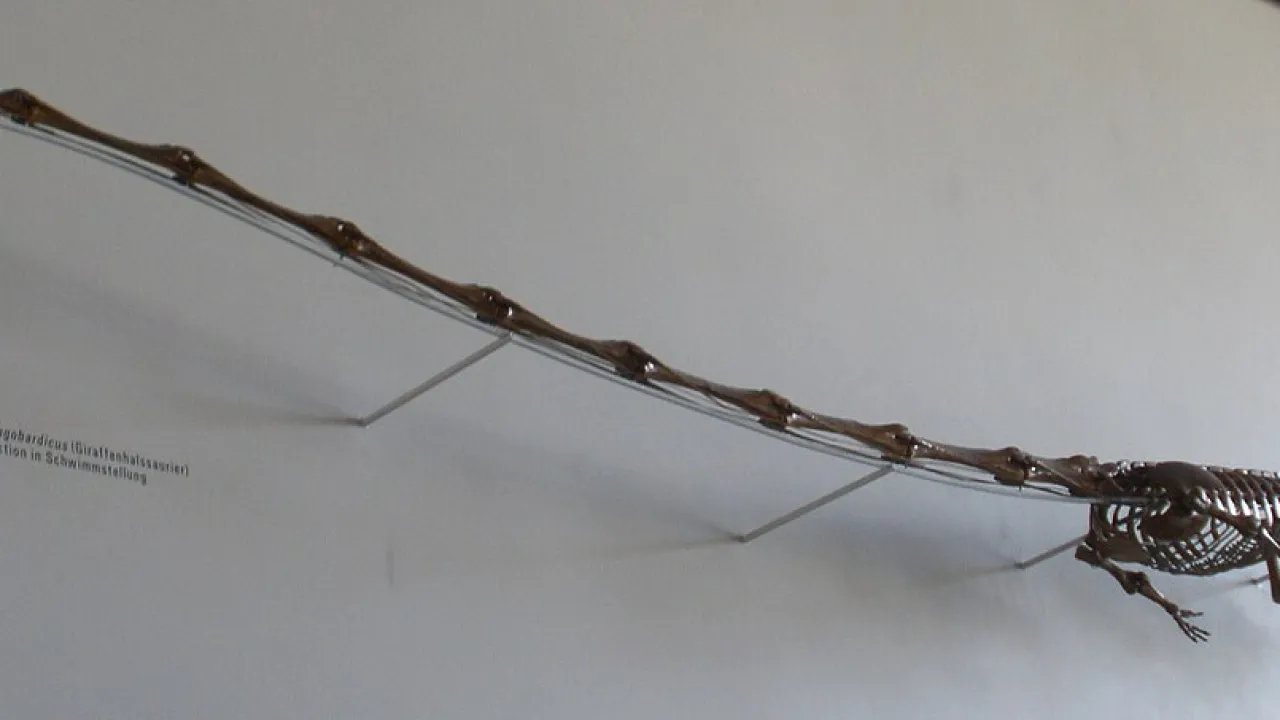
1. How long was the neck of Tanystropheus compared to the rest of it?
2. How did that super-long neck help Tanystropheus catch lunch?
🤯 Mind-Blowing Fact • Grade 2
Because its nostrils sat high on top of its tiny snout, Tanystropheus lived most of its life floating in shallow coastal lagoons!
✨ Word Sparks (Grade 2 Glossary)
Tap 🔊 to hear
Alpine
From the high Alps mountains of Europe
shortcut
A faster or simpler way of doing something
weightless
Supported by water so nothing feels heavy
🪝
How did Tanystropheus build a ten-foot neck out of only thirteen bones?
1
Giraffe Trick vs. Fishing-Pole Trick
Imagine stretching your neck out ten feet without adding extra bones! Swans grow long necks by stacking over twenty short bones. Tanystropheus took a completely different 242 million years ago: it had just thirteen neck bones, each stretched out like a broomstick handle!
2
Stiffened by Thin Ribs
Thin, needle-like ribs ran alongside those long neck bones, making the neck fairly stiff instead of bendy like a snake. Underwater, buoyancy held that ten-foot pole !
3
Small Cousins and Big Cousins
Scientists found two sizes living in the same lagoons: small five-foot bug-eaters and giant twenty-foot fish hunters!
1. How many neck bones formed the giant ten-foot neck of Tanystropheus?
2. What made holding up such an enormous neck much easier in water than on land?
🤯 Mind-Blowing Fact • Grade 3
Growth rings inside tiny five-foot skeletons proved they were mature grown-ups sharing the same lagoon with twenty-foot giant cousins!
✨ Word Sparks (Grade 3 Glossary)
Tap 🔊 to hear
synchrotron
Ultra-bright X-ray machine for scanning crushed fossils
niche partitioning
Neighbors eating different foods so both thrive
growth rings
Yearly bone circles showing an animal's age
🪝
Did Tanystropheus really stand on rocky cliffs fishing like an angler, or swim underwater?
1
Solving a Century-Old Mystery
For decades, paleontologists scratched their heads over skeletons unearthed at Monte San Giorgio on the border of Switzerland and Italy. Did Tanystropheus perch on dry boulders dipping its ten-foot neck into tide pools like a living fishing rod, or did it swim beneath the waves?
2
3D Scans Settle the Debate
In 2020, scientists placed crushed Triassic skulls inside powerful X-ray scanners and digitally reassembled every bone in 3D! Top-facing nostrils and outward-splayed cone teeth proved giant Tanystropheus hydroides was a stealthy aquatic ambush hunter.
3
Two Species Sharing One Lagoon
Even cooler, bone revealed that five-foot skeletons previously thought to be teenagers were actually full-grown adults of a second species, Tanystropheus longobardicus! Small adults crunched shrimp with three-pointed teeth, while twenty-foot giants gulped squid and fish—avoiding food fights!
4
Built-In Stealth Mode
Hovering quietly in murky lagoon water, Tanystropheus glided its tiny head right up to unsuspecting squid before snapping sideways.
1. How did 2020 3D skull scans prove giant Tanystropheus hunted underwater?
2. How could small and giant Tanystropheus species live side by side peacefully?
🤯 Mind-Blowing Fact • Grade 4
Two fossilized Tanystropheus necks studied in 2023 still bore matching tooth marks from giant Triassic sea predators that ambushed the ambush hunter!
✨ Word Sparks (Grade 4 Glossary)
Tap 🔊 to hear
cervical
Relating to the bones of the neck
archosauromorph
Reptile group related to early crocodile-dinosaur cousins
tricuspid
A tooth crown having three pointed tips
🪝
What vulnerable trade-off came with evolving the most extreme neck-to-body ratio in reptile history?
1
Bizarre Marvel of Monte San Giorgio
When Francesco Bassani and later Swiss paleontologists split dark bituminous shales from Monte San Giorgio in the Alps, they uncovered anatomy that seemed to defy physics. Stretching up to six meters in Tanystropheus hydroides, the neck alone measured three meters—exceeding torso and tail combined! Rather than multiplying vertebrae like sixty-vertebrae elasmosaurs, this elongated just thirteen hollow-chambered vertebrae braced by overlapping hair-thin cervical ribs.
2
Synchrotron Tomography Unlocks Skull Secrets
Because delicate skulls flattened like pancakes during fossilization, Tanystropheus's lifestyle sparked fierce debate until 2020 synchrotron micro-CT reconstructions reassembled a crushed skull digitally. Dorsal nostrils, flattened hydrodynamics, and interlocking fang traps confirmed aquatic ambush hunting, where its minuscule skull crept undetected into schools of fish and hook-armed phragmoteuthid squid.
3
Sympatric Dwarf and Giant Species
Paleohistology of limb bone cross-sections solved another puzzle: 1.5-meter specimens bearing (three-cusped) cheek teeth displayed closely spaced outer arrest lines, proving skeletal maturity! Thus small crustacean-crunching Tanystropheus longobardicus and giant piscivorous Tanystropheus hydroides split lagoon resources via Darwinian niche partitioning.
4
Danger for a Slender Neck
In 2023, researchers examined two Tanystropheus fossils whose necks had been cleanly severed mid-way with distinct tooth punctures matching large marine predators like Nothosaurus or Cymbospondylus—proving that an ultra-long fishing rod neck was both a brilliant hunting tool and a tempting target!
1. How did Tanystropheus construct its three-meter neck differently from plesiosaurs?
2. What dramatic discovery did paleontologists publish in 2023 about Tanystropheus?
🤯 Mind-Blowing Fact • Grade 5
Despite seeming fragile, the 'fishing-rod neck' body plan succeeded so well that tanystropheid reptiles thrived from Europe all the way to China and North America for millions of years!
✨ Word Sparks (Grade 5 Glossary)
Tap 🔊 to hear
microtomography
Scanning thin X-ray slices to build 3D models
osteohistology
Microscopic study of internal bone tissue growth
sympatric
Related species living in the exact same habitat
🪝
How did synchrotron X-ray physics, bone histology, and forensic bite marks decode every mystery of Tanystropheus?
1
From 'Wing Bones' to Archosauromorph Icon
When German paleontologist Christian Erich Hermann von Meyer examined foot-long tubular bones from Bavarian Triassic strata in 1852, he named them Tanystropheus ('long hinged')—while contemporaries mistook identical bones for giant pterosaur wing phalanges! Complete skeletons from the UNESCO-listed Besano Formation at Monte San Giorgio (242 MYA) finally stunned anatomists: those rods were thirteen hyper-elongated cervical vertebrae forming a stiffened neck longer than trunk and tail combined.
2
Biomechanical Architecture of the Neck
Supported by overlapping bundles of filamentous cervical ribs ventrolaterally, the neck resisted dorsoventral sagging while permitting horizontal sweeps. Internal pneumatic-like cavities lightened the vertebrae, and center-of-mass modeling paired with muscular hindquarters and webbed pes indicates Tanystropheus hovered calmly in shallow Tethyan lagoons while keeping its bulky torso outside the hydrodynamic wake-detection range of prey.
3
Synchrotron Resolution of Sympatric Species
In 2020, Stephan Spiekman and colleagues utilized synchrotron radiation to digitally uncrush flattened Monte San Giorgio skulls without harming fragile matrix. Combined with femoral showing lines of arrested growth (LAGs), they proved 1.5-meter specimens with tricuspid teeth represented adult Tanystropheus longobardicus, whereas six-meter giants with conical interlocking fangs represented a distinct apex species, Tanystropheus hydroides.
4
Trophic Partitioning and Cephalopod Prey
Preserved gut contents inside large specimens contain calcium-rich fish scales alongside dozens of chitinous arm hooklets from phragmoteuthid coleoids, confirming rapid lateral head strikes in low-visibility coastal waters across Europe, the Middle East, and southern China.
5
Evolutionary Trade-Offs Captured in Stone
A 2023 forensic taphonomic study by Eudald Mujal and Stephan Spiekman documented decapitated specimens of both species exhibiting circular perimortem puncture marks along severed cervical shafts—graphic yet scientifically invaluable proof that extreme morphological specialization carried real predation vulnerability before tanystropheids persisted successfully for over ten million years.