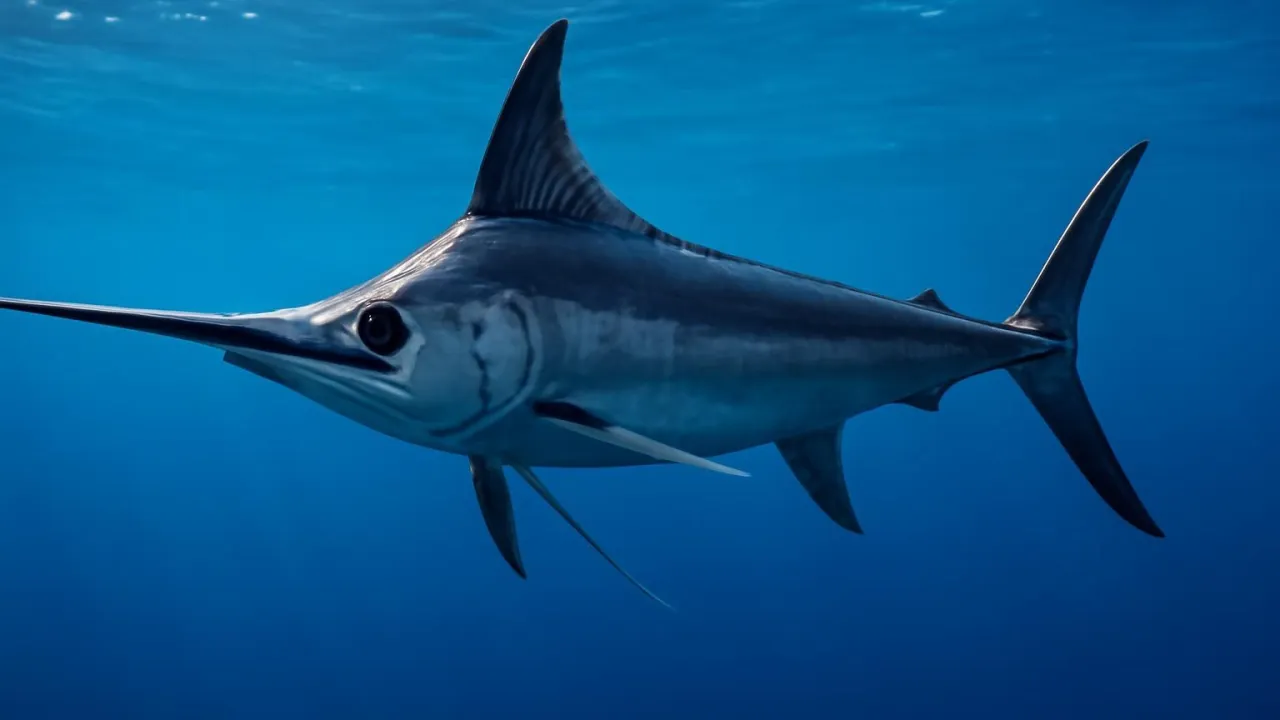
Swordfish can swim up to 60 miles per hour, making them ocean speed champions!
✨ Word Sparks (Grade 2 Glossary)
Tap 🔊 to hear
temperate
Not too hot or cold weather
slash
To cut quickly with a sharp edge
travel
To go from one place to another
🪝
Have you ever seen a fish with a long sword on its nose?
1
Swordfish’s Big Nose
The swordfish has a long, flat nose that looks like a sword blade. It uses this nose to at fish and squid. This helps it catch food quickly. The sword is very sharp and strong.
2
Where Swordfish Live
Swordfish live in warm and oceans all around the world. They swim near the surface and also deep in the water. They like open ocean places where they can move fast. They far to find food.
3
How Swordfish Grow
Swordfish start as tiny eggs that float in the ocean. They grow into small fish and then become big adults. They can grow up to 14 feet long. Their sword grows as they get bigger.
Swordfish can swim nearly as fast as a car on the highway, reaching speeds up to 60 mph!
✨ Word Sparks (Grade 3 Glossary)
Tap 🔊 to hear
adaptation
A change that helps animals survive
camouflage
Colors that help hide animals
predator
An animal that hunts other animals
🪝
Did you know the swordfish uses its sword to catch fast prey in the ocean?
1
Swordfish’s Sharp Sword
The swordfish has a long, flat bill that looks like a sword. This sword helps it slash through schools of fish and squid. The sword is an important for hunting fast prey. It can stun or injure its food before eating.
2
Where Swordfish Live and Move
Swordfish live in warm and temperate oceans worldwide. They swim near the surface and dive deep to find food. Their bodies are built for speed, helping them escape . They use to blend with the ocean water.
3
Swordfish Growth and Life Cycle
Swordfish start life as tiny eggs floating in warm ocean waters. After hatching, young swordfish grow quickly by eating small fish and squid. Adults can reach up to 14 feet long and weigh over 1,000 pounds. Their sword grows longer as they mature.
4
How Swordfish Stay Safe
Swordfish use their speed and sword to avoid danger from . Their streamlined body reduces water resistance for fast swimming. They are key predators in the ocean food web. Their sword also helps protect them from attacks.
1. How does the swordfish’s sword help it besides catching food?
2. What helps swordfish swim fast and escape predators?
🤯 Mind-Blowing Fact • Grade 4
Swordfish can swim faster than any other large fish, reaching speeds up to 60 miles per hour!
✨ Word Sparks (Grade 4 Glossary)
Tap 🔊 to hear
ecosystem
A community of living things and their home
migration
Animals moving to new places to survive
predator
An animal that hunts other animals
🪝
Have you ever wondered how swordfish use their long swords to survive in the ocean?
1
Swordfish’s Hunting Tool
The swordfish’s long, flat bill acts like a sharp sword that it uses to slash at schools of fish and squid, stunning or injuring prey for easier capture. This adaptation allows the swordfish to hunt efficiently in the open ocean where food can be scarce. Their sword is made of bone and grows longer as they mature, increasing their hunting success.
2
Ecosystem Role and Behavior
Swordfish are top in warm and temperate oceans worldwide, playing a key role in controlling fish and squid populations. They swim at various depths, from near the surface to deep waters, to find prey and avoid larger predators. Their speed and camouflage help them survive in a complex food web. Humans also fish swordfish commercially, which affects their populations.
3
Life Cycle and Growth
Swordfish begin life as tiny eggs that float in warm ocean currents before hatching into larvae. Young swordfish grow quickly by feeding on small fish and squid, gradually developing their characteristic sword. Adults can grow up to 14 feet long and weigh over 1,000 pounds, with their sword sometimes reaching nearly one-third of their body length.
4
Geographic Distribution and Migration
Swordfish are found in most of the world’s oceans, preferring warm and temperate waters between the tropics and cooler regions. They migrate long distances to follow prey and breed in specific areas. These help maintain genetic diversity and population health. Changes in ocean temperature and fishing pressure can impact their migration routes.
1. Why is the swordfish’s sword important for hunting?
2. How do swordfish migrations benefit their populations?
🤯 Mind-Blowing Fact • Grade 5
Swordfish can swim at speeds up to 60 miles per hour, faster than any other large fish in the ocean!
✨ Word Sparks (Grade 5 Glossary)
Tap 🔊 to hear
pelagic
Living in open ocean waters far from shore
spawn
To lay eggs in water for babies to grow
adaptation
A special trait that helps survival
🪝
How does the swordfish’s unique anatomy make it one of the ocean’s fastest and most efficient predators?
1
Taxonomy and Scientific Classification
The swordfish, scientifically named Xiphias gladius, belongs to the order Perciformes and family Xiphiidae. It is the only member of its family, characterized by its elongated, flattened bill resembling a sword. This species is a predator found in tropical and temperate oceans worldwide. Its evolutionary have made it a highly specialized hunter in marine ecosystems.
2
Physiological Mechanics of Speed and Hunting
Swordfish possess a streamlined body and a powerful, crescent-shaped tail fin that enable bursts of speed up to 60 miles per hour, making them one of the fastest large fish. Their elongated bill is used to slash and stun prey such as fish and squid, increasing hunting efficiency. Additionally, swordfish have specialized heat-exchange organs near their eyes that enhance muscle performance and vision in cold, deep waters.
3
Conservation Status and Human Impact
Swordfish populations are currently managed through international fishing regulations to prevent overfishing. They are targeted commercially for their meat, which is popular worldwide. Conservation efforts focus on sustainable fishing practices and monitoring population health. Climate change and ocean temperature shifts also pose challenges to their migratory patterns and habitat availability.
4
Growth, Life Cycle, and Reproductive Behavior
Swordfish begin life as eggs that hatch into larvae floating in warm ocean currents. Juveniles grow rapidly, developing their characteristic sword as they mature into adults that can reach lengths of 14 feet and weigh over 1,000 pounds. They reproduce by spawning in warm waters, releasing millions of eggs to increase survival chances. Their life span can reach up to 9 years in the wild.
5
Quantitative Comparisons and Ocean Adaptations
Swordfish can swim at speeds up to 60 miles per hour, which is faster than most large fish and comparable to some marine mammals. Their sword can measure up to 3 feet long, roughly one-third of their body length. They inhabit ocean depths ranging from the surface to 1,000 feet, adapting to temperature variations between 50 and 80 degrees Fahrenheit. These allow swordfish to thrive in diverse marine environments.