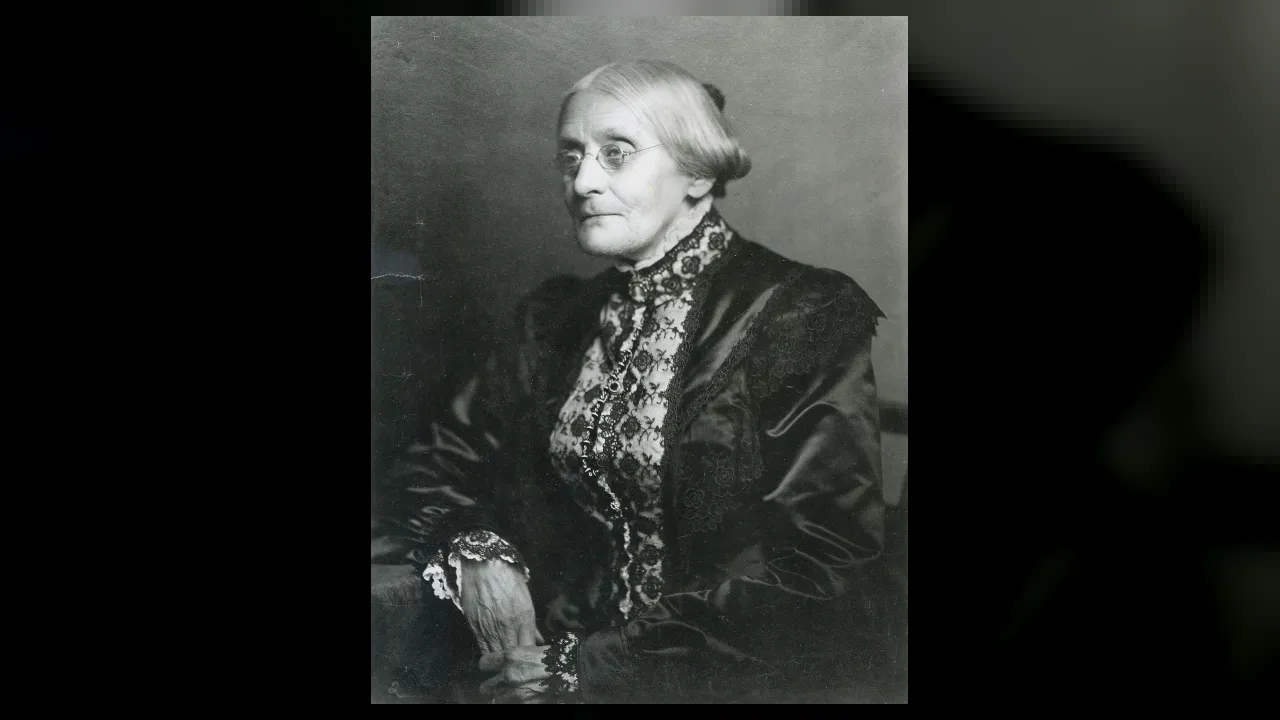
1. What unfair rule did Susan B. Anthony work hard to change?
2. What special item later showed Susan B. Anthony's face?
🤯 Mind-Blowing Fact • Grade 2
Susan B. Anthony gave between seventy-five and one hundred speeches every single year for nearly forty-five years!
✨ Word Sparks (Grade 2 Glossary)
Tap 🔊 to hear
suffrage
The legal right to vote in elections
petition
A signed paper asking leaders for change
ballot
A slip used to mark a vote
🪝
What would you do if you worked just as hard as others, yet had no voice in making laws?
1
Learning About Fairness
Picture a classroom in New York more than one hundred seventy years ago. As a schoolteacher, Susan B. Anthony noticed that male teachers earned four times as much pay as women. Growing up in a Quaker home, she believed every person deserved equal treatment and respect.
2
Traveling for Voting Rights
Susan teamed up with her friend Elizabeth Cady Stanton to work for , the right to vote. Together they wrote speeches, , and newspapers. Even through icy snowstorms, Susan rode trains from state to state, urging Americans to support voting rights for women and freedom from slavery.
3
A Dream That Came True
In 1872, Susan bravely cast a in Rochester, New York, to test the law. Although she did not live to see nationwide victory, her hard work led to the 19th Amendment in 1920.
1. Who partnered closely with Susan B. Anthony to write speeches and lead the suffrage movement?
2. What does the word 'suffrage' mean?
🤯 Mind-Blowing Fact • Grade 3
Susan B. Anthony's famous alligator-skin traveling bag is preserved today at the Smithsonian National Museum of American History!
✨ Word Sparks (Grade 3 Glossary)
Tap 🔊 to hear
ratify
To officially approve a law or amendment
amendment
An official change added to the Constitution
convention
A large meeting gathered for a goal
🪝
How did a small leather handbag stuffed with speeches help transform American democracy?
1
Quaker Roots and Early Courage
Step onto a bustling train platform in the 1850s, where a determined woman clutches a worn alligator-skin bag filled with petitions. Raised in Massachusetts and New York by Quaker parents, Susan B. Anthony learned early that every human being shares equal dignity. Before fighting for voting rights, she campaigned tirelessly against slavery and unfair wages for female teachers.
2
Building a National Movement
In 1851, Susan met reformer Elizabeth Cady Stanton on a street corner in Seneca Falls, New York. Their friendship sparked a lifelong partnership. Stanton drafted eloquent arguments from home while raising her children, and Anthony organized , collected thousands of signatures, and delivered speeches from Maine to California.
3
A Bold Vote in 1872
On Election Day in November 1872, Susan and fourteen other women walked into a barbershop polling place in Rochester, New York, and cast ballots for president. Officials arrested and fined her one hundred dollars, yet her courtroom speech inspired listeners across the nation to examine what citizenship truly meant.
4
The Nineteenth Amendment
In her final public speech in 1906, Susan declared, 'Failure is impossible!' Fourteen years later, in 1920, Congress and the states ratified the 19th , guaranteeing American women the constitutional right to vote.
1. What bold action did Susan B. Anthony take in Rochester, New York, in November 1872?
2. Which famous four-word message did Susan share in her final public speech in 1906?
🤯 Mind-Blowing Fact • Grade 4
On Election Days today, thousands of voters in Rochester, New York, visit Susan B. Anthony's grave to place their 'I Voted' stickers on her headstone!
✨ Word Sparks (Grade 4 Glossary)
Tap 🔊 to hear
abolitionist
A person who worked to end slavery
representation
Having a chosen voice inside government decisions
suffragist
A campaigner working to expand voting rights
🪝
Why did Susan B. Anthony argue that the Constitution already promised women the ballot nearly fifty years before the 19th Amendment?
1
From Classroom Teacher to Abolitionist
Imagine knocking on farmhouse doors in freezing upstate New York winter winds while holding a roll of paper Petitions. Before becoming America's best-known , Susan B. Anthony taught school for fifteen years and worked as an agent for the American Anti-Slavery Society. Alongside leaders like Frederick Douglass, a close neighbor in Rochester, she insisted that true republic liberty required abolishing slavery and recognizing equal civic rights for all citizens.
2
Organizing Strategy and 'The Revolution'
Realizing that reformers could scarcely change laws without political , Anthony focused fiercely on women's suffrage. With Elizabeth Cady Stanton, she co-founded the National Woman Suffrage Association in 1869 and published a weekly newspaper titled The Revolution. Its masthead proclaimed a clear civic principle: 'Men, their rights, and nothing more; women, their rights, and nothing less.'
3
Testing the Fourteenth Amendment
When the 14th Amendment defined all persons born or naturalized in the United States as citizens, Anthony saw a constitutional opening. After registering and voting in the 1872 presidential election, she was tried in federal court. Speaking across twenty-nine New York counties before her trial, she asked audiences a straightforward question: 'Are women persons?' Although Judge Ward Hunt fined her $100, Anthony refused to pay the unjust penalty, turning the trial into a nationwide civics lesson.
4
Legacy Across Generations
In 1878, Senator Aaron Sargent introduced a constitutional suffrage amendment drafted with Anthony's input. Reintroduced in Congress year after year, the measure finally won ratification in August 1920 as the 19th Amendment—still widely honored as the 'Susan B. Anthony Amendment.'
1. Which amendment did Susan B. Anthony cite in 1872 to argue that women were already citizens entitled to vote?
2. Why is the 19th Amendment often called the 'Susan B. Anthony Amendment'?
🤯 Mind-Blowing Fact • Grade 5
In 1900, eighty-year-old Susan B. Anthony pledged the cash value of her own life insurance policy to close a fundraising gap so women could finally enroll at the University of Rochester!
✨ Word Sparks (Grade 5 Glossary)
Tap 🔊 to hear
enfranchise
To grant citizens the legal right to vote
egalitarian
Believing all people deserve equal rights
deliberate
To discuss evidence carefully before deciding
🪝
How did one tireless organizer transform scattered local reform clubs into a disciplined fifty-year constitutional movement?
1
Quaker Conscience and Early Civic Activism
Listen to the clatter of an iron printing press in 1868 New York City as fresh sheets of newsprint roll off the cylinders, demanding equal pay and the ballot for women. Raised in an Quaker household in Adams, Massachusetts, and later Rochester, New York, Susan B. Anthony absorbed the conviction that moral law recognized no hierarchy among human souls. When male temperance conventions barred women from speaking from the floor in the early 1850s, Anthony realized that every social reform—from public education and married women's property laws to abolition—depended on securing political power through the ballot.
2
Forging an Enduring Partnership
Introduced to Elizabeth Cady Stanton in Seneca Falls in 1851, Anthony brought unmatched organizational discipline to Stanton's legal and philosophical writing. During the Civil War, the two founded the Women's Loyal National League, gathering nearly 400,000 petition signatures—the largest petition drive in United States history up to that time—to urge passage of the 13th Amendment abolishing slavery. Previously, in 1860, Anthony's persistent lobbying persuaded the New York State Legislature to grant married women control over their own wages and guardianship of their children.
3
Constitutional Challenge in United States v. Susan B. Anthony
Following ratification of the 14th and 15th Amendments, Anthony tested the 'New Departure' legal strategy, asserting that national citizenship inherently conferred voting rights. On November 5, 1872, she and fourteen women cast ballots in Rochester's Eighth Ward. Indicted under the federal Enforcement Act of 1870, Anthony delivered dozens of pre-trial lectures opening with the Preamble: 'We, the people of the United States—not we, the white male citizens; nor yet we, the male citizens; but we, the whole people.' At her June 1873 trial in Canandaigua, Justice Ward Hunt directed a guilty verdict without letting the jury and imposed a $100 fine, which Anthony famously vowed never to pay.
4
Documenting History and Building Institutions
Recognizing that movements survive only when their history is preserved, Anthony co-edited the monumental multi-volume History of Woman Suffrage and helped merge rival groups into the National American Woman Suffrage Association in 1890. She also pledged her own life insurance policy in 1900 to raise the final funds needed so the University of Rochester would admit female students.
5
Ratification and Constitutional Legacy
By the time of her death in March 1906, four western states—Wyoming, Colorado, Utah, and Idaho—had enacted full women's suffrage. Fourteen years later, on August 18, 1920, ratification of the 19th Amendment wrote the exact 1878 text she had championed directly into the United States Constitution, enfranchising more than twenty-six million women.