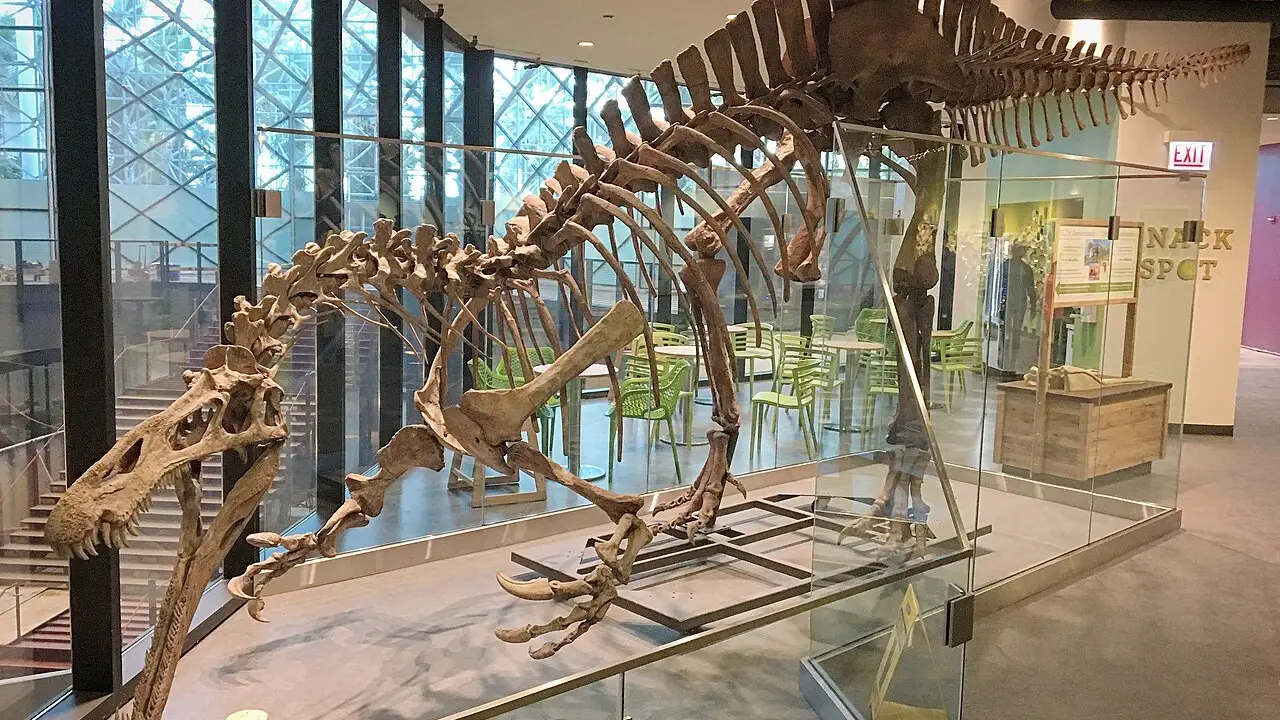
2. What was the Sahara region like when Suchomimus lived there?
🤯 Mind-Blowing Fact • Grade 2
The rivers where Suchomimus fished held ancient coelacanth fish that grew bigger than a grown-up human!
✨ Word Sparks (Grade 2 Glossary)
Tap 🔊 to hear
dune
A hill of loose sand shaped by wind
paradise
A rich, lush place full of life
spine
A tall bony spike rising from a backbone
🪝
How could a giant fish-eating dinosaur end up buried in the middle of the Sahara Desert?
1
Treasure in Shifting Sands
Imagine crossing blazing sand in Niger, Africa, and spotting a giant fossil thumb claw shining in the sun! In 1997, scientists discovered bones of a 36-foot dinosaur right in the Sahara Desert. Back in the Early Cretaceous Period, this sandy place was a green crossed by deep, winding rivers.
2
Built to Snag Monster Fish
Suchomimus had a four-foot-long skull shaped like a crocodile's snout. Inside sat more than 120 cone-shaped teeth that curved slightly backward so slippery lungfish and giant armored fish could never wriggle free.
3
A Low Ridge Down Its Back
Tall along its backbone supported a low, sturdy ridge over its hips, giving this riverside giant a bold profile.
1. How did backward-curving teeth help Suchomimus?
2. What grew along the backbone of Suchomimus?
🤯 Mind-Blowing Fact • Grade 3
Team member David Varricchio spotted the giant thumb claw of Suchomimus in late 1997, allowing paleontologist Paul Sereno's team to excavate tons of desert rock!
✨ Word Sparks (Grade 3 Glossary)
Tap 🔊 to hear
neural spine
The upward-pointing bony projection on a vertebra
interlock
To fit together closely like teeth on a zipper
excavate
To carefully dig fossils out of surrounding rock
🪝
What made Suchomimus the ultimate giant angler of ancient African swamps?
1
Wading Into a Lost Swamp
Sunlight sparkles across a wide, slow-moving river in ancient Niger 115 million years ago. Standing quietly in the shallows is Suchomimus tenerensis, an eleven-meter predator weighing up to four tons. Though buried today beneath Sahara dunes, the Elrhaz Formation once supported lush forests, giant freshwater sharks, and enormous armored fish.
2
One Hundred Twenty Fishhooks
Suchomimus belonged to the spinosaurid family, famous for crocodile-like skulls. Near the front of its slender snout, the upper jaw bulged into a rounded rosette armed with extra-long fangs. Altogether, over 120 pointed teeth interlocked tightly, stabbing and gripping writhing fish instead of slicing meat like blade-toothed hunters.
3
Powerful Arms and Ridge
Unlike short-armed theropods, Suchomimus possessed thick shoulders and muscular arms tipped with curved foot-long thumb claws. Along its vertebrae rose tall up to two feet high over the hips, forming a low skin sail or ridge.
4
Sharing Waters With Giant Crocs
Suchomimus had to watch its step in deep channels, because bus-sized prehistoric crocodyliforms like Sarcosuchus patrolled the very same rivers!
1. Why were Suchomimus teeth shaped like cones instead of flat steak knives?
2. Which other giant predator shared ancient Niger's rivers with Suchomimus?
🤯 Mind-Blowing Fact • Grade 4
Biomechanical studies published in 2021 and 2022 showed Suchomimus balanced its center of mass neatly over its long hind legs, making it an agile shoreline wader!
✨ Word Sparks (Grade 4 Glossary)
Tap 🔊 to hear
biomechanics
Studying how bones and muscles work using physics
coelacanth
An ancient lobe-finned fish lineage living since dinosaur times
sacral
Relating to the fused backbone bones above the hips
🪝
Did Suchomimus swim underwater like a seal or stalk riverbanks like a giant heron?
1
Giants of the Tenere
Blowing desert sand whips across Niger's Tenere region today, yet 115 million years ago during the Aptian stage of the Early Cretaceous, this basin brimmed with tropical rivers and Floodplain forests. Prowling the muddy sandbars was Suchomimus tenerensis, whose name honors both its crocodilian snout and the Tenere Desert where paleontologist Paul Sereno's expedition unearthed it in 1997.
2
Wader Versus Deep Diver
In recent years, scientists tested how Suchomimus and its cousin Spinosaurus moved in water by comparing bone density and body balance. While Spinosaurus had shorter hind legs and tall tail spines suited for deeper water, Suchomimus retained long, sturdy hind legs and slightly hollower limb bones. Biomechanical models show Suchomimus excelled as a shallow-water wader, stalking knee-deep shoals like a four-ton heron.
3
Cranial Engineering for Monster Prey
Its 1.2-meter skull combined retracted nostrils, a rigid bony palate that resisted twisting forces, and a terminal rosette of elongated fangs. When two-meter Mawsonia or lungfish swam within reach, Suchomimus snapped sideways and pinned heavy catches with its massive manual claws.
4
Visual Signaling on the Riverbank
Broad neural spines rising highest over its vertebrae supported a low dorsal sail that helped rivals judge size from afar without dangerous fights.
1. How did Suchomimus differ in body build from its later relative Spinosaurus?
2. What does 'tenerensis' in Suchomimus tenerensis celebrate?
🤯 Mind-Blowing Fact • Grade 5
Bone cross-sections discovered in 2022 showed Suchomimus had lighter, hollower thigh bones than Spinosaurus, proving even closely related fish-eating dinosaurs hunted at different water depths!
✨ Word Sparks (Grade 5 Glossary)
Tap 🔊 to hear
torsional
Involving twisting forces around a long central axis
medullary cavity
The central marrow-filled space inside a limb bone
Gondwana
The ancient southern supercontinent that included Africa and South America
🪝
How does Suchomimus tenerensis illuminate the evolutionary transition between European baryonychines and giant African spinosaurines?
1
A Monumental Sahara Expedition
On December 4, 1997, paleontologist David Varricchio spotted a massive fossilized thumb ungual jutting from Aptian-stage sandstones in Niger's Gadoufaoua fossil beds within the Tenere Desert. Working under Paul Sereno's expedition, researchers excavated roughly two-thirds of a subadult skeleton belonging to an eleven-meter, multi-ton theropod. Named Suchomimus tenerensis in 1998, this specimen revealed that baryonychine spinosaurids thrived across alongside early carcharodontosaurids and giant crocodyliforms.
2
Rostral Mechanics and Dentition
The 1.2-meter cranium of Suchomimus exemplifies specialized piscivory. Its elongated premaxillae and maxillae fuse along a reinforced secondary palate that counters stress when clamping thrashing aquatic vertebrates. More than 122 conical, finely fluted teeth with microscopic serrations line the jaws, culminating in an expanded terminal rosette armed with enlarged fangs while retracted external nares sit anterior to the orbits.
3
Axial Sail and Forelimb Power
Unlike the towering 1.8-meter neural spines of Spinosaurus aegyptiacus, Suchomimus possessed blade-like dorsal and sacral neural spines peaking around sixty centimeters over the pelvis, forming a low continuous crest that likely anchored display skin and axial ligaments. Simultaneously, robust deltopectoral crests on the humerus and enlarged olecranon processes on the ulna anchored powerful forelimb musculature operating curved thirty-centimeter manual digit I claws capable of gaffing heavy aquatic prey in swift currents.
4
Bone Density and Wading Ecology
Comparative bone-compactness analyses published by Matteo Fabbri and colleagues in 2022 found that while Baryonyx and Spinosaurus evolved dense, osteosclerotic femora and ribs acting as subaqueous ballast for underwater foraging, Suchomimus retained open medullary cavities typical of non-diving terrestrial and shoreline waders. Three-dimensional center-of-mass reconstructions further confirm that long, muscular hind limbs kept Suchomimus balanced squarely over its feet when striding along slippery sandbars and shallow river shoals.
5
Keystone Predator of the Elrhaz
Stalking shallow sandbars for multi-meter Mawsonia coelacanths, ceratodontid lungfish, polypterid bichirs, and freshwater sawfish, Suchomimus partitioned resources cleanly with terrestrial carcharodontosaurids like Eocarcharia, abelisaurid Kryptops, and the twelve-meter riverine crocodyliform Sarcosuchus imperator across Early Cretaceous West Africa.