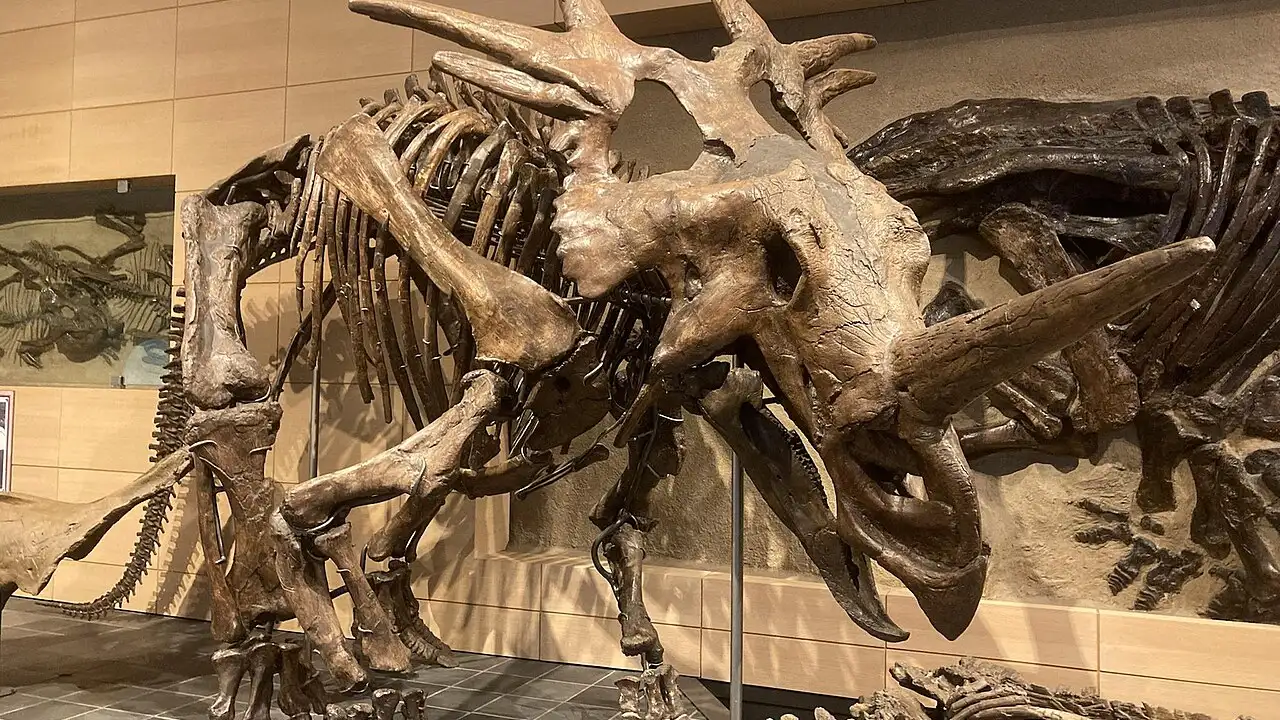
1. Where was the longest single facial horn on Styracosaurus?
2. What made the neck frill of Styracosaurus look like a spiky crown?
🤯 Mind-Blowing Fact • Grade 2
No two Styracosaurus skulls are completely identical—just like human fingerprints or moose antlers, one side of the frill often curved slightly differently than the other!
✨ Word Sparks (Grade 2 Glossary)
Tap 🔊 to hear
Silhouette
Outline shape seen clearly from far away
Brow
The ridge of bone above the eyes
Asymmetrical
Slightly different on the left and right
🪝
How do you tell Styracosaurus apart from its three-horned cousin Triceratops?
1
Spiked Lizard of Alberta
Crash! Branches snap in a lush Canadian forest 75 million years ago as a three-ton Styracosaurus marches onto a riverbank. Its name means 'spiked lizard,' named after the sharp spike at the bottom end of an ancient Greek spear!
2
Nose Horn Plus Starburst Frill
Triceratops had two giant horns and a solid, wavy frill. Styracosaurus flipped that fashion around: it grew one huge two-foot nose horn, tiny bumps over its eyes, and up to six long spikes fanning out from its neck shield!
3
Showing Off to the Herd
Two large windows covered in tough skin kept that dramatic frill light enough to lift, helping Styracosaurus dazzle herdmates and warn hungry tyrannosaurs.
2. Why wasn't Styracosaurus's spiky frill too heavy to hold up?
🤯 Mind-Blowing Fact • Grade 3
Charles H. Sternberg unearthed the very first Styracosaurus skull in Alberta in 1913, and museum visitors nicknamed it 'the unicorn with a crown'!
✨ Word Sparks (Grade 3 Glossary)
Tap 🔊 to hear
Centrosaurine
Horned dinosaur subgroup with big nose horns
Billboard
A bold visual display seen from afar
Bonebed
Rock layer holding bones from many animals
🪝
Why did Styracosaurus wear six giant spikes pointing backward instead of forward?
1
Head-Turning Centrosaurine
Imagine standing beside a winding river in Late Cretaceous Alberta 75 million years ago when a herd of Styracosaurus lowers its heads to drink! Measuring 18 feet long and weighing three tons, Styracosaurus belonged to the —short-frilled horned dinosaurs famous for oversized nose horns and flashy neck ornaments.
2
Built for Billboard Display
Pointing backward and outward from its frill rim, the longest top spikes stretched nearly two feet! Because they aimed away from predators in front, paleontologists think the spiky crown worked mainly as a giant visual —making Styracosaurus look huge when it dipped its chin to show off to rivals or scare predators.
3
Scissor-Like Dental Batteries
Behind its deep, narrow beak sat tightly packed stacks of teeth that slid past each other like vertical garden shears, slicing woody palms, cycads, and tough ferns into tiny bits.
4
Bonebeds of Hundreds
Vast in Alberta's Dinosaur Provincial Park show Styracosaurus traveled in big social herds across seasonal floodplains.
1. Why do scientists think Styracosaurus's frill spikes were mainly for visual display?
2. How did Styracosaurus's stacked cheek teeth work?
🤯 Mind-Blowing Fact • Grade 4
The famous Styracosaurus skull nicknamed 'Hannah' had such mismatched left and right frill spikes that it forced scientists to rethink several supposedly separate dinosaur species!
✨ Word Sparks (Grade 4 Glossary)
Tap 🔊 to hear
Parietal
Central upper skull bone forming the frill
Angiosperm
Any plant that produces flowers and seeds
Variation
Natural differences among individuals of one species
🪝
What did a crooked skull Named 'Hannah' teach paleontologists about how Styracosaurus grew its crown?
1
Rapid Evolution on Laramidia
During a brief 500,000-year slice of the Late Cretaceous Period (75.5 to 75 million years ago), Styracosaurus albertensis replaced its close ancestor Centrosaurus across the lush coastal plains of southern Alberta. Weighing roughly three metric tons on stocky limbs, this centrosaurine ceratopsid wielded an upright 57-centimeter nasal horn alongside an unforgettable starburst of elongated spikes.
2
Shearing Fibrous Flora
Equipped with huge nostrils and a deep, narrow rostrum, Styracosaurus cropped fibrous cycads, palms, and woody growing below head height. Inside its jaws, columns of self-sharpening teeth locked together into dental batteries; as upper and lower blades sliced past one another vertically, worn teeth dropped out while fresh replacements pushed upward from beneath.
3
Lessons From an Asymmetrical Skull
In 2015, paleontologist Robert Holmes and colleagues described a remarkably complete skull nicknamed 'Hannah' from Dinosaur Provincial Park. Surprisingly, the left side of Hannah's frill carried spikes arranged differently in number and curvature than the right side! Had paleontologists found those two halves separately, they might have mistakenly named two different dinosaur species—proving individual and growth remodeling were dramatic in horned dinosaurs.
4
Herd Life in Flooding Deltas
Mass bonebeds containing mixed juveniles, subadults, and adults indicate Styracosaurus migrated in large multi-generational herds, occasionally perishing together during catastrophic tropical storms or river floods.
1. Why was the discovery of the asymmetrical Styracosaurus skull 'Hannah' so important to science?
2. What happened when a Styracosaurus wore down a tooth chewing woody palms?
🤯 Mind-Blowing Fact • Grade 5
Precise rock-layer dating in Dinosaur Provincial Park shows Centrosaurus vanished right around 75.5 million years ago and Styracosaurus appeared immediately on top—capturing horned dinosaur evolution step-by-step in stone!
✨ Word Sparks (Grade 5 Glossary)
Tap 🔊 to hear
Stratigraphic
Arranged in stacked geologic layers by age
Epiparietal
Decorative spike bone fused along frill edges
Bilateral
Involving both left and right body sides
🪝
How did rapid evolutionary turnover and individual cranial plasticity shape the spectacular frill of Styracosaurus albertensis?
1
Stratigraphic Turnover in Dinosaur Park
Within the upper beds of Alberta's Dinosaur Park Formation, precise volcanic-ash radiometric dating pinpoints the reign of Styracosaurus albertensis to a crisp interval between 75.5 and 75.0 million years ago. Directly succeeding Centrosaurus apertus in the local rock column without overlapping stratigraphically, this 5.5-meter (18-foot), three-metric-ton herbivore exemplifies rapid anagenetic or clade-replacement evolution among Campanian centrosaurine ceratopsids.
2
Architecture of the Parietal Starburst
Collected in 1913 by Charles H. Sternberg along the Red Deer River and named that same year by Lawrence Lambe—from the Greek styrax, the bronze butt-spike of a hoplite spear—Styracosaurus flipped chasmosaurine proportions on their head. Its postorbital brow horns shrank in adults to low pits or blunt bosses, while fused nasal bones soared into a straight, 57-centimeter lance. Framing paired parietal fenestrae, ossifications (loci P3, P4, and often P5) elongated into radiating 50-centimeter spikes, flanked below by shorter hooks.
3
Developmental Plasticity and Taxonomic Caution
In 2020, Robert Holmes, Michael Ryan, and Caleb Brown published a landmark analysis of specimen UALVP 55900 ('Hannah'), an intact skull displaying pronounced asymmetry across its parietal ornamentation: the right frill margin bore an extra spike locus absent on the left, mimicking traits once deemed diagnostic of separate species like Styracosaurus ovatus (now Rubeosaurus). Combined with ontogenetic growth series showing juvenile spikes budding late and resorbing bone as animals aged, Hannah proved ceratopsid frills responded dynamically to individual hormone and growth signals.
4
Vertical Shearing and Niche Ecology
Inside its deep oral cavity, vertical columns of tightly appressed teeth met at steep ~80-degree wear facets, functioning strictly as high-pressure guillotines rather than mammalian grinders to dice tough cycads, ferns, and woody dicots.
5
Monodominant Bonebeds and Herd Dynamics
Bonebed 42 and related mass-mortality horizons in Dinosaur Provincial Park preserve disarticulated remains of dozens of Styracosaurus individuals with minimal other taxa mixed in, confirming large gregarious herds navigated coastal floodplains under the watch of tyrannosaurids like Daspletosaurus.