⚡ Planet Earth SparkConstructs Earth's most iconic symmetrical peaks—and unleashes its towering ash plumes
🤯 Mind-Blowing Fact • Grade 1
Japan's famous snow-capped Mount Fuji is actually three volcanoes stacked one on top of another like nesting cups!
✨ Word Sparks (Grade 1 Glossary)
Tap 🔊 to hear
composite
Made up of different parts or layers together.
ash
Tiny bits of rock blown from a volcano.
steep
Slanting sharply up and down like stairs.
🪝
When you draw a tall, pointy volcano with snow on top, what kind of volcano did you just sketch?
1
A Giant Layer Cake
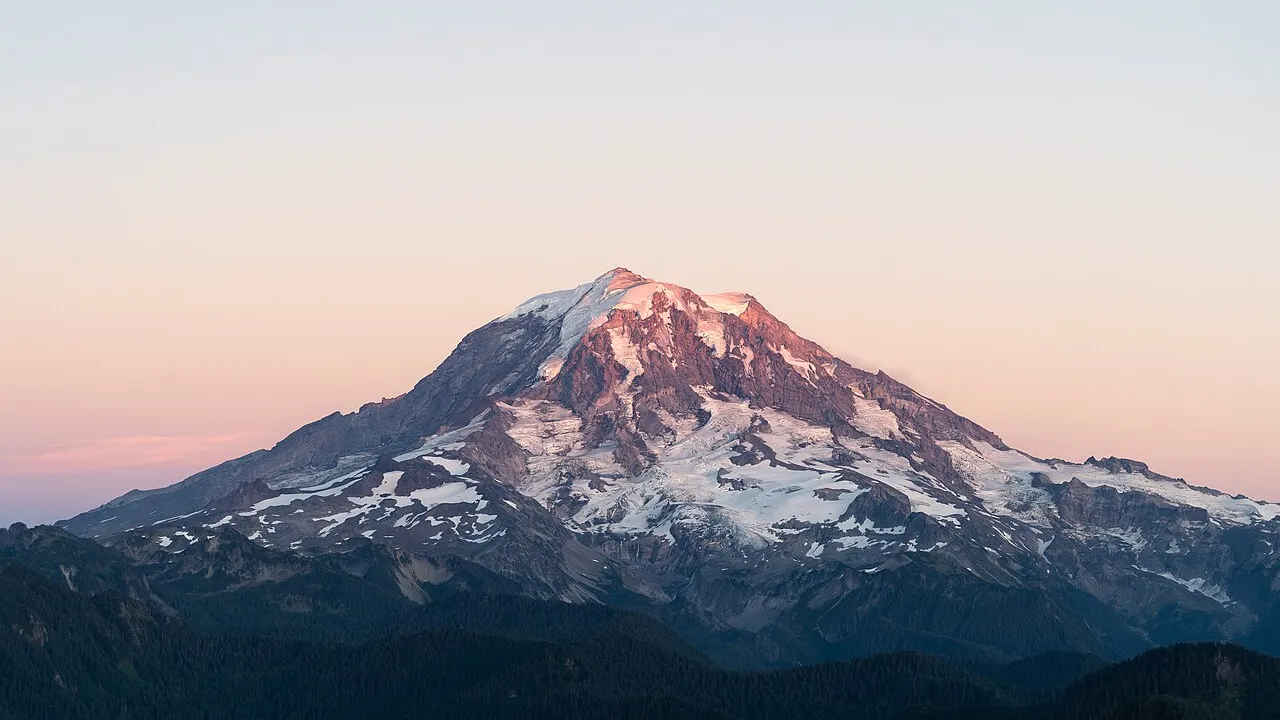
Picture a tall mountain with sides and a snowy white top. Inside, it is stacked like a giant layer cake! One layer is hard lava, and the next is grey .
2
Thick, Sticky Magma
Deep inside these volcanoes, melted rock is thick like oatmeal. Gas bubbles get trapped tight until—BOOM!— shoots high into the sky.
3
Famous Snowy Peaks
Mount Fuji in Japan and Mount Rainier in Washington are both tall, beautiful stratovolcanoes!
1. Why are composite volcanoes compared to a giant layer cake?
2. Why do stratovolcanoes often erupt with big booms?
🤯 Mind-Blowing Fact • Grade 2
When Mount St. Helens erupted in Washington State in 1980, its ash cloud climbed 15 miles high in just 15 minutes!
✨ Word Sparks (Grade 2 Glossary)
Tap 🔊 to hear
strata
Stacked horizontal layers of rock or volcanic ash.
plume
A tall, rising column of ash and steam.
crater
A bowl-shaped opening at a volcano's top.
🪝
Why do stratovolcanoes grow steep and tall instead of spreading wide like Hawaii's volcanoes?
1
Two Names for One Mountain
Close your eyes and picture a classic storybook volcano rising steeply into the clouds. Scientists give these majestic mountains two helpful names: 'stratovolcanoes' for their stacked rock layers, or 'composite volcanoes' because they combine different volcanic materials.
2
Sticky Lava Builds Steep Sides
Unlike runny Hawaiian lava, magma inside a stratovolcano is thick and pasty. When it oozes out, it cools and hardens before traveling very far, piling up into steep slopes near the top.
3
Standing Along the Ring of Fire
Other times, trapped gases blast dusty ash and rocky blocks across the cone, adding fresh layers. Mount St. Helens, Mount Hood, and Italy's Mount Vesuvius are all famous stratovolcanoes!
1. Why does lava on a stratovolcano pile up into steep slopes?
2. Which famous volcano in Italy is a composite stratovolcano?
🤯 Mind-Blowing Fact • Grade 3
Stratovolcanoes erupt frothy pumice stone packed with so many tiny trapped gas bubbles that solid rock actually floats on water!
✨ Word Sparks (Grade 3 Glossary)
Tap 🔊 to hear
andesite
Medium-grey volcanic rock named after the Andes Mountains.
pumice
Frothy, lightweight volcanic rock that floats on water.
lahar
Fast volcanic mudflow of melted snow and ash.
🪝
How does shaking a fizzy soda bottle explain the explosive power of a composite volcano?
1
Subduction Feeds the Cone
Almost every stratovolcano on Earth stands near a subduction zone, where a wet ocean plate dives beneath another plate. Rising magma melts through thick continental crust, picking up extra silica that makes the melted rock thick and sticky.
2
The Fizzy-Bottle Effect
Deep underground, high pressure keeps steam and carbon dioxide dissolved inside the magma, just like fizz inside a sealed bottle. As thick magma inches upward and pressure drops, gas bubbles expand violently and shatter magma into jagged volcanic ash and !
3
Alternating Strata
Quieter eruptions squeeze out thick tongues of lava or push up steep lava domes inside the crater. Over thousands of years, alternating ashfalls and lava flows construct a strong, steep cone.
4
Glaciers and Lahars
Because tall stratovolcanoes like Mount Rainier wear caps of snow and ice, volcanic heat can rapidly melt glaciers into fast-moving volcanic mudflows called .
2. What do volcanologists call a rapid mudflow formed when volcanic heat melts summit snow and mixes with ash?
🤯 Mind-Blowing Fact • Grade 4
Oregon's deep blue Crater Lake sits inside the collapsed caldera of Mount Mazama, a giant stratovolcano that blew its top roughly 7,700 years ago!
✨ Word Sparks (Grade 4 Glossary)
Tap 🔊 to hear
tephra
All rock fragments and ash blasted from volcanoes.
dacite
Sticky, silica-rich volcanic rock common in lava domes.
conduit
Pipe-like underground passage carrying magma to a vent.
🪝
Why do stratovolcanoes sweep gracefully upward like curved ramps—getting steeper and steeper near their snowy summits?
1
Concave Profiles and Composite Strength
Stand across a valley from Japan's Mount Fuji, Ecuador's Cotopaxi, or Washington's Mount Baker, and notice how their slopes sweep upward in a graceful concave curve—gentle around the broad apron at the base, steepening to 30 or 35 degrees near the summit crater! Geologists call these landmarks stratovolcanoes or composite cones because internal cross-sections reveal alternating strata of viscous lava flows, airborne (ash and cinders), and radiating vertical rock walls called dikes that act like structural ribs.
2
Intermediate-to-Felsic Chemistry
What gives composite volcanoes such different personalities from Hawaiian shields? Above subduction zones, rising magma assimilates silica-rich crust, producing andesite, , and rhyolite containing 55 to 70+ percent silica (`SiO2`) at cooler temperatures (800 to 1,000 °C). High silica links into tangled molecular chains, creating high viscosity that traps dissolved water vapor and sulfur gases.
3
Dormant Decades and Plinian Columns
Between eruptions, cooled lava plugs seal the central for decades or centuries while wildflowers and glaciers cloak the peak. When fresh magma recharges the chamber below, gas pressure eventually blasts the plug apart, launching Plinian ash columns high into the stratosphere—as Mount Pinatubo did in 1991, briefly cooling global temperatures by half a degree Celsius!
4
Watching North America's Cascade Arc
Across Oregon, Washington, and California, USGS volcano observatories monitor Cascade stratovolcanoes like Mount Shasta, Crater Lake (ancient Mount Mazama), and Mount Rainier with seismometers, gas sniffers, and lahar-detection tripwires.
1. How do vertical rock walls called dikes help a stratovolcano grow thousands of meters tall?
2. How did the 1991 eruption of Mount Pinatubo in the Philippines affect Earth's weather?
🤯 Mind-Blowing Fact • Grade 5
In the two months before May 18, 1980, rising sticky magma pushed the north side of Mount St. Helens outward by nearly five feet every single day!
✨ Word Sparks (Grade 5 Glossary)
Tap 🔊 to hear
cryptodome
Bulging mass of viscous magma swelling inside a volcano.
Plinian eruption
Powerful blast shooting ash high into the stratosphere.
andisol
Exceptionally fertile soil formed from weathered volcanic ash.
🪝
How does fractional crystallization turn dark mantle melt into explosive dacite—and why did Mount St. Helens blast sideways in 1980?
1
Magmatic Differentiation in Subduction Arcs
Roughly 60 percent of Earth's individual volcanoes are composite stratovolcanoes clustered along convergent arcs like the Andes, Cascades, Indonesia, and Japan. Although flux melting in the mantle wedge initially generates basaltic melt, that magma stalls inside thick arc crust on its way up. Through fractional crystallization (iron-magnesium minerals settling out early) and crustal assimilation, the remaining melt grows progressively richer in silica (`SiO2` 57–70+%) and volatiles (`H2O`, `CO2`, `SO2`), evolving into viscous andesite, dacite, or rhyolite.
2
Polymerization, Fragmentation, and Plinian Columns
Inside high-silica magmas, silicon-oxygen tetrahedra link into dense 3D networks that resist gas escape. As ascending magma decompresses inside the conduit, dissolved volatiles exsolve into rapidly expanding bubbles until the frothy melt crosses its fragmentation threshold—shattering violently into microscopic glass shards (ash) and vesicular pumice. Driven upward by jet momentum and convective buoyancy, columns can punch 25 to 40 kilometers into the stratosphere.
3
Cryptodomes and Sector Collapse: Mount St. Helens 1980
In spring 1980, viscous dacite intruding inside Washington's Mount St. Helens pushed its north flank outward by 1.5 meters per day—creating a bulge called a . On May 18, a magnitude 5.1 earthquake triggered the largest landslide in recorded history; uncorked instantaneously, the pressurized cryptodome unleashed a supersonic lateral blast, leveled 600 square kilometers of forest, and lowered the summit by 400 meters.
4
Hydrothermal Alteration and Lahar Risk
Acidic volcanic gases streaming through a stratovolcano's core chemically weather sturdy andesite into weak clay, destabilizing steep upper slopes while summit glaciers store vast volumes of water poised to generate valley-filling lahars.
5
Fertile Andisols and Predictive Monitoring
Despite hazards, weathered stratovolcano ash creates mineral-rich soils that feed hundreds of millions of people—protected today by broadband seismic networks, satellite InSAR deformation maps, and `SO2` spectrometers.