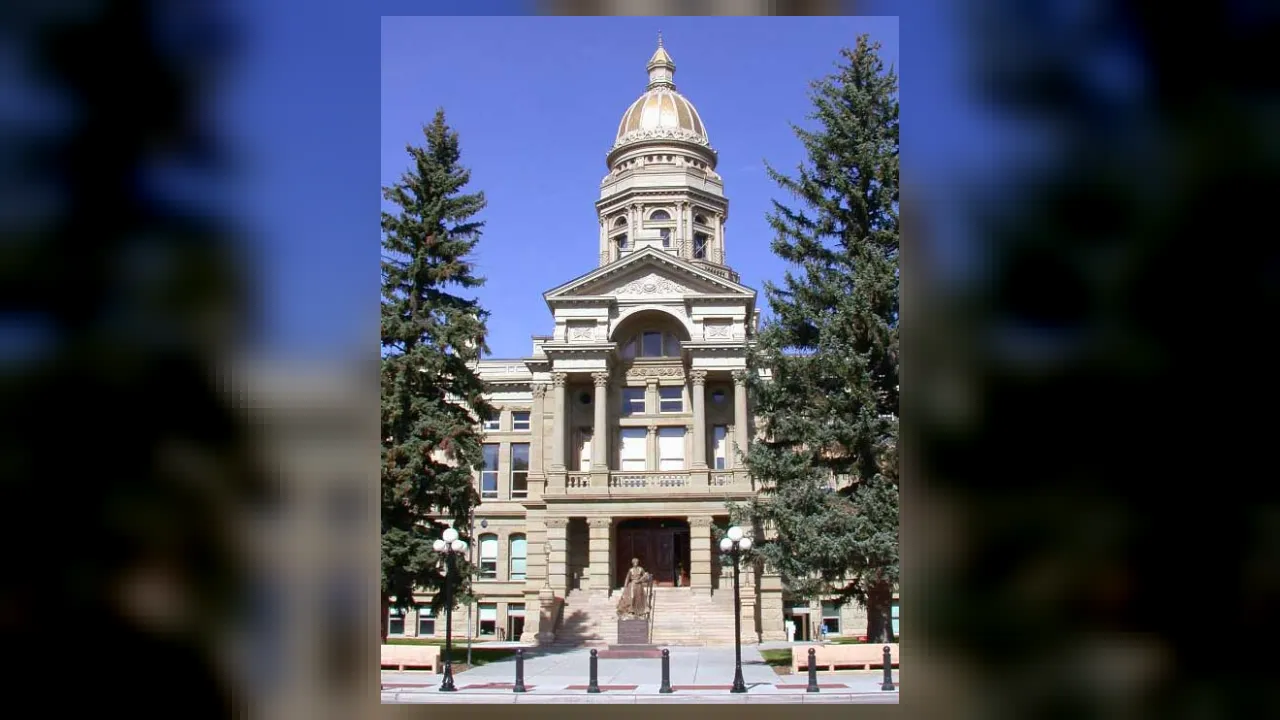
1. What famous natural fountain shoots hot water and steam into the air in Wyoming?
2. How does Wyoming's population compare with the other 49 U.S. states?
🤯 Mind-Blowing Fact • Grade 2
Fast-running pronghorn—which can sprint fifty-five miles per hour—actually outnumber people in the State of Wyoming!
✨ Word Sparks (Grade 2 Glossary)
Tap 🔊 to hear
national park
natural land protected by law for everyone
pronghorn
super-fast hoofed animal of western plains
hot spring
pool of groundwater warmed by Earth's heat
🪝
Which place in Wyoming inspired countries around the world to create national parks?
1
The World's First National Park
Step onto wooden boardwalks past rainbow-colored hot pools, bubbling mud pots, and roaring waterfalls! In 1872, Congress protected Yellowstone—mostly in northwestern Wyoming—as the very first anywhere in the world. Just south of Yellowstone, the jagged Grand Teton Mountains rise straight up behind mirror-bright lakes.
2
Why It Is the Equality State
Even before Wyoming became the forty-fourth state in 1890, its leaders made fairness history in 1869 by passing a law guaranteeing women the right to vote and hold public office!
3
Cowboy Trails and Cheyenne
Cattle ranches, swift , and rodeos surround the southeastern capital city of Cheyenne.
1. What world record did Yellowstone set when Congress protected it in 1872?
2. Why is Wyoming proudly called 'The Equality State'?
🤯 Mind-Blowing Fact • Grade 3
Grand Prismatic Spring in Yellowstone gets its glowing rings of orange, yellow, and emerald green from billions of heat-loving microscopic organisms living in hot water!
✨ Word Sparks (Grade 3 Glossary)
Tap 🔊 to hear
suffrage
legal right of citizens to vote
monument
special landmark protected for history or science
Continental Divide
mountain line splitting rivers toward two oceans
🪝
Why did Wyoming tell Congress 'We will stay out of the Union a hundred years rather than come in without the women'?
1
Standing Firm for Equal Rights
Imagine lawmakers in Washington, D.C., arguing in 1890 over whether Wyoming Territory should be allowed to become a state if women kept voting! Wyoming's territorial leaders wired back a famous telegram: they would rather wait a hundred years than enter the Union without women's . Congress backed down, and on July 10, 1890, Wyoming became the forty-fourth state—and later elected America's first female governor, Nellie Tayloe Ross, in 1924!
2
First Park and First Monument
Wyoming holds two conservation firsts: Yellowstone became the world's first national park in 1872, and in 1906 President Theodore Roosevelt named flat-topped Devils Tower (Bear Lodge) in northeastern Wyoming America's very first national .
3
Crossing the Continental Divide
High Rocky Mountain ridges split river waters toward two oceans, while gentle South Pass guided covered wagons west along the Oregon Trail.
4
Wide Rectangular Borders
Only Colorado and Wyoming have state borders drawn as simple four-sided latitude-and-longitude rectangles on the map!
1. Which landmark in northeastern Wyoming became America's very first national monument in 1906?
2. Who made history in Wyoming after the 1924 election as the first woman to serve as governor of any U.S. state?
🤯 Mind-Blowing Fact • Grade 4
At Parting of the Waters high on Two Ocean Pass in Wyoming, a single mountain creek literally splits in two—sending one branch to the Pacific Ocean and the other branch all the way to the Atlantic Ocean!
✨ Word Sparks (Grade 4 Glossary)
Tap 🔊 to hear
geothermal
warmed by natural heat deep inside Earth
obsidian
shiny black volcanic glass cooled from lava
justice of the peace
local judge who settles community legal cases
🪝
How did a hidden mountain saddle in Wyoming carry half a million pioneers across the Rocky Mountains?
1
High Plains, Jagged Tetons, and South Pass
Although Wyoming ranks tenth in land area at 97,813 square miles, its average elevation of 6,700 feet makes it the second-highest state in America after neighboring Colorado! Sheer granite peaks such as the Wind River Range (topped by 13,804-foot Gannett Peak) and the fault-block Teton Range tower over sagebrush basins. Yet between those steep walls lies a wide, grassy twenty-mile gap called South Pass—discovered by Indigenous travelers and fur trappers—gentle enough for covered wagons on the Oregon, California, and Mormon trails to cross the Continental Divide.
2
Indigenous Homelands and a Surprising Eastern Name
Shoshone, Arapaho, Crow, Cheyenne, and Lakota nations hunted bison, gathered stone tools at Yellowstone's Obsidian Cliff, and honored Bear Lodge (Devils Tower). Surprisingly, the name 'Wyoming' migrated west from Pennsylvania's Wyoming Valley—derived from a Munsee Delaware word meaning 'at the big river flat'!
3
World-Changing Suffrage Laws
On December 10, 1869, Wyoming's territorial legislature passed the first unconditional, permanent law in world history guaranteeing women the right to vote and hold office. Weeks later in South Pass City, Esther Hobart Morris became the first female in the United States, and Laramie convened the first jury to include women.
4
Geothermal Wonders and Dinosaur Beds
Deep beneath Yellowstone, a plume of hot magma heats groundwater to power over five hundred active geysers, while Como Bluff in southeastern Wyoming yielded the first celebrated skeletons of Apatosaurus, Diplodocus, and Allosaurus!
1. Why was Wyoming's South Pass so important to pioneers traveling west in the 1840s and 1850s?
2. Where did the word 'Wyoming' surprisingly travel from before naming this western territory?
🤯 Mind-Blowing Fact • Grade 5
Archaeologists have discovered black volcanic glass (obsidian) quarried from Yellowstone's Obsidian Cliff in Wyoming inside two-thousand-year-old Indigenous Hopewell mounds more than 1,200 miles away in Ohio!
✨ Word Sparks (Grade 5 Glossary)
Tap 🔊 to hear
hydrothermal
relating to Earth-heated underground water and steam
intermontane
wide basin lying between tall mountain ranges
statute
formal written law enacted by a legislature
🪝
How do a mantle hotspot, three continental river basins, and an uncompromising 1869 suffrage statute define America's least-densely-populated state?
1
Latitudinal Geometry and Triple-Ocean Hydrology
Bounded neatly between 41° and 45° north latitude and 104°03' and 111°03' west longitude, Wyoming spans 97,813 square miles of Rocky Mountain ranges and sagebrush basins with fewer than six residents per square mile—the lowest population density in the contiguous forty-eight states. Straddling the Continental Divide from 13,804-foot Gannett Peak in the Wind River Range to the Yellowstone Plateau, Wyoming feeds three titanic North American river systems: the Snake-Columbia toward the Pacific, the Green-Colorado toward the Gulf of California, and the Yellowstone, Powder, and North Platte rivers toward the Missouri-Mississippi and Gulf of Mexico.
2
Hotspot Volcanism, Fault Blocks, and Paleontological Riches
Beneath northwestern Wyoming sits the Yellowstone Hotspot, a stationary thermal plume whose magma chamber lies just miles below the surface, fueling more than ten thousand features—over half of Earth's geysers. Immediately south, movement along the Teton Fault thrust Precambrian gneiss nearly 7,000 vertical feet above Jackson Hole without foothills. Elsewhere, Eocene Green River shales at Fossil Butte preserve fifty-million-year-old fish and palm leaves in microscopic detail, while Como Bluff's Morrison Formation sparked nineteenth-century vertebrate paleontology.
3
Indigenous Trails, South Pass, and Transcontinental Arteries
Eastern Shoshone, Northern Arapaho (sharing Wind River Reservation today), Crow, Cheyenne, and Lakota nations navigated mountain passes and quarried Yellowstone obsidian traded as far east as Ohio Hopewell mounds two millennia ago. During the 1840s–1860s, nearly half a million emigrants—and Pony Express riders—funneled through Wyoming's gentle South Pass, until the Union Pacific Railroad founded Cheyenne in 1867 along a southern rail corridor.
4
Constitutional Vanguard of the Equality State
Signed on December 10, 1869, Wyoming Territory's Suffrage Act was the first on Earth granting women unrestricted, continuous voting and office-holding rights. Pioneering milestones followed swiftly: Esther Hobart Morris served as the nation's first female justice of the peace in 1870, Wyoming refused congressional pressure to repeal women's suffrage upon entering the Union as the forty-fourth state on July 10, 1890, and Nellie Tayloe Ross took office in January 1925 as the first woman governor of a U.S. state.
5
Global Conservation Model and Energy Stewardship
When President Ulysses S. Grant signed the Yellowstone National Park Protection Act on March 1, 1872, and President Theodore Roosevelt invoked the Antiquities Act in 1906 at Devils Tower (Bear Lodge), Wyoming gave humanity the legal blueprint for national parks and monuments—today balanced alongside wind generation, trona mineral mining, ranching, and wildlife migration corridors.