1. Which state is the only one larger in land size than Texas?
2. Which city serves as the state capital of Texas?
🤯 Mind-Blowing Fact • Grade 2
El Paso in western Texas is actually closer to the Pacific Ocean in California than it is to Beaumont on the eastern edge of Texas!
✨ Word Sparks (Grade 2 Glossary)
Tap 🔊 to hear
republic
country where citizens vote to choose leaders
canyon
deep narrow valley with steep rock walls
mission
historic stone settlement built during Spanish rule
🪝
Did you know Texas was once its very own country with its own president?
1
Once an Independent Country
Gaze at the red, white, and blue Texas flag with its single white star. Before Texas became the twenty-eighth U.S. state in 1845, it stood for nine years as an independent country called the of Texas! Historic stone like the Alamo in San Antonio still remind visitors of that era.
2
Deserts, Beaches, and Canyons
Because Texas is so gigantic, its weather and land change in every direction. Sandy islands line the Gulf Coast, piney woods grow in the east, and steep slice through Big Bend along the Rio Grande.
3
Guiding Space Explorers
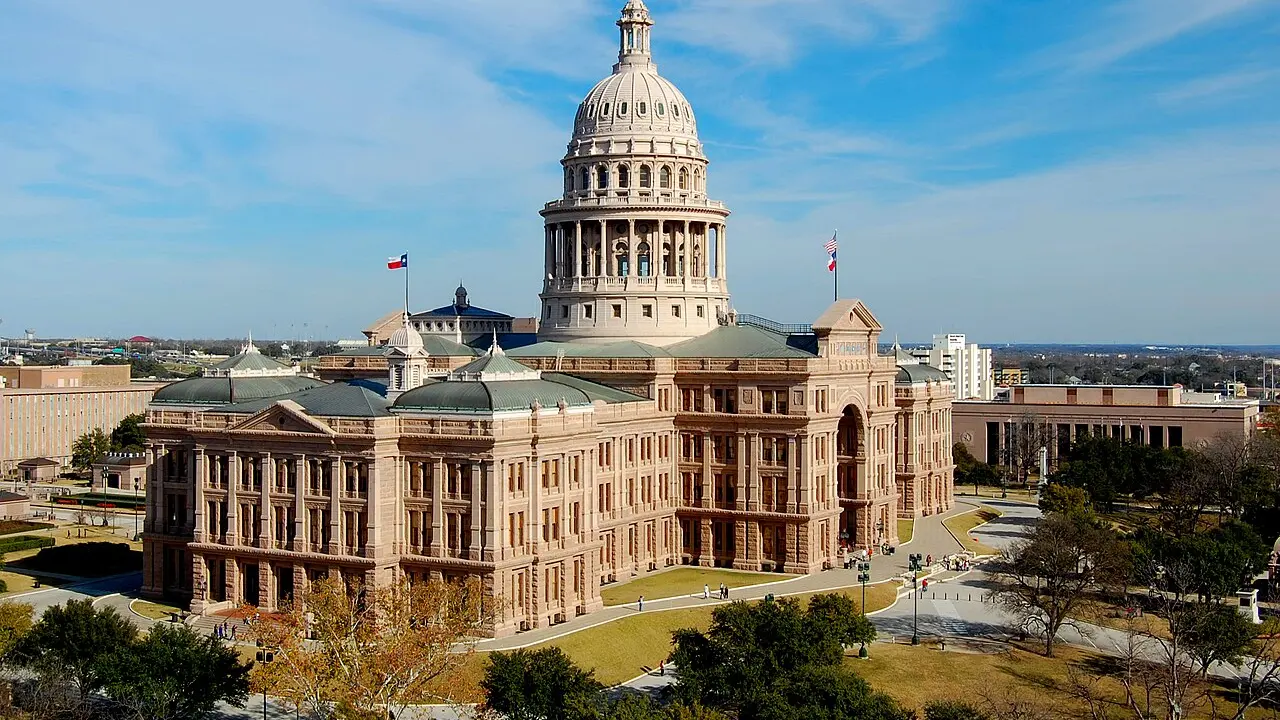
In Austin, lawmakers work inside a pink-granite Capitol taller than the U.S. Capitol, while engineers in Houston guide astronauts aboard spacecraft!
1. What made Texas unusual for nine years before it joined the United States in 1845?
2. In which Texas city do NASA flight controllers talk with astronauts in orbit?
🤯 Mind-Blowing Fact • Grade 3
Under the Congress Avenue Bridge right in downtown Austin, about 1.5 million Mexican free-tailed bats fly out at sunset every summer evening to eat tons of insects!
✨ Word Sparks (Grade 3 Glossary)
Tap 🔊 to hear
motto
short phrase expressing a group's guiding spirit
panhandle
narrow strip of a state shaped like a handle
turbine
tall spinning windmill that makes clean electricity
🪝
Where did the friendly word 'Texas' come from long before maps had state lines?
1
A Name Meaning Friends
Imagine walking through tall East Texas pines five hundred years ago and hearing Caddo villagers greet neighbors with the word 'taysha,' meaning 'friends' or 'allies.' Spanish explorers wrote that greeting down as 'Tejas,' and over time it became Texas—fitting well with the official state , 'Friendship'!
2
Four Giant Natural Regions
Spanning 268,596 square miles, Texas stretches from Gulf Coastal Plains and central Hill Country up to the flat High Plains of the —carved by colorful Palo Duro Canyon—and west to the Chihuahuan Desert mountains of Big Bend.
3
From Republic to Twenty-Eighth State
After separating from Mexico in 1836 following battles at the Alamo and San Jacinto, the Republic of Texas governed itself until joining the United States by treaty and congressional resolution on December 29, 1845.
4
Wind Turbines to Spaceflight
Today, Texas leads the nation in wind-generated electricity, cattle ranching, technology hubs around Austin and Dallas-Fort Worth, and human spaceflight operations in Houston.
1. What does the Caddo word 'taysha'—which inspired the name Texas—mean?
2. Which colorful Texas Panhandle landmark is the second-largest canyon in the United States?
🤯 Mind-Blowing Fact • Grade 4
Guadalupe Mountains National Park in West Texas preserves Capitan Reef—a giant limestone reef formed under a warm tropical sea about 265 million years ago, long before dinosaurs walked Earth!
✨ Word Sparks (Grade 4 Glossary)
Tap 🔊 to hear
barrier island
long narrow coastal island shielding mainland bays
emancipation
act of setting enslaved people legally free
confederacy
alliance of communities united for mutual support
🪝
Why do historians talk about 'Six Flags Over Texas,' and how did that crossroads shape America's second-largest state?
1
Crossroads of Continents and Climates
Stand on 8,751-foot Guadalupe Peak in far west Texas—an ancient fossilized coral reef thrust skyward—and look east toward humid bayous, limestone springs in the Edwards Plateau, and Padre Island, the longest undeveloped in the world. Bordered by the Sabine, Red, and Rio Grande rivers, Texas bridges the American South, the Great Plains, and the desert Southwest across 268,596 square miles.
2
Indigenous Nations and Six Historic Flags
Caddo agricultural confederacies in the east, Karankawa coastal fishers, Jumano pueblo traders in the west, and Comanche and Lipan Apache horsemen on the plains shaped Texas for centuries. Over more than three hundred years, six nations raised flags over parts of Texas: Spain, France, Mexico, the independent Republic of Texas, the during the Civil War, and the United States.
3
Statehood and Juneteenth Milestone
Admitted as the twenty-eighth U.S. state on December 29, 1845, Texas later became the site of a landmark national celebration of freedom. On June 19, 1865—more than two years after the Proclamation—Union General Gordon Granger arrived in Galveston to announce that all enslaved people in Texas were free, inspiring the national holiday known as Juneteenth.
4
Energy, Silicon Hills, and Space Exploration
From the 1901 Spindletop oil gusher near Beaumont to modern West Texas wind and solar farms, Texas powers American industry while Austin's 'Silicon Hills,' Port Houston's shipping channels, and NASA's Johnson Space Center drive global science.
1. Which historic event in Galveston, Texas, on June 19, 1865, is honored today as the Juneteenth federal holiday?
2. What surprising ancient feature forms the high cliffs of Guadalupe Peak in West Texas?
🤯 Mind-Blowing Fact • Grade 5
Because Texas joined the United States in 1845 as a formerly independent republic rather than a federal territory, it kept ownership of its public lands and offshore waters—dedicating billions of dollars in land revenues to public schools and universities!
✨ Word Sparks (Grade 5 Glossary)
Tap 🔊 to hear
sovereign
self-governing and independent of outside rule
annexation
joining an independent territory into a larger nation
agrarian
based mainly on farming and raising livestock
🪝
How did a sovereign nine-year republic evolve into a continental hub of agriculture, renewable energy, semiconductor engineering, and human spaceflight?
1
Four Physiographic Provinces on a Continental Scale
Second only to Alaska in both area (268,596 square miles) and to California in population, Texas spans more than 800 miles from the Panhandle's northern border to the subtropical lower Rio Grande Valley. Geographers divide this expanse into four major provinces: the Gulf Coastal Plains curving past Galveston Bay and 113-mile-long Padre Island; the North Central Plains; the Great Plains encompassing the Llano Estacado, Palo Duro Canyon, and the spring-fed limestone Edwards Plateau; and the Basin and Range mountains of West Texas, crowned by 8,751-foot Guadalupe Peak and Big Bend's towering Santa Elena Canyon.
2
Indigenous Civilizations and Spanish-Mexican Heritage
Long before European cartographers mapped the Gulf, Caddo mound-building chiefdoms cultivated maize in East Texas—lending their greeting 'taysha' ('friends') to the state's name—while Comanche, Lipan Apache, Tonkawa, and Puebloan communities adapted skillfully to plains and desert river corridors. Beginning in the late seventeenth century, Spanish friars and settlers built presidios and missions, including the five UNESCO-recognized San Antonio Missions along the San Antonio River, laying enduring foundations in ranching vocabulary, water law, and architecture.
3
Republic of Texas, Annexation, and Juneteenth
Following Mexican independence from Spain in 1821, tensions between Texian and Tejano federalists and Mexico's centralist government culminated in the 1836 siege of the Alamo and Sam Houston's decisive victory at San Jacinto. For nearly a decade, the Republic of Texas maintained diplomatic legations abroad before entering the Union as the twenty-eighth state by joint congressional resolution on December 29, 1845. Two decades later, after the Civil War, Galveston Harbor witnessed the June 19, 1865 enforcement of emancipation—commemorated nationwide as Juneteenth.
4
From Cattle Trails and Spindletop to Renewable Power
Postwar cattle drives along the Chisholm and Goodnight-Loving trails gave way in January 1901 to the Lucas Gusher at Spindletop, transforming Texas from an state into an industrial refining powerhouse. In the twenty-first century, Texas also leads all fifty states in utility-scale wind power and rapidly expanding solar generation across its sunny western plains.
5
Aerospace, Medicine, and Civic Reach
Anchored by Austin's semiconductor research, Dallas-Fort Worth's aviation crossroads, the Texas Medical Center, and NASA's Johnson Space Center in Houston, the Lone Star State links frontier history directly to lunar and Martian exploration.