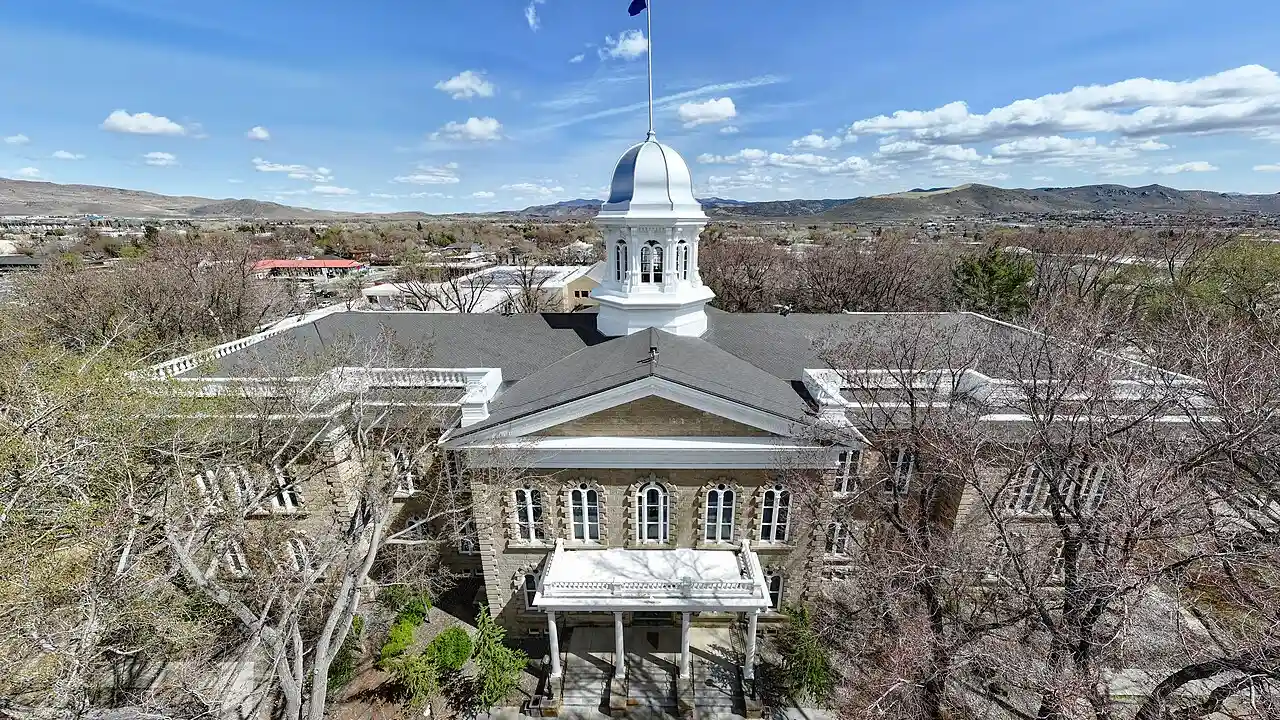
1. What valuable metal gave Nevada its nickname, 'The Silver State'?
2. Which city is the state capital of Nevada?
🤯 Mind-Blowing Fact • Grade 2
Ancient twisted bristlecone pine trees high on Nevada's mountain peaks have been growing alive for nearly five thousand years!
✨ Word Sparks (Grade 2 Glossary)
Tap 🔊 to hear
telegram
Message sent fast as clicks over wire
turbine
Spinning wheel turning rushing water into electricity
tortoise
Land turtle with a high domed shell
🪝
Why did Nevada tap out the longest telegram in history just before Halloween in 1864?
1
Snow-Clad Peaks Above Dry Valleys
Stand beside sapphire-blue Lake Tahoe and look up at snowy mountain ridges! 'Nevada' means snow-clad in Spanish, even though sunny valleys farther east make Nevada the driest state in America. Joshua trees and desert live down south.
2
A Super-Long Telegram to Lincoln
After miners struck rich silver at the Comstock Lode, President Abraham Lincoln needed a new free state during the Civil War. Leaders in capital city Carson City telegraphed Nevada's entire constitution to Washington, and Nevada became the thirty-sixth state on October 31, 1864!
3
Mighty Hoover Dam
Down on the Colorado River border, workers built the towering 726-foot Hoover Dam in the 1930s, forming Lake Mead and spinning giant water for clean power.
2. How did Nevada send its brand-new state constitution quickly to President Abraham Lincoln in 1864?
🤯 Mind-Blowing Fact • Grade 3
Enough concrete was poured into Hoover Dam to pave a two-lane highway stretching all the way from San Francisco to New York City!
✨ Word Sparks (Grade 3 Glossary)
Tap 🔊 to hear
basin
Bowl-shaped land holding water inside without ocean outlets
reservoir
Large human-made lake storing needed fresh water
evaporate
Turn from liquid water into invisible vapor
🪝
Where do Nevada's desert rivers go if almost none of them ever reach the ocean?
1
Mystery of the Great Basin
Trace the Humboldt or Truckee River on a map of Nevada and watch a geographic surprise unfold—the water never reaches the sea! Most of Nevada lies inside the Great , a bowl-shaped region of parallel mountain ranges where streams empty into desert lakes or beneath sunny skies.
2
Indigenous Peoples and Comstock Silver
Northern and Southern Paiute, Western Shoshone, and Washoe nations harvested pine nuts, trout, and desert plants here for thousands of years. In 1859, prospectors discovered the dazzling Comstock Lode of silver and gold at Virginia City, drawing thousands of newcomers near Carson City.
3
Battle Born Statehood
Because Nevada entered the Union during the Civil War on October 31, 1864—supporting the Thirteenth Amendment to end slavery—its state flag proudly reads 'Battle Born.'
4
Hoover Dam and Ancient Trees
Completed in 1935 across Black Canyon, Hoover Dam created Lake Mead, America's largest by volume, while Great National Park protects caves and ancient bristlecone pines.
1. What happens to most rivers flowing inside Nevada's Great Basin?
2. Why do the words 'Battle Born' appear on Nevada's state flag?
🤯 Mind-Blowing Fact • Grade 4
Although nicknamed the Silver State, Nevada today mines more gold each year than all the other forty-nine U.S. states combined!
✨ Word Sparks (Grade 4 Glossary)
Tap 🔊 to hear
geothermal
Clean energy harnessed from natural underground heat
bonanza
Exceptionally rich deposit of silver or gold
precipitation
Rain, snow, sleet, or hail falling down
🪝
Why is sunny Nevada actually the most mountainous state in the lower forty-eight—and the nation's top producer of gold?
1
Rain Shadows Across Basin and Range
Mention Nevada and many travelers picture flat sand, yet geologists count more than three hundred separate mountain ranges marching north-to-south across its 110,572 square miles! Moisture blowing inland from the Pacific rises over California's tall Sierra Nevada mountains and drops its snow there, casting a dry 'rain shadow' across Nevada. Averaging under ten inches of yearly, Nevada is America's driest state, spanning the sagebrush Great Basin and the warm Mojave Desert.
2
Washoe, Paiute, and Shoshone Homelands
Washoe families summered beside crystal alpine Lake Tahoe, while Northern Paiute, Southern Paiute, and Western Shoshone communities skillfully stewarded desert springs and pinyon-juniper woodlands—led by respected voices like Northern Paiute author Sarah Winnemucca, the first Native American woman to publish an English-language book in 1883.
3
Comstock Silver and the 1864 Telegraph
The 1859 Comstock Lode silver in Virginia City financed mining inventions like square-set timbering to brace deep tunnels. Eager for anti-slavery congressional votes in 1864, officials in Carson City transmitted the entire 16,543-word state constitution by telegraph—costing over four thousand dollars—so President Lincoln could declare Nevada the thirty-sixth state on October 31, 1864.
4
Engineering Marvels and Modern Energy
During the Great Depression, thousands of workers built the 726-foot concrete arch-gravity Hoover Dam across the Colorado River, taming floods, storing water in Lake Mead, and powering Southwestern cities like Las Vegas and Reno. Today, Nevada leads the nation in gold production alongside solar and clean energy!
1. Why does Nevada receive less yearly rain and snow than any other U.S. state?
2. Who wrote a landmark 1883 book advocating for the Northern Paiute people of Nevada?
🤯 Mind-Blowing Fact • Grade 5
Deep inside Virginia City's Comstock mines in the 1860s, young newspaper reporter Samuel Clemens first signed a humorous column with the pen name 'Mark Twain'!
✨ Word Sparks (Grade 5 Glossary)
Tap 🔊 to hear
endorheic
Closed drainage basin never reaching any ocean
orographic
Weather pattern caused by air climbing mountains
bullion
Refined gold or silver cast into bars
🪝
How did crustal stretching, rain-shadow aridity, Civil War statecraft, and Colorado River engineering shape America's Silver State?
1
Tectonic Extension, Rain Shadows, and Endorheic Basins
Spanning 110,572 square miles as the seventh-largest U.S. state, Nevada exemplifies Basin and Range geology: crustal stretching fractured the landscape into over three hundred fault-block mountain ranges—topping out at 13,147-foot Boundary Peak and 13,065-foot Wheeler Peak—alternating with down-dropped desert valleys. Because the towering Sierra Nevada along the western border intercepts Pacific storm tracks, Nevada sits inside a pronounced rain shadow, averaging roughly 9.5 inches of precipitation annually as the nation's most arid state. Across the Great Basin, rivers such as the Humboldt, Truckee, and Carson terminate in saline sinks or desert lakes like Pyramid Lake rather than reaching the sea.
2
Indigenous Stewardship and Sarah Winnemucca's Advocacy
For over ten millennia—evidenced by woven sagebrush sandals preserved in dry caves—Northern Paiute (Numu), Southern Paiute (Nuwuvi), Western Shoshone (Newe), and Washoe (Wa She Shu) peoples practiced seasonal transhumance from pinyon-pine uplands to marshlands and alpine Lake Tahoe. In the late nineteenth century, Northern Paiute educator and lecturer Sarah Winnemucca founded a bilingual school near Lovelock and authored 'Life Among the Piutes' (1883), the earliest known autobiography published by a Native American woman.
3
Comstock Engineering and 'Battle Born' Statehood
Following the 1859 discovery of the Comstock Lode beneath Mount Davidson at Virginia City, German-born engineer Philipp Deidesheimer invented honeycombed 'square-set' timbering to prevent deep ore chambers from collapsing, while Comstock silver bolstered Union credit and western expansion. Determined to secure additional congressional support for the Union and the pending Thirteenth Amendment abolishing slavery, territorial officials in Carson City wired Nevada's entire 16,543-word constitution via Morse code to Washington—the longest telegram of its era—enabling President Abraham Lincoln to proclaim Nevada the thirty-sixth state on October 31, 1864.
4
Hoover Dam and Southwestern Transformation
Between 1931 and 1935, Six Companies crews poured 3.25 million cubic yards of concrete into Black Canyon on the Nevada-Arizona border to raise 726.4-foot Hoover Dam, impounding Lake Mead and delivering flood control, municipal water, and two gigawatts of hydroelectric capacity across the Southwest, catalyzing growth in nearby Las Vegas.
5
Carlin Gold Trends, Clean Tech, and Dark-Sky Parks
Producing roughly three-quarters of U.S. gold from microscopic Carlin-trend deposits, twenty-first-century Nevada also leads utility-scale solar, geothermal power, lithium battery recycling near Reno, and ancient bristlecone conservation inside Great Basin National Park.