🇺🇸 U.S. HISTORY
🏛️ 18th U.S. State • The Pelican State
VA History & Social Science SOL K.1, 1.2, 2.4, VS.1–VS.10, USI & USII
State of Louisiana
Jazz Horns, Cypress Bayous, and River Deltas
Grade 2 • Developing • 87 words
⏳ Era / StatehoodAdmitted April 30, 1812 (18th State)
🗺️ Region / CapitalGulf Coast / South Central U.S. • Capital: Baton Rouge
📜 Key MilestoneMouth of the Mississippi River, New Orleans Jazz, Bayous & 64 Parishes
⚡ Historical SparkFirst state carved from the 1803 Louisiana Purchase, birthplace of American jazz music, and the only U.S. state divided into parishes
🤯 Mind-Blowing Fact • Grade 1
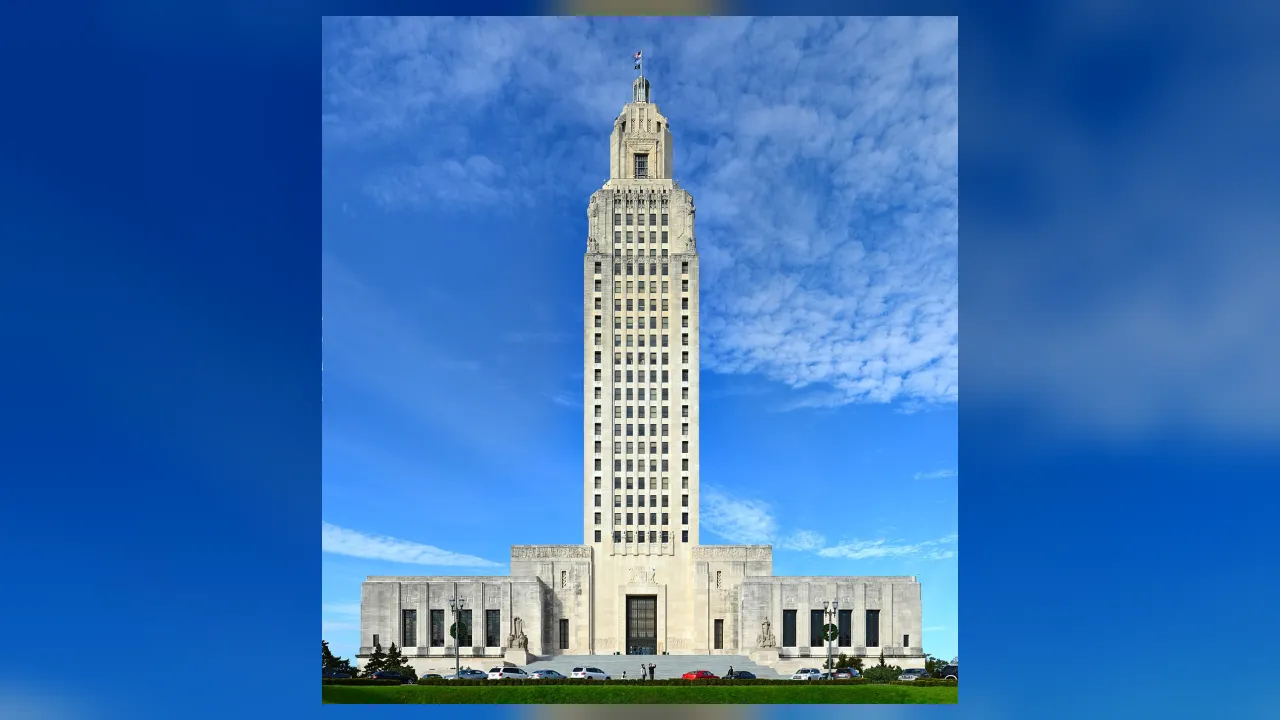
Louisiana's state Capitol building in Baton Rouge stands thirty-four stories tall—the tallest state capitol skyscraper in the United States!
✨ Word Sparks (Grade 1 Glossary)
Tap 🔊 to hear
bayou
Slow, marshy stream winding through flat lowlands
jazz
Lively American music using brass and rhythm
pelican
Big coastal bird with a pouch beak
🪝
Where does America's biggest river meet the warm sea to cheerful brass trumpet music?
1
Lively Jazz Music
Tap your toes to happy brass trumpets and drums in New Orleans! Musicians in Louisiana invented lively music for the whole world.
2
Pelicans and Cypress Trees
Big brown swoop over warm waters, and mossy cypress trees stand in shallow swamps.
3
Baton Rouge on the River
Baton Rouge is the state capital beside the mighty Mississippi River, featuring America's tallest capitol tower!
1. Which style of music was born in New Orleans, Louisiana?
2. What is the capital city of the State of Louisiana?
🤯 Mind-Blowing Fact • Grade 2
Louisiana is the only state in America divided into sixty-four 'parishes' instead of counties!
✨ Word Sparks (Grade 2 Glossary)
Tap 🔊 to hear
parish
Local government district in Louisiana like counties
causeway
Long raised highway bridge built across water
purchase
Land or goods bought through an agreement
🪝
Why does Louisiana have 'parishes' instead of counties, and a bridge so long you lose sight of land?
1
End of the Mighty Mississippi
Watch big cargo ships and paddlewheel steamboats glide past Baton Rouge and New Orleans! After flowing more than two thousand miles from Minnesota, the Mississippi River empties into the Gulf of Mexico right through Louisiana.
2
Louisiana Purchase to Eighteenth State
In 1803, President Thomas Jefferson bought the huge Louisiana Territory from France, doubling the size of our young country! Nine years later, on April 30, 1812, Louisiana became our eighteenth state—keeping sixty-four local districts called instead of counties.
3
Longest Bridge Over Water
Near New Orleans, the Lake Pontchartrain stretches nearly twenty-four miles straight across shimmering water!
1. Which U.S. president arranged the 1803 Louisiana Purchase that doubled the size of the United States?
2. What does Louisiana call its sixty-four local government areas instead of counties?
🤯 Mind-Blowing Fact • Grade 3
Driving across Louisiana's twenty-four-mile Lake Pontchartrain Causeway takes you so far from shore that for eight miles in the middle you see nothing but water in every direction!
✨ Word Sparks (Grade 3 Glossary)
Tap 🔊 to hear
silt
Fine rich soil carried by river water
cypress
Water-loving wetland tree with wide flared trunk
creole
Blended Louisiana heritage of many global cultures
🪝
How did muddy river silt build southern Louisiana like a giant boot sticking into the sea?
1
Land Built by a River
Look at Louisiana's boot-shaped map and trace its ragged toe jutting into the Gulf of Mexico! Over thousands of years, the Mississippi River carried mud, sand, and rich from thirty-one states and dropped it at the river's mouth—building the fertile Mississippi River Delta.
2
America's Largest River Swamp
West of Baton Rouge lies the Atchafalaya Basin, a vast wetland of bald trees with knobby 'knees,' snowy egrets, crawfish, and American alligators. Brown pelicans—honored right on Louisiana's flag—dive for fish along barrier islands.
3
Cultural Gumbo and Eighteenth State
Admitted on April 30, 1812, Louisiana blended Native American, French, Spanish, West African, Caribbean, and Acadian ('Cajun') traditions into vibrant languages, Cajun and foods, and New Orleans jazz pioneered by trumpeter Louis Armstrong.
4
Busy Gateway Ports
Because thirty-one inland states drain down the Mississippi, the Port of South Louisiana transfers millions of tons of grain and goods onto ocean ships.
1. How was the land of the Mississippi River Delta in southern Louisiana created?
2. Why does 'Baton Rouge' mean 'Red Stick' in French?
🤯 Mind-Blowing Fact • Grade 4
Beneath coastal marshes like Avery Island in southern Louisiana sit solid underground mountains of pure crystal rock salt stretching miles deep from an ancient evaporated sea!
✨ Word Sparks (Grade 4 Glossary)
Tap 🔊 to hear
levee
Raised riverbank wall built to hold floods
concentric
Curved rings sharing the very same center
envoy
Representative sent to negotiate with another country
🪝
Why did ancient peoples build curved earthen rings at Poverty Point three thousand years ago—and why is Louisiana's law system unique?
1
3,400-Year-Old Earthworks at Poverty Point
Long before Rome was founded, Indigenous hunter-gatherers in northeastern Louisiana moved millions of basketfuls of soil around 1700–1100 BCE to sculpt Poverty Point—six giant C-shaped ridges facing Bayou Maçon alongside a seventy-two-foot Bird Mound! Recognized as a UNESCO World Heritage Site, Poverty Point traded copper from the Great Lakes and flint from the Ohio Valley.
2
Why New Orleans Triggered the Louisiana Purchase
Farmers across Kentucky, Ohio, and western territories floated crops on flatboats down the Mississippi River, so keeping the port of New Orleans open was vital to the young United States. When President Thomas Jefferson sent to buy New Orleans in 1803, France offered the entire 828,000-square-mile Louisiana Territory for $15 million! Carved from the southern tip, the State of Louisiana entered the Union on April 30, 1812.
3
Civil Law and Underground Salt Domes
Because of its French and Spanish roots, Louisiana is the only U.S. state whose private civil law is based on written Napoleonic civil codes rather than solely English common law. Beneath coastal marshes rise giant underground pillars of pure rock salt called 'salt domes,' such as Avery Island!
4
Protecting Coastal Wetlands and Levees
Engineered keep river floods out of low-lying New Orleans, while coastal scientists rebuild marsh islands that buffer Gulf hurricanes.
1. Why did President Thomas Jefferson originally send representatives to France in 1803 before buying all of Louisiana Territory?
2. What ancient UNESCO World Heritage monument in northeastern Louisiana features six giant curved earthen ridges built over 3,000 years ago?
🤯 Mind-Blowing Fact • Grade 5
NASA's giant Michoud Assembly Facility in New Orleans built the massive external fuel tanks for the Space Shuttle and welds the towering core stages of NASA's Artemis Moon rockets, shipping them by barge!
✨ Word Sparks (Grade 5 Glossary)
Tap 🔊 to hear
distributary
River branch splitting away toward the sea
improvisation
Creating fresh musical melodies right on stage
buoyant
Lighter than surrounding rock, rising slowly upward
🪝
What connects deltaic lobe switching, Jurassic evaporite salt domes, Napoleonic civil jurisprudence, and polyrhythmic jazz improvisation in the eighteenth state?
1
Deltaic Lobe Switching and Evaporite Salt Domes
Draining forty-one percent of the contiguous United States—roughly 1.2 million square miles across thirty-one states and two Canadian provinces—the Mississippi River delivers hundreds of millions of tons of sediment toward the Gulf of Mexico across Louisiana's 52,378 square miles. Over the past seven thousand years, the river naturally shifted its main channel every thousand years like a wagging garden hose, building overlapping delta lobes and today's bird's-foot Balize Delta while feeding the Atchafalaya River controlled by the Old River Control Structure. Deep beneath these sediments, thick Jurassic Louann Salt beds buoyantly punched upward as cylindrical 'salt domes' that rise as isolated wooded hills like Avery and Weeks islands and trap important energy reserves.
2
Indigenous Trade Hubs, 1803 Geopolitics, and 1812 Statehood
Millennia after Poverty Point's Late Archaic earthworks, Chitimacha, Houma, Tunica-Biloxi, Coushatta, Caddo, and Natchez nations navigated bayou networks. Claimed for France by La Salle in 1682, ceded to Spain in 1762, and retroceded to France before the landmark 1803 Louisiana Purchase, the Territory of Orleans entered the Union on April 30, 1812, as the eighteenth state—three years before Andrew Jackson's diverse coalition defended the city in the January 1815 Battle of New Orleans.
3
Parishes and the Civil Code Tradition
Alone among the fifty states, Louisiana retained sixty-four civil parishes and codified private law modeled on Roman-French civil-code principles (the Louisiana Civil Code) alongside American constitutional law, reflecting its multilingual French, Spanish, Acadian, Creole, and Anglo-American heritage.
4
Congo Square and the Birth of Jazz
At the turn of the twentieth century in New Orleans—rooted in West African polyrhythms preserved at Congo Square, brass marching bands, blues, ragtime, and European harmonies—innovators like Buddy Bolden, Jelly Roll Morton, Sidney Bechet, and Louis Armstrong forged jazz, America's quintessential original art form.
5
Global Tonnage Ports and Space Assembly
Today, the Port of South Louisiana—stretching fifty-four miles along the Mississippi between Baton Rouge and New Orleans—leads the Western Hemisphere in bulk cargo tonnage, while NASA's Michoud Assembly Facility in New Orleans welds core rocket stages for lunar exploration!