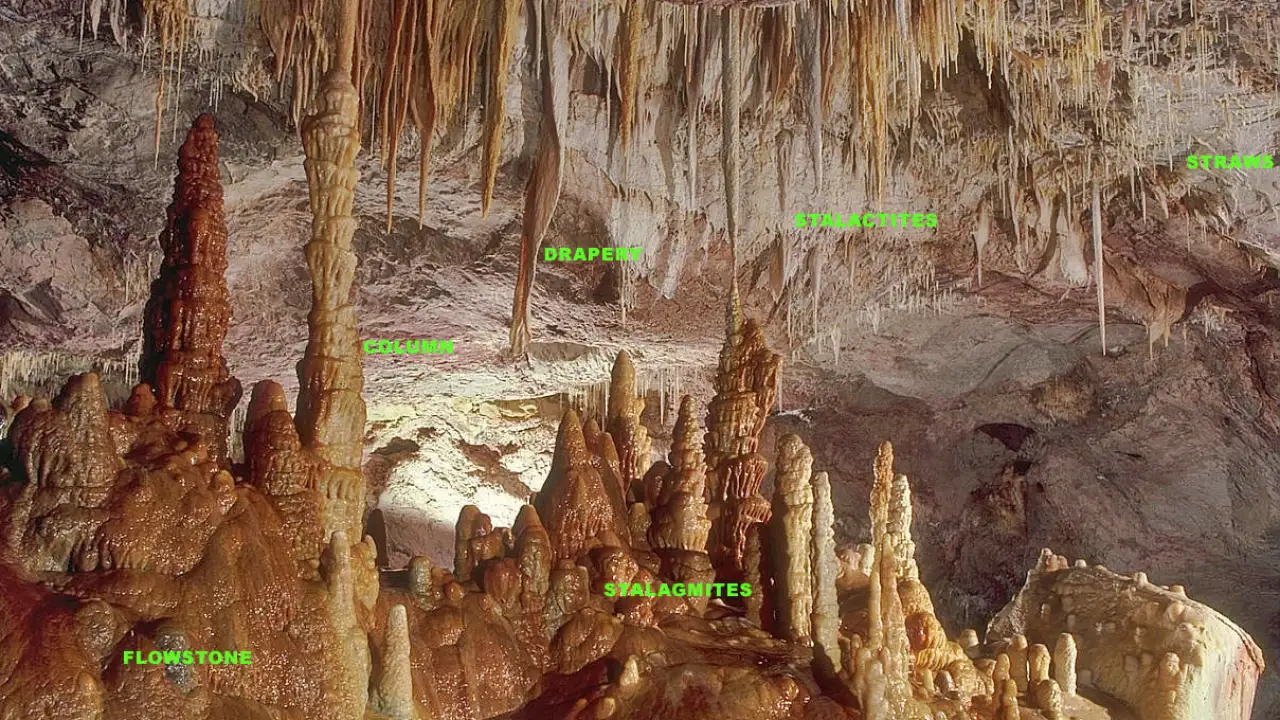
1. Which cave formation hangs downward from the ceiling?
2. What builds stalactites and stalagmites over thousands of years?
🤯 Mind-Blowing Fact • Grade 2
Inside Virginia's Luray Caverns, an invention called the Great Stalacpipe Organ gently taps natural stalactites of different sizes with rubber mallets to play real music across the whole cave!
✨ Word Sparks (Grade 2 Glossary)
Tap 🔊 to hear
Column
Pillar formed when stalactite and stalagmite join
Soda Straw
Thin, hollow baby stalactite on cave ceilings
Mineral
Natural crystal material carried in cave water
🪝
What happens when a hanging stalactite and a rising stalagmite finally touch in the middle?
1
Starting as a Soda Straw
Look up at a cave ceiling with a flashlight, and you might spot fragile hollow tubes no wider than a drinking straw! Every stalactite starts life as a thin '' built as water drops leave tiny rings of calcite around their edges.
2
Meeting in the Middle
When water plugs the hollow straw, new drops slide down the outside to build a cone-shaped stalactite. Meanwhile, drops splashing onto the floor pile up rounded stalagmites. After thousands of years, the two meet and fuse into a floor-to-ceiling pillar called a !
3
Protecting Living Caves
Natural oils from human fingers make water slide right off cave rock instead of leaving behind. Keeping hands in pockets keeps 'living' cave formations growing!
1. What forms when a ceiling stalactite and a floor stalagmite grow together and connect?
2. Why do cave guides ask visitors not to touch wet stalactites and stalagmites?
🤯 Mind-Blowing Fact • Grade 3
One of the longest free-hanging stalactites in the world dangles inside Ireland's Doolin Cave—stretching more than 23 feet (7.3 meters) from a crack no wider than a pencil!
✨ Word Sparks (Grade 3 Glossary)
Tap 🔊 to hear
Speleothem
Any mineral formation grown inside a cave
Carbonic Acid
Weak natural acid formed by water and CO2
Flowstone
Sheet-like calcite rock formed by flowing water
🪝
How can clear rainwater dissolve solid gray rock above ground, then rebuild sparkling colorful sculptures underground?
1
Rainwater's Secret Acid
Follow a raindrop soaking through forest soil in Virginia's Shenandoah Valley! As rainwater trickles past decaying leaves and roots, it absorbs carbon dioxide gas and turns into very weak . Seeping through cracks in gray limestone bedrock, that weakly acidic water dissolves invisible amounts of calcium carbonate.
2
Exhaling Gas Into Cave Air
The magic flips the moment a water drop pokes into an open underground cavern! Just like an opened bottle of fizzy soda losing gas, the water drop releases carbon dioxide into the cave air. Without that gas, the water cannot hold all its dissolved mineral anymore—leaving a microscopic crystal ring of calcite!
3
Why Cave Rocks Have Colors
Pure calcite dripstone gleams snow-white or translucent milk-glass. Rust-red, golden-amber, and chocolate-brown shades appear when groundwater carries tiny traces of iron oxide or natural soil acids, while rare copper tints formations blue-green!
4
Curtains, Popcorn, and Pearls
Stalactites and stalagmites belong to a whole family of cave decorations called —including wavy 'cave bacon' draperies, cascading waterfalls, and round cave pearls!
1. Why does a drop of cave water suddenly deposit calcite mineral when it enters an open cavern?
2. What gives many stalactites and flowstones warm orange, tan, or reddish-brown colors?
🤯 Mind-Blowing Fact • Grade 4
Inside Vietnam's colossal Hang Son Doong—the largest cave passage on Earth—stalagmites tower up to 260 feet (80 meters) tall, higher than a 20-story skyscraper!
✨ Word Sparks (Grade 4 Glossary)
Tap 🔊 to hear
Water Table
Underground level below which rocks are water-filled
Helictite
Twisting cave crystal growing sideways against gravity
Paleoclimate
Ancient weather and climate patterns of Earth
🪝
How can scientists slice open a broken stalagmite and read ancient droughts and monsoons like tree rings?
1
Two-Stage Karst Creation
Walk beneath the towering columns of Luray Caverns, Skyline Caverns, or Grand Caverns in Virginia's Valley and Ridge province, and you are witnessing stage two of karst geology! During stage one, millions of years ago when these chambers lay completely below the , acidic groundwater dissolved huge rooms out of folded Paleozoic limestone and dolostone. Stage two began only after nearby rivers cut deeper valleys—lowering the water table, draining the chambers full of air, and allowing ceiling drips to degas CO2 and precipitate calcite dripstone.
2
Why Stalactites Are Pointed and Stalagmites Are Rounded
Compare their shapes closely: ceiling stalactites taper to sharp icicle tips because surface tension holds each water drop at the narrow tip while a ring of calcite precipitates. When that drop finally falls meters downward and splatters on the floor, water splashes outward in a wider film—building thicker, blunt-domed stalagmites that never have a central hollow canal!
3
Gravity-Defying Helictites
In Skyline Caverns near Front Royal, Virginia, rare calcite and aragonite formations called anthodites and twist sideways and even curl upward like frost flowers! Instead of dripping by gravity, microscopic capillary films squeeze through tiny pores so slowly that capillary forces overpower gravity.
4
Tree Rings Made of Stone
Like trees adding yearly rings, stalagmites grow faster during rainy centuries and slower (or dustier) during severe droughts. Paleoclimatologists study naturally fallen stalagmites to reconstruct rainfall patterns spanning hundreds of thousands of years!
1. Why can stalactites and stalagmites only grow AFTER the water table drops and drains a limestone cave?
2. Why are stalagmites typically wider and more rounded on top than pointed ceiling stalactites?
🤯 Mind-Blowing Fact • Grade 5
Scuba-diving geologists exploring deep flooded blue holes in the Bahamas found giant stalagmites 150 feet underwater—proving those caves stood dry above sea level during the last Ice Age when glaciers locked up ocean water!
✨ Word Sparks (Grade 5 Glossary)
Tap 🔊 to hear
Vadose Zone
Air-filled rock zone above the water table
Degassing
Dissolved gas escaping from liquid into air
Cenote
Flooded limestone sinkhole connected to underwater caves
🪝
Why do cave stalagmites hold the most accurately dated paleoclimate records of the last half-million years anywhere on land?
1
Reversible Carbonate Equilibrium in the Vadose Zone
Listen to water dripping in a silent karst cavern, and you are hearing a reversible chemical equation ticking drop by drop! Rainwater percolating through root-respiring topsoil absorbs soil CO2 at partial pressures 10 to 100 times higher than open air, forming carbonic acid (H2CO3) that dissolves bedrock limestone into calcium and bicarbonate ions: CaCO3 + H2O + CO2 <-> Ca2+ + 2HCO3-. Once that solution emerges into an air-filled (vadose) cavern with lower atmospheric CO2, the reaction reverses! CO2 degasses into the cave atmosphere, raising droplet pH and supersaturating CaCO3 until trigonal calcite—or needle-like orthorhombic aragonite when magnesium-to-calcium ratios are elevated—precipitates at typical rates of 0.01 to 0.3 millimeters per year.
2
Non-Karst Impostors: Lavaicles and Rusticles
Although classical speleothems consist of calcium carbonate in karst terrains, fluid physics produces stalactite morphologies in surprising environments! Inside volcanic lava tubes in Hawaii and Iceland, dripping molten basalt freezes into 'lavacicles.' Beneath bridges or concrete tunnels, hyper-alkaline water reacts with air to grow rapid white 'calthemites' in mere months, while iron-oxidizing bacteria 3,800 meters deep on the Atlantic seafloor drape shipwrecks in fragile iron-oxide 'rusticles.'
3
Uranium-Thorium Dating and Oxygen Isotope Archives
What makes cave stalagmites superstar archives for climate science? Groundwaters dissolve trace amounts of water-soluble uranium-234 while leaving insoluble thorium-230 behind in soil clay. Locked inside clean calcite growth laminae, uranium-234 decays steadily into thorium-230—allowing mass spectrometers to date individual stalagmite layers back 600,000 years with errors under one percent! Paired with oxygen-18/oxygen-16 and carbon-13/carbon-12 isotope ratios, stalagmites from China's Hulu Cave to Virginia's Shenandoah Valley pinpoint ancient Ice Age shifts, volcanic winters, and megadroughts to the exact decade.
4
Submerged Speleothems and Sea-Level History
In coastal underwater caves like the Bahamas 'blue holes' and Mexico's Yucatán , scuba-diving geologists encounter massive stalactites and stalagmites 100 meters below modern sea level! Because carbonate dripstone cannot form underwater, dating those submerged columns reveals exact global sea-level drops when continental ice sheets locked up ocean water during Pleistocene glacial maxima.
5
Cave Conservation and Microclimate Balance
Show caves carefully engineer airlock doors and cool LED lighting to prevent artificial warming, lint buildup, or 'lampenflora' algae blooms from altering cavern CO2 balance and halting natural speleothem growth.