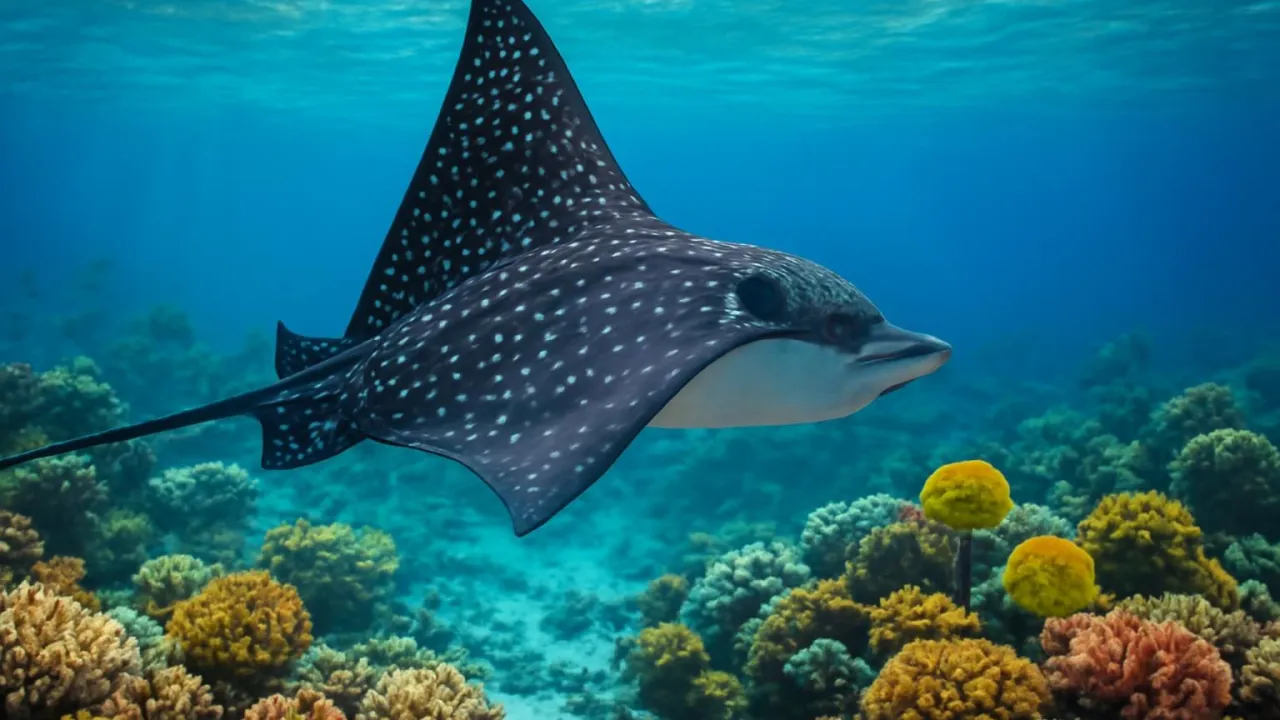
Spotted eagle rays can leap up to 10 feet out of the water to escape danger!
✨ Word Sparks (Grade 2 Glossary)
Tap 🔊 to hear
mollusks
Soft animals with hard shells like clams
predator
An animal that hunts other animals
nutrients
Food parts that help animals grow
🪝
Have you ever seen a fish jump out of the ocean like a bird?
1
Spotted Eagle Ray’s Look
The spotted eagle ray has white spots all over its dark body, and it has wide wings. It swims by flapping these wings up and down in the water. Its long tail trails behind it like a ribbon. This tail can sting to protect it from danger.
2
Where It Calls Home
It lives in warm, shallow coastal waters around the world near coral reefs. It likes to stay where the water is clear and warm. It often swims near the ocean floor looking for food. Sometimes it leaps out of the water to escape .
3
What It Likes to Eat
The spotted eagle ray eats like clams and snails, and small fish. It crushes hard shells with its strong teeth. It uses its mouth on the ocean floor to find tasty meals. This helps it get the it needs to grow.
Spotted eagle rays can leap over 10 feet out of the water to avoid predators!
✨ Word Sparks (Grade 3 Glossary)
Tap 🔊 to hear
camouflage
Colors that help animals hide from others
adaptation
A body part that helps survival
predator
An animal that hunts other animals
🪝
Did you know the spotted eagle ray uses its wings to fly underwater like a bird?
1
Amazing Body and Camouflage
The spotted eagle ray has wide flat pectoral fins that look like wings to swim. Its body is dark with bright white spots that help it blend in with the ocean floor. This keeps it safe from . Its long tail has a venomous spine for protection.
2
Habitat and Adaptations
It lives in shallow warm coastal waters near coral reefs and sandy bottoms. This habitat provides food and shelter. Its flat body helps it glide smoothly over the ocean floor to find prey. The ray’s eyes are on top of its head to watch for danger.
3
Diet and Feeding
The spotted eagle ray feeds on mollusks, crustaceans, and small fish using strong crushing teeth. It uses its snout to dig into sand and uncover hidden prey. This feeding method is an to get nutrients from hard-shelled animals. It plays an important role in controlling prey populations.
4
Survival and Behavior
When threatened, the ray can leap out of the water to escape like sharks. This behavior is a quick escape . It often swims in groups called schools for safety. The spotted eagle ray’s graceful movements help it avoid danger and find food.
Spotted eagle rays can leap over 10 feet out of water to escape predators and swim in groups for safety.
✨ Word Sparks (Grade 4 Glossary)
Tap 🔊 to hear
camouflage
Colors that help animals hide from others
ecosystem
A community of plants and animals living together
venomous
Can inject poison to protect itself
🪝
Have you ever wondered how a fish can fly underwater and jump high out of the sea?
1
Physical Traits and Movement
The spotted eagle ray has broad, flat pectoral fins that resemble wings, allowing it to glide gracefully underwater. Its dark body is covered with bright white spots that provide against the sandy ocean floor, protecting it from predators. The ray’s long tail is equipped with spines used for defense. This unique body design helps it swim efficiently and avoid danger.
2
Habitat and Geographic Range
This ray inhabits warm, shallow coastal waters worldwide, often near coral reefs and sandy bottoms. These habitats offer abundant food and shelter. The spotted eagle ray’s distribution spans tropical and subtropical oceans, including the Atlantic, Pacific, and Indian Oceans. Its ability to adapt to various coastal environments helps maintain healthy .
3
Diet and Ecological Role
Feeding mainly on mollusks, crustaceans, and small fish, the spotted eagle ray uses strong crushing teeth to break hard shells. It digs in the sand with its snout to uncover hidden prey, playing a vital role in controlling populations of benthic animals. This ray contributes to the balance of marine food webs and supports coral reef health through its feeding habits.
4
Behavior and Human Impact
When threatened by predators such as sharks, the ray can leap high out of the water to escape quickly. It often swims in schools, which provides safety in numbers. Human activities like fishing and habitat destruction can threaten spotted eagle ray populations. Conservation efforts focus on protecting coastal habitats and regulating fishing to ensure their survival.
1. Why do spotted eagle rays have spots on their bodies?
2. What human action can harm spotted eagle rays?
🤯 Mind-Blowing Fact • Grade 5
Spotted eagle rays can swim up to 20 miles per hour and leap over 10 feet out of water to escape danger.
✨ Word Sparks (Grade 5 Glossary)
Tap 🔊 to hear
electroreceptors
Body parts that sense electric signals in water
benthic
Living on or near the ocean floor
bycatch
Animals caught accidentally in fishing nets
🪝
How does the spotted eagle ray’s unique body help it survive in diverse ocean habitats?
1
Scientific Classification and Physical Description
The spotted eagle ray (Aetobatus narinari) belongs to the family Myliobatidae, which includes rays with wing-like pectoral fins. It can reach a wingspan of up to 10 feet (3 meters) and weigh around 220 pounds (100 kilograms). Its dark dorsal surface is marked with distinctive white spots that serve as camouflage. The ray’s long, whip-like tail contains venomous spines used for defense against predators.
2
Physiological Mechanics and Movement
This species propels itself by flapping its large pectoral fins in a flying motion, allowing graceful and energy-efficient swimming. Its flattened body shape reduces water resistance, enabling quick bursts of speed up to 20 miles per hour (32 kilometers per hour). The ray’s help detect prey buried in the sand, while its eyes positioned on top of the head provide a wide field of vision.
3
Feeding Behavior and Ecological Importance
Spotted eagle rays feed primarily on mollusks, crustaceans, and small fish, using strong, flattened teeth to crush hard shells. Their foraging behavior aerates the ocean floor, promoting nutrient cycling and supporting benthic ecosystems. By controlling prey populations, they help maintain balance within coral reef food webs. Their feeding habits also indirectly support the health of seagrass beds.
4
Conservation Status and Human Impact
Although not currently endangered, spotted eagle rays face threats from overfishing, , and coastal habitat degradation. Their slow reproductive rate makes population recovery difficult after declines. Conservation programs focus on habitat protection, fishing regulations, and public education to reduce human impact. Marine protected areas have shown success in preserving their populations and habitats.
5
Quantitative Comparisons and Unique Behaviors
Spotted eagle rays can leap more than 10 feet (3 meters) out of the water to evade predators, a rare behavior among rays. They swim at speeds up to 20 miles per hour (32 kilometers per hour), faster than many other ray species. Their wingspan rivals that of a small airplane wing. These impressive physical traits enable them to thrive in diverse tropical and subtropical marine environments.