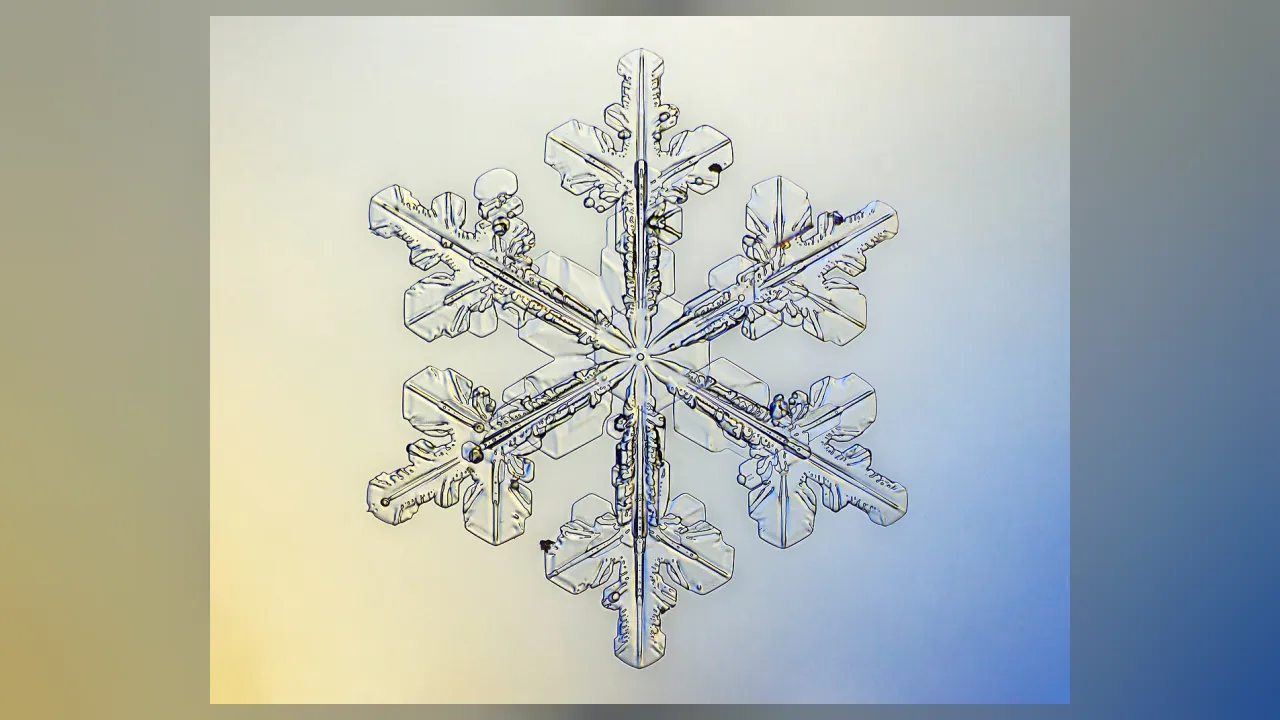
1. How many main sides or branches does a classic snow crystal grow?
2. What is the best color mitten to wear if you want to spot a tiny snowflake's shape?
🤯 Mind-Blowing Fact • Grade 2
More than a hundred years ago, Vermont farmer Wilson 'Snowflake' Bentley photographed over 5,000 snowflakes through a microscope—and never found two alike!
✨ Word Sparks (Grade 2 Glossary)
Tap 🔊 to hear
molecule
tiniest building block of water or gas
branch
an icy arm growing out from a corner
microscope
a tool with lenses to see tiny things
🪝
How do all six arms of one snowflake know how to grow the exact same lacy pattern?
1
Not Frozen Raindrops!
Many people guess that snowflakes are just frozen raindrops, but frozen raindrops are actually round balls of sleet! A real snow crystal grows when invisible water gas freezes straight onto a tiny dust speck inside a cold cloud.
2
Built Like Six-Sided Tiles
Tiny water are shaped like little V's. When they freeze, they hold hands in neat six-sided rings called hexagons, starting every snow crystal as a tiny six-sided prism.
3
Six Arms Traveling Together
As one small crystal swirls through warmer and colder spots in the cloud, all six corners feel the exact same changes at the exact same second—so all six arms sprout matching !
1. How does a lacy six-sided snow crystal form inside a cloud?
2. Why do all six arms on one single snowflake match each other so closely?
🤯 Mind-Blowing Fact • Grade 3
Natural ice crystals actually count as a true mineral under geology rules—until spring sunshine melts them back into liquid water!
✨ Word Sparks (Grade 3 Glossary)
Tap 🔊 to hear
dendrite
a branching, tree-like six-pointed snow crystal
mineral
a natural solid with an orderly crystal structure
column
a six-sided pillar-shaped ice crystal
🪝
Did you know some snow crystals look like hollow pencils or tiny wheels on an axle instead of stars?
1
Snow Crystal vs. Snowflake
Hold a magnifying glass over freshly fallen powder on a crisp winter morning! Scientists call one single six-sided ice gem a snow crystal, while a 'snowflake' can be either one solo crystal or dozens of crystals tangled together into a big, fluffy puffball.
2
Why Corners Sprout Branches
Once water vapor freezes into a tiny six-sided hexagon plate, its six sharp corners stick out slightly farther into the humid cloud air than its flat sides. Extra water molecules bump and freeze onto those corners fastest, stretching out six symmetrical arms!
3
Temperature Picks the Shape
Not every snow crystal is a lacy star! Near 23 degrees Fahrenheit (minus 5 Celsius), crystals grow as slender six-sided needles and . Around 5 degrees Fahrenheit (minus 15 Celsius), humid clouds grow classic feathery stars called stellar !
4
Snowflake Bentley's Legacy
Catching crystals on a cold blackboard with a turkey feather in 1885, self-taught scientist Wilson Bentley proved Earth's winter clouds are microscopic art galleries.
1. Why do the six corners of an ice hexagon grow into long branches faster than the flat sides?
2. What cloud temperature grows the biggest, laciest six-pointed star crystals (stellar dendrites)?
🤯 Mind-Blowing Fact • Grade 4
Japanese physicist Ukichiro Nakaya called snowflakes 'hieroglyphs sent from the sky' because simply looking at a crystal's shape tells scientists the exact temperature and humidity inside the cloud overhead!
✨ Word Sparks (Grade 4 Glossary)
Tap 🔊 to hear
hydrogen bond
attraction linking water molecules into six-sided rings
capped column
ice pillar with flat six-sided plates on ends
morphology
scientific study of shapes and structures
🪝
How can every snow crystal read the cloud's temperature and humidity like a tiny carved diary?
1
Molecular Geometry of Water
Zoom down ten million times smaller than a snowflake landing on a Virginia pine needle, and you will spot individual H2O molecules—one oxygen atom bonded to two hydrogen atoms in a V shape angled near 104.5 degrees. When water vapor cools below freezing and undergoes deposition directly from gas to solid, electrical attractions called lock six water molecules into a sturdy hexagonal ring! That atomic blueprint guarantees strict six-fold crystal symmetry from the inside out.
2
Nakaya's Crystal Map
In the 1930s, Japanese physicist Ukichiro Nakaya grew the world's first artificial snowflakes in a cold lab using a single rabbit hair! By adjusting temperature and moisture, he discovered an astonishing chart: flat hexagonal plates grow near minus 2 degrees Celsius; slender needles and hollow columns dominate near minus 5 degrees Celsius; wide, lacy stellar dendrites blossom between minus 12 and minus 16 degrees Celsius; and prism columns return below minus 22 degrees Celsius!
3
Capped Columns: Changing Zones Mid-Flight
What happens if an ice column formed at minus 6 degrees gets blown into a minus-15-degree cloud pocket? Flat hexagonal plates suddenly grow onto both ends of the pillar, building a wild crystal shaped like two wheels on an axle called a !
4
Order Without Exact Duplicates
Because a complex snowflake incorporates roughly a quintillion water molecules while tumbling along a one-of-a-kind path, Nakaya lovingly called each snow crystal 'a letter sent to us from the sky.'
1. Why does solid ice naturally form six-sided hexagons instead of squares or pentagons?
2. How does a 'capped column' snow crystal get its wheel-and-axle shape?
🤯 Mind-Blowing Fact • Grade 5
Because saturation vapor pressure is lower over ice than over supercooled liquid water, growing snow crystals literally 'steal' moisture right out of neighboring cloud droplets!
✨ Word Sparks (Grade 5 Glossary)
Tap 🔊 to hear
basal face
flat top or bottom surface of a hexagon
supersaturation
air holding extra vapor beyond 100% humidity
lattice
repeating three-dimensional grid of bonded atoms
🪝
Why does shifting a cloud's temperature by just three degrees completely flip a growing snow crystal from flat stars to slender needles?
1
Hexagonal Lattice of Ice Ih
Under ordinary tropospheric pressures, freezing water vapor crystallizes into mineralogical Ice Ih ('ice one-h'), whose crystal belongs to the hexagonal system. Each oxygen atom forms four tetrahedral hydrogen bonds with neighboring H2O molecules, tessellating three-dimensionally into stacked puckered hexagonal rings. On a macroscopic scale, that atomic lattice exposes two primary types of crystal surfaces: two flat hexagonal 'basal' faces on top and bottom, and six rectangular 'prism' facets around the perimeter.
2
Faceted Attachment vs. Mullins–Sekerka Branching
Whether a nascent prism grows into a flat plate or an elongated column hinges on a molecular race between basal and prism faces! Amazingly, surface-premelting physics flips which face captures water vapor faster at minus 4 degrees, minus 10 degrees, and minus 22 degrees Celsius—explaining Ukichiro Nakaya's famous morphology diagram. When is high, diffusion-limited instability (the Mullins–Sekerka instability) starves flat faces of vapor while protruding six-fold vertices jut into richer vapor gradients, sprouting intricate dendritic side-branches.
3
The Bergeron–Findeisen Process in Mixed Clouds
Inside subfreezing clouds, saturation vapor pressure is lower over solid ice than over supercooled liquid water! Consequently, supercooled droplets steadily evaporate to feed rapidly growing snow crystals—the Wegener–Bergeron–Findeisen process that initiates most mid-latitude precipitation.
4
Symmetry Meets Combinatorial Uniqueness
Synchronized exposure across a 3-millimeter crystal's micro-environment preserves breathtaking six-fold symmetry, yet turbulent eddies ensure no two trajectories match. Containing roughly 10^18 water molecules—including 1 in 3,200 deuterium 'heavy water' molecules scattered randomly—two complex stellar dendrites have virtually zero mathematical chance of being identical!
5
Laboratory Twin Crystals and Optical Albedo
Physicist Kenneth Libbrecht has grown 'identical-twin' microscopic snow crystals side by side on a sapphire glass substrate by pulsing identical lab temperatures—while out in nature, trillions of unique dendritic facets give fresh snowpack a dazzling 80 to 90 percent solar albedo!